
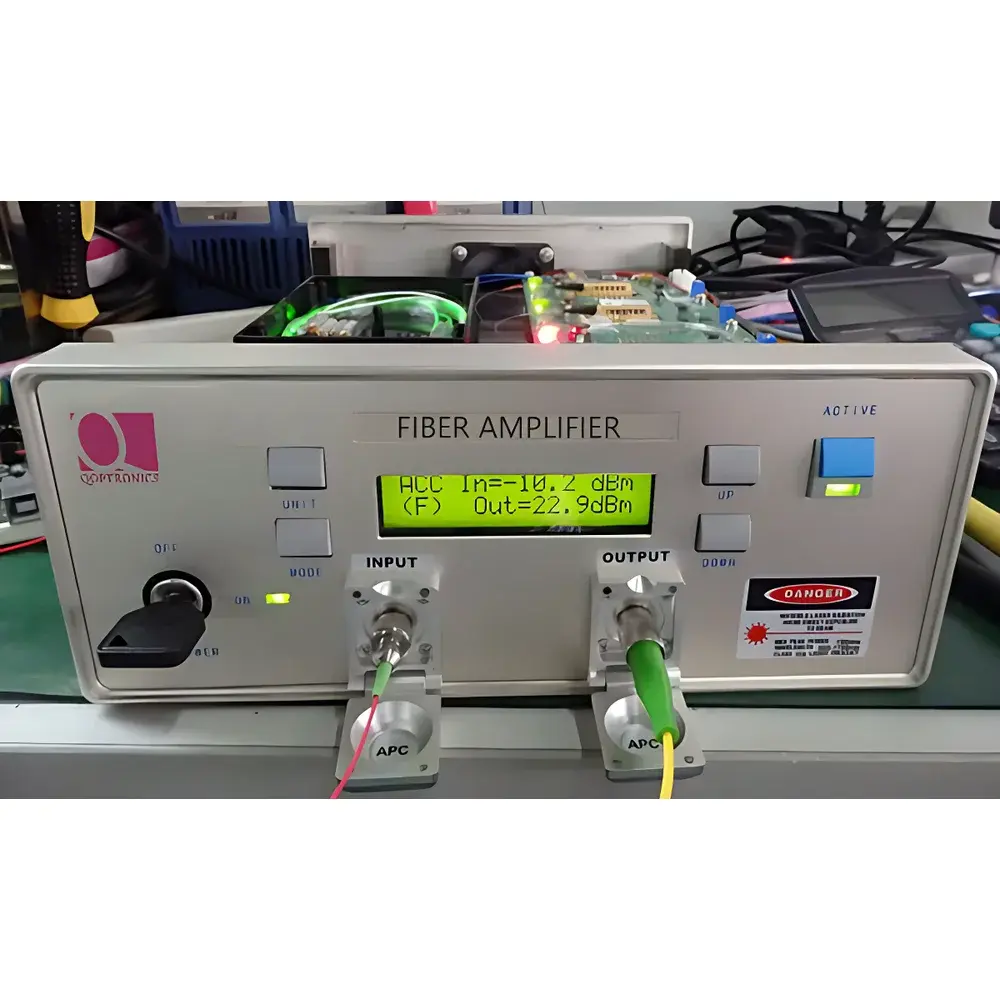
QOptronics High Power Erbium-Ytterbium Doped Fiber Amplifier (EYDFA)
| Brand | QOptronics |
|---|---|
| Origin | Shanghai, China |
| Model | High Power EYDFA |
| Operating Wavelength | 1535–1565 nm |
| Input Power Range | –5 to +10 dBm |
| Output Power Range | 27–37 dBm |
| Noise Figure (at 0 dBm input) | ≤6 dB |
| Polarization-Dependent Gain | ≤0.5 dB |
| Pump Leakage to Output | ≤–30 dBm |
| Pump Leakage to Input | ≤–30 dBm |
| Return Loss (EDFA off) | ≥40 dB |
| AC Power Supply | 100–240 VAC |
| Power Consumption | 8–50 W |
| Operating Temperature | –5 to +55 °C |
| Storage Temperature | –20 to +70 °C |
| User Interface | LCD display with LED status/alarm indicators |
| Network Interface | RJ-45, RS-232, or RS-485 |
| Dimensions | 90×70×19 mm (module), 483×385×44 mm (1U 19″ rack), or 320×220×90 mm (benchtop) |
| Control Modes | ACC, APC, AGC |
| Output Power Options | 10, 13, 20, 27 dBm (customizable) |
| Pigtail Fiber Options | 250 µm, 900 µm, 2 mm, 3 mm |
| Connector Types | FC/UPC, FC/APC, SC/APC |
Overview
The QOptronics High Power Erbium-Ytterbium Doped Fiber Amplifier (EYDFA) is a compact, high-efficiency optical amplifier engineered for C-band signal boosting in fiber-optic communication systems, testbeds, and scientific instrumentation. Leveraging dual-doped Er3+/Yb3+ silica fiber architecture, the amplifier achieves high quantum efficiency through Yb3+ sensitization—where Yb ions absorb pump photons at 915 nm or 976 nm and transfer energy resonantly to Er3+ ions, enabling efficient population inversion in the 1535–1565 nm range. This design overcomes the limitations of conventional EDFA configurations by delivering higher output power (>37 dBm) with low noise figure (≤6 dB at 0 dBm input) and excellent gain flatness across the extended C-band. The device operates under strict thermal management and features integrated pump laser diodes with automatic current control (ACC), ensuring long-term stability and repeatability required for laboratory-grade optical experiments and industrial system integration.
Key Features
- High-output C-band amplification: configurable output power from 10 dBm to 37 dBm (e.g., 27 dBm standard)
- Low-noise operation: noise figure ≤6 dB (measured at 0 dBm input, 1550 nm)
- Stable gain performance: polarization-dependent gain (PDG) ≤0.5 dB ensures minimal signal distortion in polarization-sensitive setups
- Integrated pump suppression: residual pump leakage ≤–30 dBm at both input and output ports, minimizing interference in cascaded optical paths
- Robust front-panel interface: LCD display shows real-time operating parameters (gain, input/output power, pump current, temperature); multi-color LEDs indicate operational status and fault conditions
- Flexible control architecture: supports Automatic Current Control (ACC), Automatic Power Control (APC), and Automatic Gain Control (AGC) modes via local interface or remote protocols
- Multiple form factors: modular (90×70×19 mm), 1U 19″ rack-mount (483×385×44 mm), and benchtop (320×220×90 mm) configurations for integration into diverse optical labs and telecom environments
- Comprehensive connectivity: RS-232, RS-485, and RJ-45 Ethernet interfaces enable seamless integration with LabVIEW, Python-based control suites, or networked monitoring systems
Sample Compatibility & Compliance
The EYDFA is compatible with standard single-mode fiber (SMF-28 or equivalent) and accepts input signals with polarization states typical of tunable lasers, DFB sources, and modulated transmitters. It supports pigtail options ranging from bare 250 µm acrylate-coated fiber to armored 3 mm jacketed cable, with connectorized variants including FC/UPC, FC/APC, and SC/APC to match common test instrumentation. While not certified for telecommunication carrier-grade deployment (e.g., ITU-T G.663), the amplifier meets essential laboratory safety and electromagnetic compatibility requirements per IEC 61326-1 (electrical equipment for measurement, control, and laboratory use) and conforms to RoHS Directive 2011/65/EU. Its analog control loop design and absence of proprietary firmware ensure full traceability and audit readiness in GLP-compliant optical characterization workflows.
Software & Data Management
The EYDFA includes embedded firmware supporting ASCII-based serial command sets (RS-232/RS-485) and Modbus TCP over Ethernet (RJ-45). No proprietary drivers are required—standard terminal emulators or Python pyserial and pymodbus libraries enable full parameter readout and configuration. All operational logs—including pump current drift, temperature excursions, and alarm timestamps—are stored in non-volatile memory and accessible via query commands. While the device does not implement FDA 21 CFR Part 11 electronic signature functionality, its deterministic response behavior, fixed command syntax, and hardware-level write protection on critical registers support validation documentation for ISO/IEC 17025-accredited calibration laboratories.
Applications
- Booster amplification in free-space optical links and fiber-coupled interferometric sensors
- Seed source pre-amplification for ultrafast fiber laser systems (e.g., picosecond pulse amplifiers)
- Gain medium characterization in nonlinear optics experiments (e.g., four-wave mixing, supercontinuum generation)
- Test and measurement of DWDM component insertion loss and channel crosstalk
- Optical coherence tomography (OCT) system development requiring stable, high-power swept-source illumination
- Quantum optics setups involving heralded photon pair generation and time-bin entanglement distribution
FAQ
What pump wavelengths are supported?
The amplifier is optimized for 915 nm and 976 nm pump diodes; custom configurations for dual-pump schemes are available upon request.
Can the EYDFA operate in constant-gain mode with fluctuating input power?
Yes—AGC mode maintains set gain within ±0.2 dB over the specified input range (–5 to +10 dBm), provided thermal conditions remain within operational limits.
Is optical isolation included internally?
A high-isolation (>40 dB) circulator-based input stage is integrated; external isolators are recommended only for applications involving highly reflective downstream components.
Does the unit support analog voltage control for output power?
No—control is digital-only via serial or Ethernet; analog modulation requires external DAC interfacing through GPIO pins (available on custom firmware builds).
What is the typical warm-up time to achieve stable output?
Full thermal stabilization occurs within 15 minutes after power-on; gain drift remains below 0.05 dB/min thereafter under ambient conditions (25 °C, still air).





