
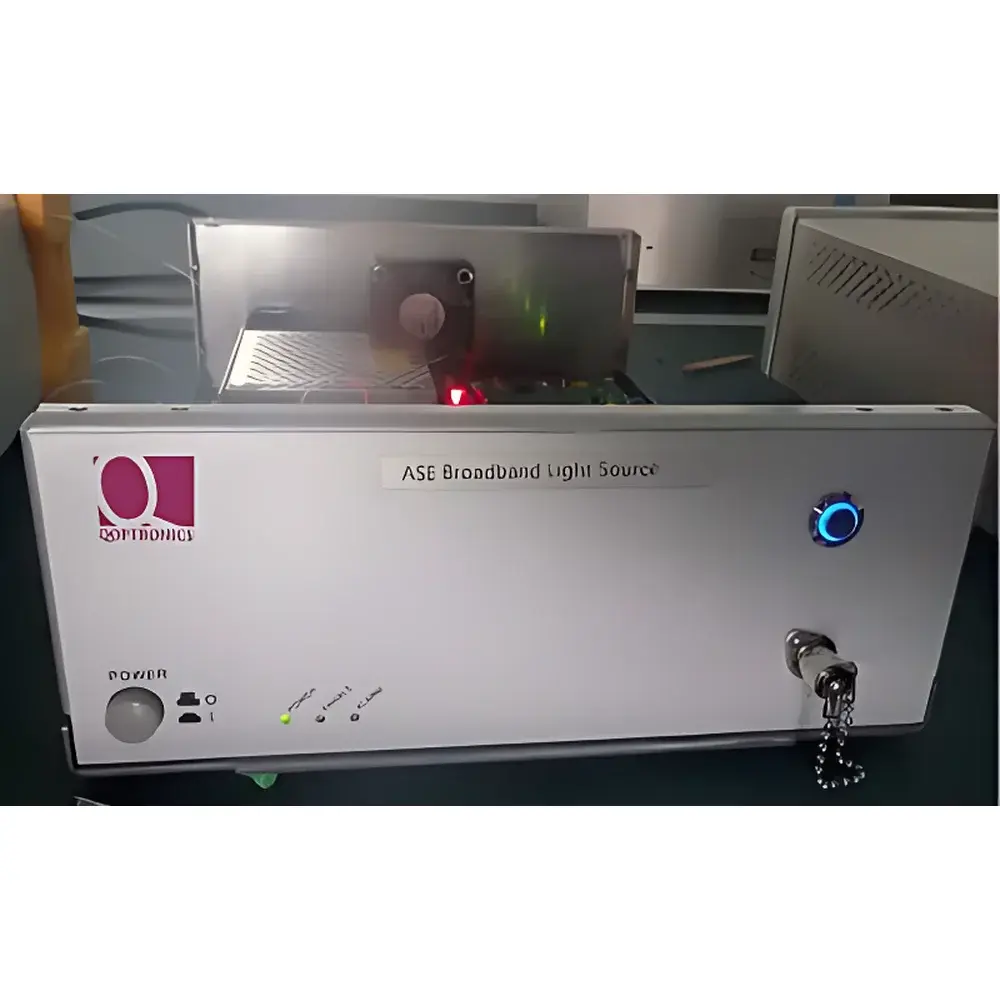
QOptronics LQ-SLED-1310-P Series 1310 nm Superluminescent Diode Broadband Light Source
| Brand | QOptronics |
|---|---|
| Origin | Shanghai, China |
| Model | LQ-SLED-1310-P-PW-SP |
| Central Wavelength | 1310 ± 10 nm |
| −3 dB Spectral Bandwidth | ≥ 45 nm |
| Output Power Options | 1, 5, 10, 20, 30, 35 mW |
| Spectral Ripple | ≤ 0.2 dB |
| Short-Term Power Stability | ≤ ±0.01 dB / 15 min |
| Long-Term Power Stability | ≤ ±0.03 dB / 8 h |
| Operating Temperature | 0–40 °C |
| Storage Temperature | −20–70 °C |
| Power Supply | AC 110/220 V ±10 %, 50 Hz, 20 W |
| Package Options | Benchtop (320 × 220 × 90 mm) or Module (90 × 70 × 19 mm) |
| Fiber Pigtail | SMF-28 single-mode |
| Output Connector | FC/UPC or FC/APC |
| Operating Mode | Continuous Wave (CW) |
| Feedback Protection | Optional (SP=1) |
Overview
The QOptronics LQ-SLED-1310-P Series is a high-stability, fiber-coupled superluminescent diode (SLED) broadband light source engineered for precision optical testing and measurement applications in the near-infrared (NIR) spectral region. Operating at a center wavelength of 1310 ± 10 nm with a minimum −3 dB spectral bandwidth of 45 nm, this SLED source delivers smooth, low-coherence output ideal for interferometric sensing, optical coherence tomography (OCT) system development, fiber optic component characterization (e.g., FBG interrogation, coupler loss testing), and calibration of wavelength-dependent devices. Unlike laser diodes, SLEDs generate amplified spontaneous emission (ASE), resulting in inherently low temporal coherence—critical for minimizing speckle noise and parasitic interference in metrology-grade setups. The device is thermally stabilized and optimized for continuous-wave (CW) operation under controlled ambient conditions (25 ± 2 °C after 30-minute warm-up), ensuring reproducible spectral shape and power output across extended measurement cycles.
Key Features
- High spectral flatness: ≤ 0.2 dB ripple across the full emission band, enabling accurate spectral responsivity mapping and spectrometer calibration.
- Exceptional power stability: ≤ ±0.01 dB short-term fluctuation over 15 minutes and ≤ ±0.03 dB long-term drift over 8 hours—validated under constant-temperature test conditions per IEC 61290-1-3.
- Flexible packaging architecture: Available as a compact OEM module (90 × 70 × 19 mm) with 14-pin butterfly housing or as a fully integrated benchtop unit (320 × 220 × 90 mm) featuring front-panel power control, status indicators, and EMI-filtered AC input.
- Configurable output: Selectable output powers (1–35 mW in discrete steps), polarization-maintaining or standard SMF-28 pigtailing, and choice of FC/UPC or FC/APC connectors to match system alignment requirements.
- Integrated feedback protection (optional SP=1): Built-in optical isolator and monitor photodiode circuitry safeguard the SLED chip against back-reflected light—a critical reliability feature in reflective or resonant optical assemblies.
- Compliant with RoHS 2011/65/EU and CE marking directives for electromagnetic compatibility (EN 61326-1) and safety (EN 61010-1).
Sample Compatibility & Compliance
This SLED source is compatible with standard single-mode fiber infrastructure (ITU-T G.652.D compliant SMF-28), making it suitable for integration into passive component test benches, tunable filter characterization rigs, and swept-source OCT reference arms. Its low-coherence output meets the spectral requirements defined in ISO 13697:2021 (optical coherence tomography systems) and ASTM F2796-19 (fiber optic component spectral loss measurement). The device supports GLP-compliant workflows through traceable calibration documentation (available upon request) and adheres to laboratory environmental specifications outlined in ISO/IEC 17025:2017 Annex A.4 for stable optical source validation.
Software & Data Management
While the LQ-SLED-1310-P operates as a standalone analog source, its modular design supports integration with third-party control systems via TTL-compatible enable/disable signals (optional interface board available). Benchtop units include RS-232 or USB-C digital interfaces for remote power monitoring and logging. All stability and spectral data are recorded in accordance with FDA 21 CFR Part 11 principles when used in regulated environments—audit trails, user access logs, and electronic signature support can be implemented via external LabVIEW or Python-based DAQ platforms interfacing with the source’s analog monitor output (0–5 V proportional to optical power).
Applications
- Fiber Bragg grating (FBG) and long-period grating (LPG) spectral response characterization
- Insertion loss, return loss, and polarization-dependent loss (PDL) testing of WDM components
- Benchmarking and calibration of optical spectrum analyzers (OSAs) and optical time-domain reflectometers (OTDRs)
- Development and verification of interferometric fiber sensors (e.g., Michelson, Mach-Zehnder, Sagnac configurations)
- Low-coherence interferometry (LCI) for micro-displacement and surface topography measurement
- Education and research labs requiring stable, broadband NIR illumination without mode-hopping artifacts
FAQ
What is the typical coherence length of the LQ-SLED-1310-P at 35 mW output?
Coherence length is approximately 25–30 µm (calculated from Δλ ≈ 45 nm), consistent with Gaussian-shaped ASE spectra. Exact values depend on spectral shaping and are provided in the delivered test report.
Can this source be modulated at kHz frequencies?
No—this is a CW-only device. For intensity modulation, external electro-optic or acousto-optic modulators must be used downstream.
Is temperature-controlled operation required for specified stability?
Yes. Performance metrics assume ambient temperature maintained within ±2 °C of 25 °C. Active thermal management (e.g., lab air conditioning or enclosure cooling) is recommended for metrology-grade repeatability.
Does the module version include driver electronics?
Yes—the 14-pin butterfly module integrates a constant-current driver and TEC controller; only DC power (±5 V, 2 A) is required for operation.
Are custom center wavelengths or bandwidths available?
QOptronics offers engineering support for tailored SLED variants (e.g., 1550 nm, 850 nm, or asymmetric spectral profiles) under NRE agreement and minimum order quantities.





