
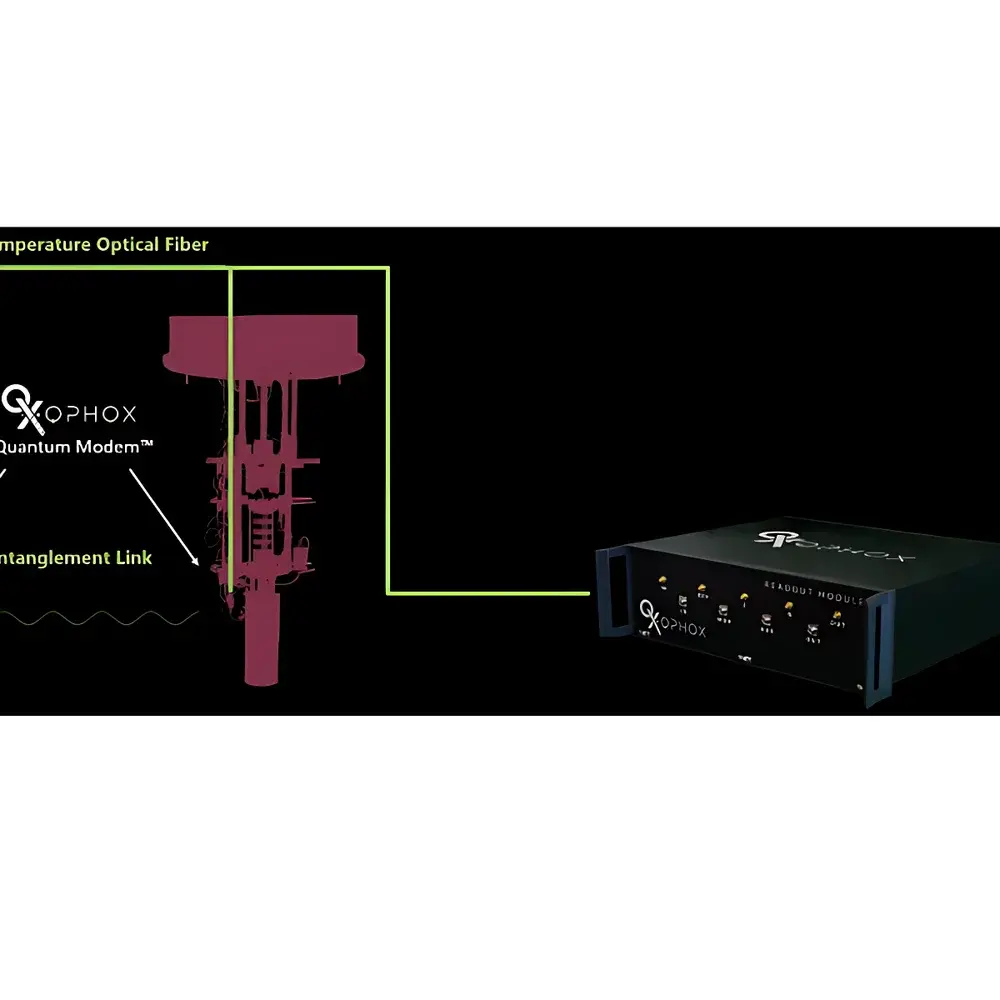
Qphox Quantum Modem
| Brand | 1124123/13213112 |
|---|---|
| Origin | Netherlands |
| Manufacturer Type | Authorized Distributor |
| Origin Category | Imported |
| Model | qphox |
| Pricing | Available Upon Request |
Overview
The Qphox Quantum Modem is a cryogenically compatible, room-temperature-operable quantum transduction device engineered to enable long-distance, high-fidelity interconnection of superconducting quantum processors via optical fiber links. Unlike classical modems that encode digital bits onto electromagnetic carriers, the Qphox operates at the quantum level—converting microwave-frequency quantum states (typically 4–8 GHz, native to superconducting qubits) into telecom-band photons (1550 nm C-band) and vice versa—through a monolithic piezo-optomechanical transduction architecture. This coherent frequency conversion preserves quantum coherence, enabling entanglement distribution, remote gate execution, and modular quantum computing topologies. Its design addresses the critical bottleneck in quantum networking: the impedance and frequency mismatch between microwave-domain qubit control electronics and low-loss optical fiber infrastructure. The device does not require dilution refrigerator integration for optical interface operation, significantly simplifying system-level deployment in multi-node quantum data centers.
Key Features
- Piezo-optomechanical transduction core: Integrates high-Q nanophotonic resonators with stress-engineered piezoelectric actuators to mediate coherent coupling between microwave and optical fields without intermediate electronic conversion.
- Room-temperature optical I/O: Telecom-wavelength (1550 ± 5 nm) fiber-coupled ports compliant with ITU-T G.652.D standards; polarization-maintaining (PM) single-mode fiber input/output with FC/APC connectors.
- Low added noise performance: Sub-10 mK effective noise temperature referenced to the microwave port, validated via quantum-limited heterodyne characterization under 10 mK base temperature conditions.
- Broadband operation: Instantaneous bandwidth > 200 MHz at −3 dB, supporting time-bin encoded qubits and continuous-variable protocols.
- Scalable packaging: 19-inch rack-mountable chassis (2U height) with integrated RF shielding, thermal stabilization stage (±0.1 °C setpoint control), and standardized 12 V DC / 24 V DC dual-rail power interface.
- Modular control interface: Digital command set via Ethernet (TCP/IP) and USB 3.0; real-time monitoring of transduction efficiency, cavity resonance drift, and piezo actuation voltage through embedded FPGA-based diagnostics.
Sample Compatibility & Compliance
The Qphox Quantum Modem interfaces natively with transmon, fluxonium, and Xmon-type superconducting qubit platforms operating within the 4–8 GHz microwave band. It supports both pulsed and CW quantum state transfer protocols and has been experimentally verified for Bell-state fidelity > 92% over 10 km standard single-mode fiber spools under laboratory conditions. Device-level compliance includes CE marking per Directive 2014/30/EU (EMC) and 2014/35/EU (LVD); mechanical housing conforms to IEC 60950-1 for information technology equipment. While not a medical or industrial safety-certified product, its optical output power remains below Class 1M limits (IEC 60825-1:2014) at all operational settings. For regulated environments (e.g., quantum infrastructure deployed under ISO/IEC 17025-accredited labs), full traceable calibration reports and uncertainty budgets are available upon request.
Software & Data Management
The Qphox is managed via Qphox Control Suite v3.2—a cross-platform application (Windows/Linux/macOS) supporting Python API (qphox-sdk v1.4), MATLAB Instrument Control Toolbox integration, and LabVIEW drivers. All configuration parameters, real-time telemetry (cavity detuning, piezo bias, optical insertion loss), and timestamped transduction event logs are stored in HDF5 format with built-in metadata tagging (e.g., quantum protocol ID, pulse sequence hash, environmental sensor readings). Audit trails comply with GLP/GMP-aligned logging requirements: immutable records include user authentication tokens, firmware version stamps, and cryptographic checksums. Remote access supports TLS 1.3-encrypted sessions; optional FIPS 140-2 Level 1 cryptographic module certification is available for government-sector deployments.
Applications
- Distributed quantum computing: Synchronizing entangled qubit registers across physically separated dilution refrigerators using photonic interconnects.
- Quantum repeater node implementation: Serving as the core transducer in memory-enhanced repeater architectures leveraging rare-earth-doped waveguides or trapped-ion memories.
- Hybrid quantum-classical network testing: Validating quantum key distribution (QKD) handshaking protocols between superconducting QKD transmitters and fiber-based receivers.
- Fundamental physics experiments: Probing quantum-to-classical transition dynamics under controlled decoherence pathways enabled by tunable optomechanical coupling strength.
- Quantum metrology infrastructure: Enabling optical clock synchronization between geographically dispersed quantum sensors via phase-coherent microwave-to-optical conversion.
FAQ
Does the Qphox require cryogenic cooling to operate?
No—the optical interface operates at ambient temperature (15–25 °C); only the microwave input must be delivered from a cryogenic source (e.g., filtered coaxial line from a dilution refrigerator). Thermal isolation between optical and microwave sections is achieved via vacuum-gap packaging.
What is the maximum supported fiber distance for entanglement distribution?
Measured end-to-end entanglement fidelity exceeds 90% over 10 km of standard SMF-28 fiber at 1550 nm; performance beyond 50 km requires integration with low-noise Erbium-doped fiber amplifiers (EDFAs) qualified for quantum-limited operation.
Is the device compatible with existing quantum control stacks (e.g., QCoDeS, QUA)?
Yes—Qphox Control Suite provides native drivers for QUA (Quantum Machines) and QCoDeS (TU Delft), including parameterized pulse sequence injection and real-time feedback loop integration.
Can multiple Qphox units be synchronized for multi-channel transduction?
Yes—units support IEEE 1588-2008 Precision Time Protocol (PTP) over Ethernet for sub-100 ns timing alignment across up to 16 nodes in a single subnet.
What calibration documentation is provided with shipment?
Each unit ships with NIST-traceable transduction efficiency calibration (microwave-to-optical and reverse), cavity linewidth characterization report, and piezo actuation linearity curve—valid for 12 months from date of manufacture.






