
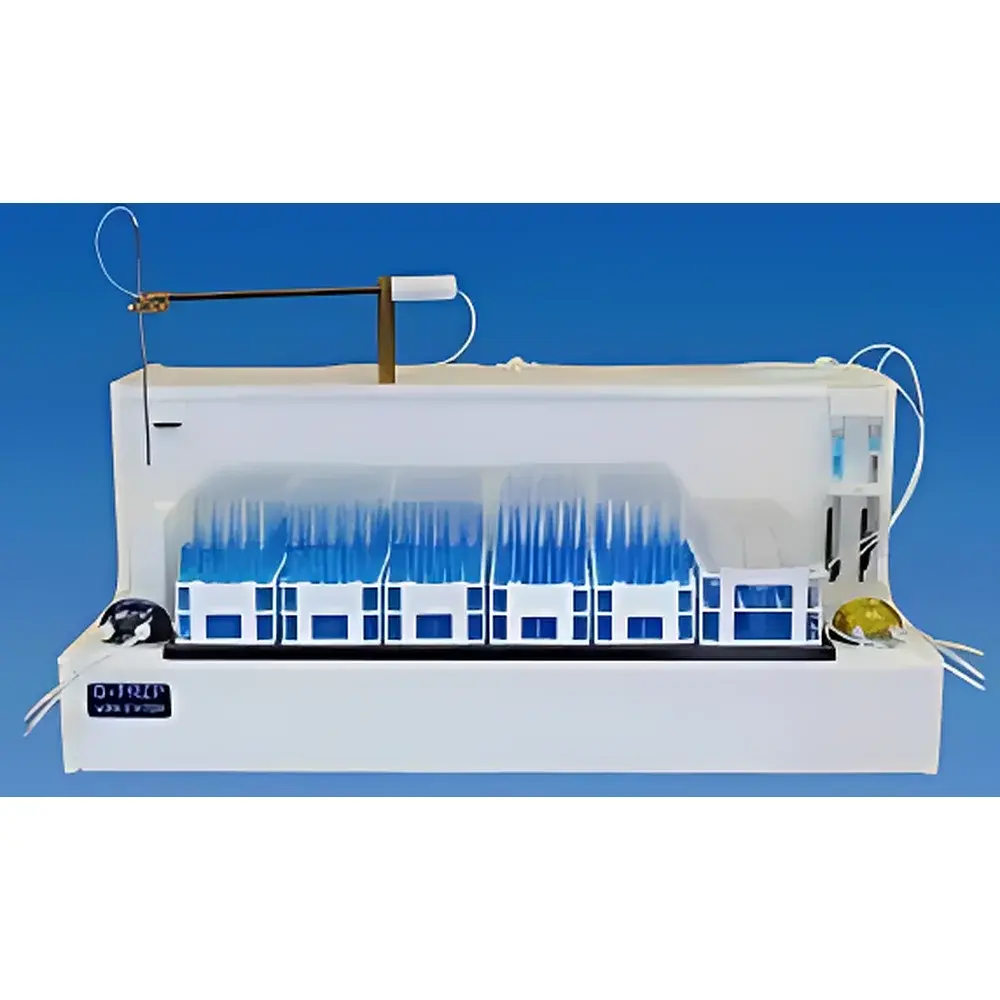
QTechCorp QPrep Automated Liquid Handling Workstation
| Brand | QTechCorp |
|---|---|
| Origin | Canada |
| Manufacturer Type | Authorized Distributor |
| Product Origin | Imported |
| Model | QPrep |
| Price Range | USD 13,500 – 40,500 (est.) |
| Deck Capacity | 1 |
| Pipetting Accuracy | ±0.1% (at full scale) |
| Pipetting Volume Range | 1–1000 µL |
| Sample Throughput | 42 samples per run |
| Dimensions | 92 × 48 × 48 cm |
| Power Supply | 100–240 VAC, 50/60 Hz |
| Weight | 35 kg |
| Compatible OS | Windows XP / 7 (USB interface required) |
| Z-Axis Positioning Accuracy | ±0.3 mm |
| Peristaltic Pump Flow Rate | 0.5–2 mL/sec |
| Optional Syringes | 5–25 mL |
| Fluidic Path Materials | PTFE-coated graphite sampling probe |
| Maximum Rack Capacity | 6 standard racks (360 positions) |
Overview
The QTechCorp QPrep Automated Liquid Handling Workstation is a benchtop, single-deck precision liquid handling platform engineered for reproducible, low-volume fluid manipulation in regulated and research-intensive laboratory environments. Built on a modular architecture combining positive-displacement syringe pumping and peristaltic flow control, the QPrep operates via Couette-flow–based aspiration/dispense mechanics and gravimetrically validated volume delivery—enabling traceable, calibration-compliant operation across aqueous, organic, and highly corrosive media including hydrofluoric acid (HF). Its fully enclosed plastic chassis eliminates metallic contamination pathways, while the PTFE-coated graphite probe and optional TFM syringes ensure chemical inertness and long-term integrity of fluidic surfaces. Designed for integration into QC/QA workflows, method development, and pre-analytical sample preparation, the QPrep supports ISO/IEC 17025-aligned operations and meets foundational requirements for GLP-compliant documentation when paired with audit-trail-enabled software configurations.
Key Features
- Hybrid actuation system: Synchronized syringe pump (1–1000 µL range) and peristaltic pump (0.5–2 mL/sec) for rapid reagent transfer and high-fidelity low-volume dispensing
- Z-axis positioning accuracy of ±0.3 mm via stepper-motor–driven probe movement, ensuring repeatable tip immersion depth and meniscus contact control
- Chemically resistant fluid path: Standard PTFE-coated graphite sampling probe; optional TFM syringes for extended HF or strong oxidizer compatibility
- Full-plastic construction with no exposed metal components—minimizing leaching risk and enabling use in ultra-trace elemental analysis labs
- Flexible deck configuration: Accommodates up to six standard ANSI/SLAS-format racks (360 total positions), with software-defined rack mapping for heterogeneous plate layouts
- PC-based control via USB interface; compatible with Windows XP and Windows 7 operating systems; no proprietary hardware dongles or runtime licenses required
Sample Compatibility & Compliance
The QPrep handles diverse sample matrices—including acidic digestates (e.g., HF/HNO₃ mixtures), organic solvents (acetonitrile, methanol), viscous buffers (≥10 cP), and particulate-laden suspensions—without cross-contamination or carryover due to its non-contact probe design and programmable wash cycles. All wetted materials comply with USP Class VI biocompatibility standards and meet ASTM D4295-22 specifications for fluoropolymer-lined fluidic components. While the base system does not include 21 CFR Part 11-compliant electronic signatures or audit trail modules, its deterministic command protocol and timestamped log export functionality support validation under GMP Annex 11 and ISO 15197:2013 frameworks when deployed with qualified third-party LIMS integration.
Software & Data Management
The QPrep is controlled through a native Windows application that enables drag-and-drop method building, multi-step protocol sequencing (e.g., serial dilution trees, spike recovery workflows), and real-time status monitoring. Methods are stored as human-readable XML files, facilitating version control, peer review, and regulatory submission readiness. Raw execution logs—including timestamped volume dispensed, motor step counts, error codes, and environmental temperature readings—are exportable in CSV format for trend analysis and root-cause investigation. The software supports external trigger inputs (TTL-compatible) for synchronization with HPLC autosamplers or mass spectrometer acquisition cycles, enabling closed-loop analytical automation.
Applications
- Automated preparation of calibration standards and QC reference materials across environmental, clinical, and pharmaceutical testing labs
- Multi-level dilution series generation for ICP-MS, AAS, and UV-Vis quantification workflows
- Reagent addition and internal standard spiking in sample digestion protocols prior to trace metal analysis
- High-reproducibility assay setup for ELISA, PCR master mix assembly, and cell culture media formulation
- Method transfer support between R&D and production QC laboratories due to deterministic, parameterized liquid handling logic
FAQ
Does the QPrep support 21 CFR Part 11 compliance?
The base software does not include electronic signatures or built-in audit trails; however, its structured log export and deterministic execution model allow integration with validated third-party compliance middleware.
Can the QPrep handle hydrofluoric acid without degradation?
Yes—when equipped with the optional TFM syringe and operated with the standard PTFE-coated graphite probe, the system maintains functional integrity during routine HF handling at concentrations ≤5% v/v.
What is the minimum dispensing volume with guaranteed accuracy?
The QPrep achieves ±0.1% accuracy at full-scale volumes; for 1 µL dispenses, typical coefficient of variation (CV) remains ≤2.5% under optimized humidity and temperature conditions.
Is robotic arm integration possible?
No—the QPrep is a fixed-deck workstation without external robotic interface ports; it is designed for standalone or PC-synchronized operation only.
How often does the PTFE coating require replacement?
Under normal usage (≤2000 pipetting cycles/week), the PTFE layer on the graphite probe shows no measurable wear over 12 months; visual inspection and gravimetric verification are recommended quarterly.



