
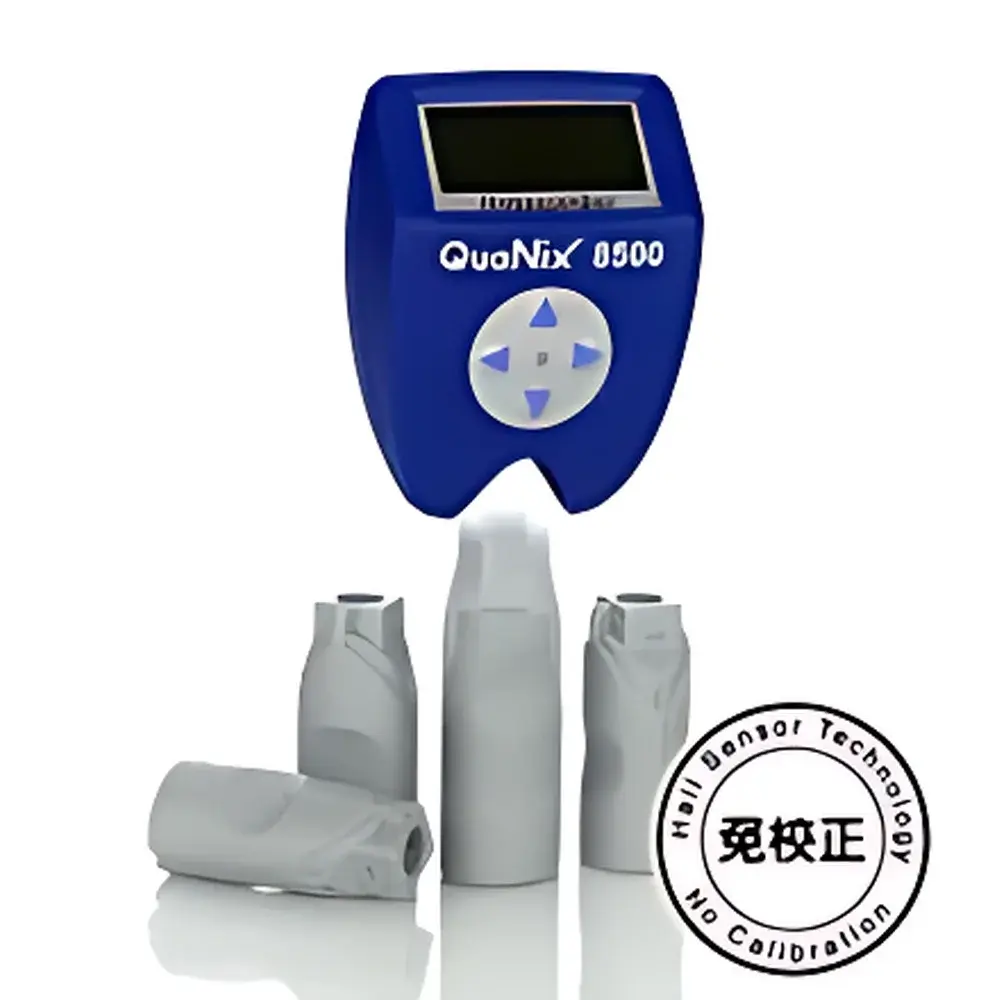
QuaNix 8500 Basic Electromagnetic Eddy Current & Magnetic Induction Dual-Mode Coating Thickness Gauge
| Origin | Germany |
|---|---|
| Manufacturer Type | Authorized Distributor |
| Origin Category | Imported |
| Model | 8500 Basic |
| Pricing | Available Upon Request |
| Measurement Range | 0–2000 µm (standard), 0–5000 µm (optional) |
| Resolution | 0.1 µm / 1 µm / 0.01 mm |
| Substrate Compatibility | Ferrous (Fe): steel, iron (min. thickness 0.2 mm) |
| Non-ferrous (NFe) | aluminum, zinc, copper, brass (min. thickness 0.05 mm) |
| Measurement Area | 20 × 20 mm² |
| Probe Types | 5 modular interchangeable probes (magnetic induction, eddy current, or dual-mode) |
| Memory Capacity | 100 readings |
| Calibration | Single- or dual-point user-defined curve |
| Display | High-resolution backlit LCD with 180° flip orientation |
| Indicators | Dual-color (red/green) LED status feedback |
| Keypad | Illuminated 4-directional navigation keys |
| Compliance | ISO 2178, ISO 2360, DIN 50981, BS 3900-E7, ASTM B499, ASTM D7091 |
| Certification | Traceable calibration certificate issued by PTB (Physikalisch-Technische Bundesanstalt, Germany) |
| Optional Accessories | QuaNix PC software, USB interface cable |
Overview
The QuaNix 8500 Basic is a handheld, dual-mode coating thickness gauge engineered for high-reproducibility non-destructive measurement of non-conductive coatings on conductive substrates. It operates simultaneously via two complementary electromagnetic principles: magnetic induction for ferrous (Fe) substrates—such as carbon steel and cast iron—and eddy current testing for non-ferrous (NFe) metals including aluminum, copper, zinc, and brass. This dual-sensor architecture eliminates instrument switching between material types, enabling rapid, consistent verification across mixed-production environments—automotive body shops, metal finishing lines, aerospace component suppliers, and industrial maintenance teams. The device complies fully with internationally recognized metrological standards governing coating thickness instrumentation, including ISO 2178 (magnetic method), ISO 2360 (eddy current method), ASTM B499 (standard test method for measurement of coating thicknesses by magnetic and eddy-current test methods), and ASTM D7091 (practice for nondestructive measurement of dry film thickness of nonmagnetic coatings applied to ferrous metals and nonconductive coatings applied to non-ferrous metals). Its design prioritizes traceability, operational robustness, and field-deployable accuracy—each unit ships with a PTB-traceable calibration certificate ensuring compliance with ISO/IEC 17025 requirements for accredited calibration laboratories.
Key Features
- Dual-mode electromagnetic sensing: automatic mode selection based on substrate conductivity and magnetic permeability—no manual mode switching required
- Zero-based measurement protocol: single-point zeroing directly on uncoated substrate eliminates drift-related recalibration and ensures long-term stability of probe sensitivity
- Modular probe system: five interchangeable probe configurations—including integrated, external, high-range, miniature, and curved-surface variants—support application-specific optimization without hardware replacement
- High-contrast, backlit LCD display with 180° rotational viewing—enabling ergonomic reading in confined or overhead positions
- Intuitive 4-way illuminated keypad with tactile feedback—designed for single-hand operation under gloves or low-light conditions
- Dual-color LED status indicators: green for valid measurement confirmation; red for error conditions including substrate thickness violation, lift-off deviation, or probe misalignment
- Onboard statistical analysis: real-time calculation of mean, min/max, standard deviation, and count for up to 100 stored readings—supporting in-process quality control without external data transfer
- Configurable alarm thresholds: programmable upper/lower limits with audible and visual alerts for out-of-specification results
Sample Compatibility & Compliance
The QuaNix 8500 Basic supports measurement of organic and inorganic coatings—including paint, enamel, plastic, rubber, and ceramic layers—on metallic substrates meeting minimum thickness requirements: ≥0.2 mm for ferrous materials and ≥0.05 mm for non-ferrous substrates. Its 20 × 20 mm² effective measurement area ensures representative averaging over surface irregularities while maintaining spatial resolution suitable for production line sampling. All measurements are traceable to national standards through PTB-certified calibration, fulfilling audit requirements under ISO 9001, IATF 16949, and AS9100 quality management systems. The instrument’s conformity with ISO 2178 and ISO 2360 validates its suitability for use in regulated manufacturing sectors where coating integrity directly impacts corrosion resistance, adhesion performance, and functional durability.
Software & Data Management
Data export and advanced analysis are enabled via optional QuaNix PC software and USB interface cable. The software supports batch export of measurement logs in CSV and XLSX formats, customizable report generation with embedded statistics and pass/fail summaries, and graphical trend visualization across sequential batches. Audit trails include timestamped operator ID (if configured), probe serial number, calibration date, and environmental metadata—ensuring alignment with FDA 21 CFR Part 11 requirements for electronic records and signatures when deployed in pharmaceutical or medical device manufacturing contexts. Raw data files retain full measurement context, supporting retrospective review during internal audits or regulatory inspections.
Applications
- Automotive OEM and Tier-1 suppliers: verification of e-coat, primer, basecoat, and clearcoat thickness on stamped steel and aluminum body panels
- Aerospace MRO facilities: inspection of protective anodized, chromate conversion, and thermal barrier coatings on turbine housings and structural alloys
- Architectural metal fabricators: quality assurance of powder-coated aluminum extrusions and stainless-steel cladding systems
- Galvanizing and electroplating plants: monitoring of zinc, nickel, and chromium layer uniformity on fasteners, brackets, and chassis components
- Marine equipment manufacturers: validation of anti-fouling and cathodic protection coatings on hulls, propellers, and offshore platform structures
FAQ
Does the QuaNix 8500 Basic require periodic factory recalibration?
No—its zero-based measurement principle and stable probe electronics enable indefinite field use after initial PTB-traceable calibration. Users perform substrate zeroing before each measurement session; no routine recalibration is mandated unless physical probe damage occurs.
Can the same probe measure both Fe and NFe substrates?
Yes—the dual-mode probes (e.g., model 8500-DUAL) automatically detect substrate type and switch measurement physics accordingly. Single-mode probes are also available for optimized sensitivity in dedicated applications.
Is the device compatible with GLP/GMP documentation workflows?
Yes—when used with QuaNix software and properly configured user accounts, it supports electronic signature capture, audit trail logging, and secure data archiving compliant with GLP (OECD Principles) and GMP (EU Annex 11, FDA 21 CFR Part 11) requirements.
What is the minimum substrate thickness for reliable measurement?
0.2 mm for ferrous substrates and 0.05 mm for non-ferrous substrates—below these thresholds, magnetic saturation or eddy current penetration depth limitations compromise accuracy.
How is measurement uncertainty quantified?
Uncertainty is derived from PTB calibration reports and conforms to ISO/IEC Guide 98-3 (GUM). Typical expanded uncertainty (k=2) is ±(1% + 1 µm) for standard ranges, validated across certified reference standards per ISO 2178 and ISO 2360.



