
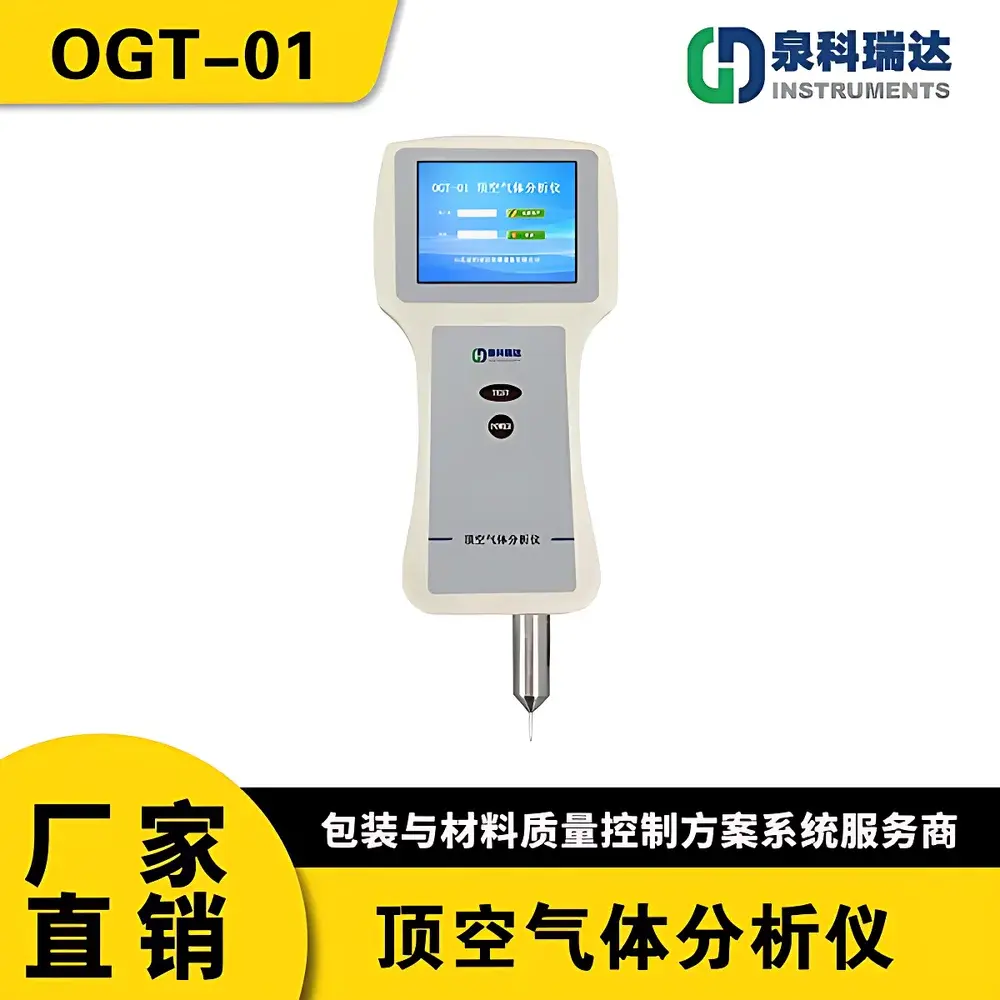
QuankeRida OGT-01 Controlled Atmosphere Headspace Oxygen Analyzer for Ready-to-Eat and Meat Packaging
| Brand | QuankeRida / qktester |
|---|---|
| Origin | Shandong, China |
| Manufacturer Type | Direct Manufacturer |
| Region of Origin | Domestic (China) |
| Model | OGT-01 |
| Price | USD 145 (converted from ¥999 at 1:6.9) |
| Measurement Range | 0–21% O₂ (typical) |
| Accuracy | ±0.2% O₂ (full scale) |
| Sample Volume | ≥5 mL (at standard atmospheric pressure) |
| Detection Principle | Fluorescence Quenching or Electrochemical Sensing (user-selectable/configurable per unit) |
| Operation Mode | Manual probe insertion with real-time sensor response |
| Data Storage | Internal non-volatile memory (≥1,000 test records) |
| Power Supply | AC 220 V ±10% or rechargeable Li-ion battery (field-deployable) |
| Dimensions | 350 × 330 × 200 mm (L×W×H) |
| Net Weight | 5.5 kg |
Overview
The QuankeRida OGT-01 Controlled Atmosphere Headspace Oxygen Analyzer is a dedicated analytical instrument engineered for non-destructive, quantitative measurement of residual oxygen concentration in the headspace of sealed packaging—primarily for ready-to-eat (RTE) foods, processed meat products, pharmaceuticals, and personal care items. It operates on either fluorescence quenching or electrochemical transduction principles, both validated for high reproducibility in low-oxygen environments typical of modified atmosphere packaging (MAP). The device quantifies O₂ partial pressure by extracting a representative gas sample directly from the package headspace via a sterile, single-use stainless-steel sampling needle, eliminating the need to open or compromise package integrity. This capability supports critical quality assurance workflows where oxygen ingress—or insufficient initial purge—directly correlates with lipid oxidation, microbial proliferation, color degradation (e.g., myoglobin oxidation in red meat), and active ingredient instability in sensitive formulations.
Key Features
- Non-invasive headspace sampling: Uses a precision-calibrated, low-dead-volume needle probe to extract ≥5 mL of headspace gas without package rupture or product exposure.
- Dual-sensor configuration option: Standard O₂ measurement (0–21% v/v) with optional integrated CO₂ channel (0–100% v/v) for full MAP verification compliance.
- Fluorescence quenching sensor (standard): Offers long-term stability, minimal drift (<0.05% O₂/month), and immunity to CO₂ cross-sensitivity—critical for high-acid or CO₂-rich food packages.
- Electrochemical sensor module (configurable): Provides rapid response (<15 s T₉₀) and suitability for routine QC labs requiring frequent calibration traceability.
- Onboard data logging: Stores up to 1,000 timestamped measurements with operator ID, batch number, and environmental conditions (ambient T/P logged automatically).
- Regulatory-ready output: Exportable CSV files support audit trails compliant with ISO 22000, HACCP, and FDA 21 CFR Part 11 (when paired with secure user authentication and electronic signature protocols).
Sample Compatibility & Compliance
The OGT-01 interfaces with rigid and semi-rigid packaging formats including vacuum-sealed trays, thermoformed MAP pouches, aluminum-laminated sachets, glass jars, PET bottles, blister packs, and flexible stand-up pouches. Its sampling probe accommodates seal thicknesses up to 3 mm and punctures without leakage under ≤10 kPa internal pressure. Instrument performance adheres to ASTM F2714–21 (“Standard Test Method for Determining Oxygen Transmission Rate Through Plastic Film and Sheeting Using a Coulometric Sensor”) for method validation, and supports alignment with USP <1207> “Packaging Integrity Evaluation” for pharmaceutical secondary packaging. All sensor calibrations are traceable to NIST-certified gas standards (O₂ in N₂, 1.00% ±0.02% and 10.00% ±0.05%). Routine verification follows internal SOPs aligned with GLP and GMP documentation requirements.
Software & Data Management
The embedded firmware supports USB-C data export and optional Bluetooth 5.0 wireless transmission to Windows-based QC software (QK-Analyzer Suite v3.2, included). Raw sensor voltage outputs, temperature-compensated %O₂ values, and pass/fail flags (relative to user-defined limits) are recorded with ISO 8601 timestamps. Audit logs capture calibration events, sensor zero/span adjustments, and user login/logout sequences—enabling full 21 CFR Part 11 compliance when deployed with role-based access control and digital certificate signing. Data exports include metadata fields required for LIMS integration (e.g., sample ID, lot number, tester initials, instrument serial number).
Applications
- Food manufacturing: Verification of MAP efficacy in cooked sausage, sliced deli meats, marinated poultry, and RTE salads; trending O₂ ingress over shelf life for predictive stability modeling.
- Pharmaceutical packaging: Residual O₂ assessment in lyophilized vials, desiccant-containing blister cards, and oxygen-scavenging sachet-activated pouches—supporting ICH Q5C stability protocol adherence.
- Cosmeceuticals: Monitoring headspace O₂ in airless dispensers and aluminum-tube packaging to prevent vitamin C, retinol, or polyphenol degradation.
- Contract packaging QA: On-site validation of sealing line performance across shift changes; correlation of O₂ levels with seal jaw temperature, dwell time, and vacuum level.
- Regulatory submissions: Generating documented evidence for FSMA Preventive Controls, EU Regulation (EC) No 1935/2004, and China GB 4806.1–2016 food contact material compliance dossiers.
FAQ
What gases can the OGT-01 measure simultaneously?
The base configuration measures oxygen only. A factory-installed dual-channel variant supports concurrent O₂ and CO₂ quantification using independent optical and electrochemical sensors.
Is calibration required before each use?
No. The instrument performs automatic zero-point verification at power-on using ambient air (20.9% O₂ reference). Full two-point calibration (zero and span) is recommended every 8 hours of continuous operation or prior to critical batch release testing.
Can it analyze packages under vacuum or positive pressure?
Yes. The sampling manifold includes a pressure-balancing valve that equalizes headspace pressure with ambient conditions before aspiration, ensuring accurate volumetric sampling across –80 kPa to +50 kPa gauge ranges.
Does it meet international regulatory requirements for pharmaceutical packaging?
It satisfies the technical criteria outlined in USP <1207> and Ph. Eur. 5.1.3 for headspace analysis. Full 21 CFR Part 11 compliance requires deployment with the optional QK-Analyzer Suite and configured user access controls.
How is sensor longevity maintained in high-humidity environments?
The fluorescence quenching sensor contains hydrophobic diffusion barriers and integrated desiccant cartridges (replaceable every 12 months), extending functional life to ≥24 months under typical food plant RH 40–85% operating conditions.





