
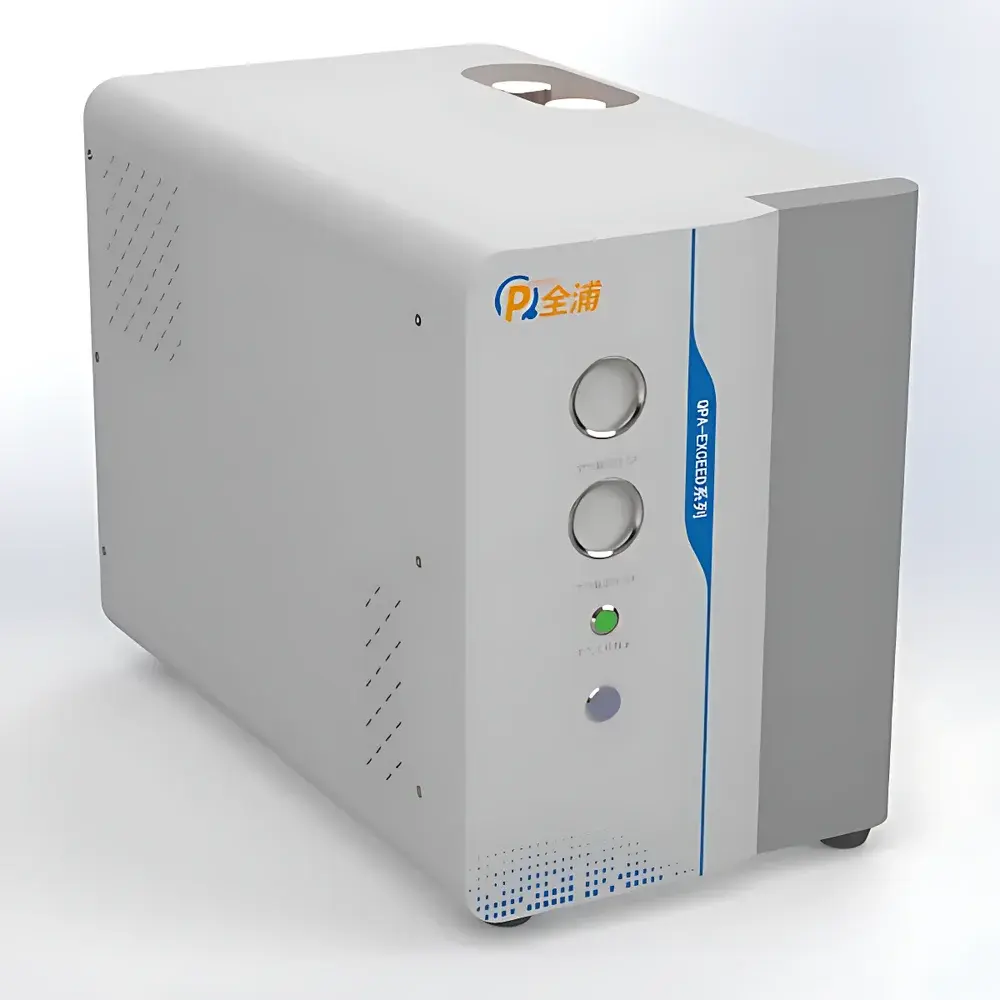
Quanpu QP-Plus-A3 Silent Air Generator
| Brand | Quanpu |
|---|---|
| Origin | Shanghai, China |
| Model | QP-Plus-A3 |
| Output Flow Rate | 3 L/min |
| Output Pressure | Port A: 0.4 MPa, Port B: 0.5 MPa |
| Air Quality | Oil-free, Dry, Triple-Purified |
| Particle Filtration | ≤0.01 µm |
| Drying Method | Adsorption (Silica Gel) |
| Noise Level | <40 dB(A) |
| Power Supply | 220 V / 50 Hz |
| Max. Power Consumption | 180 W |
| Dimensions (L×W×H) | 550 × 305 × 425 mm |
| Weight | 27 kg |
| Tank Material | Electropolished SS316 |
| Gas Pathway | Electropolished & Ultrasonically Cleaned Stainless Steel Tubing |
| Safety Features | Pressure Relief Valve, High-Sensitivity Pressure Controller, Overcurrent Protection, Manual Vent Valve |
| Certifications | Compliant with ISO 8573-1 Class 1:2:1 (Compressed Air Purity), GLP-Compatible Design |
Overview
The Quanpu QP-Plus-A3 Silent Air Generator is an engineered solution for laboratories requiring continuous, high-purity, oil-free compressed air at stable pressure and ultra-low acoustic emission. Designed around a dual-chamber architecture—separating the compression stage from the purification and storage modules—the system eliminates mechanical resonance and achieves noise levels below 40 dB(A), meeting stringent requirements for quiet operation in analytical labs, cleanrooms, and shared instrumentation suites. Its core function relies on oil-free piston compression followed by triple-stage purification: pre-filtration to remove particulates ≥0.01 µm, catalytic hydrocarbon removal via HL-A adsorption media (targeting volatile organic compounds including esters and hydrocarbons), and final desiccant drying using regenerable silica gel. The integrated electropolished SS316 storage tank and fully stainless steel (316) gas pathway—subjected to ultrasonic cleaning prior to assembly—ensure long-term corrosion resistance and eliminate iron oxide contamination, supporting compliance with ISO 8573-1:2010 Class 1:2:1 for solid particles, water, and oil content.
Key Features
- Ultra-quiet operation (<40 dB(A)) enabled by independent compression chamber and proprietary vibration-damping mountings
- Triple-stage air purification: particulate filtration (0.01 µm), catalytic hydrocarbon/ester/oil adsorption (HL-A module), and adsorption-based drying (silica gel)
- Electropolished ASTM F86-compliant SS316 storage tank with automatic condensate drainage—prevents rust formation and eliminates yellow iron oxide discharge
- Dual regulated output ports: Port A delivers 0.4 MPa (±0.01 MPa stability), Port B delivers 0.5 MPa (±0.01 MPa stability), both with M8×1 thread and φ3.3 mm orifice
- Fail-safe protection suite: ASME-certified pressure relief valve, high-sensitivity electronic pressure controller, motor overcurrent cutoff, and manual vent valve for safe desiccant replacement without disassembly
- Maintenance-free HL-A adsorption cartridge with no scheduled servicing; silica gel drying column features quick-release vent valve—no system depressurization required during media exchange
Sample Compatibility & Compliance
The QP-Plus-A3 is compatible with all air-dependent laboratory instruments requiring Class 1:2:1 compressed air per ISO 8573-1, including gas chromatographs (GC), GC-MS systems, FTIR spectrometers, nitrogen generators (as feed air), and pneumatic sample handling modules. Its oil-free, particle-controlled, and hydrocarbon-scavenged output meets the inlet air specifications of major OEMs (e.g., Agilent, Thermo Fisher, Shimadzu) for detector gases and carrier gas support. The unit’s design supports Good Laboratory Practice (GLP) environments: pressure logs are traceable via optional analog output (0–5 V), and its sealed, non-lubricated compression mechanism avoids hydrocarbon carryover that could compromise chromatographic baselines or mass spectral integrity. While not inherently 21 CFR Part 11 compliant, the generator’s stable output and mechanical reliability facilitate integration into validated workflows under GMP or ISO/IEC 17025 frameworks when paired with external audit-trail-capable monitoring systems.
Software & Data Management
The QP-Plus-A3 operates as a standalone hardware platform with no embedded firmware or touchscreen interface—prioritizing robustness, electromagnetic compatibility, and long-term serviceability. All operational parameters (output pressure, motor status, thermal cut-off events) are indicated via front-panel LED indicators and analog pressure gauges calibrated to EN 837-1. For integration into centralized lab infrastructure, a 0–5 V analog signal output is provided for remote pressure monitoring and logging via SCADA, LabVIEW, or LIMS platforms. No proprietary software is required; configuration remains purely mechanical and electrical. This architecture minimizes cybersecurity exposure, ensures deterministic response times, and aligns with IEC 61508 SIL-1 functional safety expectations for auxiliary lab utilities.
Applications
- Carrier and detector gas supply for capillary GC and GC-MS systems where hydrocarbon-free air prevents baseline drift and false-positive peaks
- Actuation air for automated liquid handlers, autosamplers, and robotic workstations requiring stable, dry, particle-free pressure
- Feed air for membrane-based nitrogen generators (PSA or hollow-fiber), ensuring extended membrane life and consistent N₂ purity
- Zero-air generation for environmental air quality analyzers (e.g., ozone monitors, NOₓ chemiluminescence detectors)
- Supply air for cleanroom pressurization and laminar flow hoods where particulate and VOC control are critical
- Calibration gas dilution systems requiring repeatable, low-moisture air matrices
FAQ
What is the expected service life of the HL-A hydrocarbon adsorption cartridge?
Under typical lab usage (8 hrs/day, 5 days/week), the HL-A module maintains performance for ≥12 months without regeneration or replacement.
Can the QP-Plus-A3 be installed in an enclosed cabinet?
No. Ambient airflow must remain unrestricted: minimum 15 cm clearance on all sides and above the unit is required to maintain operating temperature (0–35°C) and prevent thermal shutdown.
Is the silica gel drying column replaceable in situ?
Yes. The integrated vent valve allows full depressurization of the drying column without disconnecting gas lines or tools—desiccant can be exchanged in <90 seconds.
Does the unit meet ISO 8573-1 Class 0 for oil content?
It meets Class 1 for total oil (≤0.01 mg/m³), verified by condensate analysis per ISO 8573-2. Class 0 (oil-free compression) requires scroll or diaphragm compressors; this unit uses oil-free piston technology with upstream adsorption, achieving equivalent functional purity for analytical applications.
What maintenance is required beyond desiccant replacement?
None. The SS316 tank’s auto-drain, sealed motor, and non-lubricated compression mechanism eliminate routine lubrication, filter changes, or internal cleaning protocols.



