
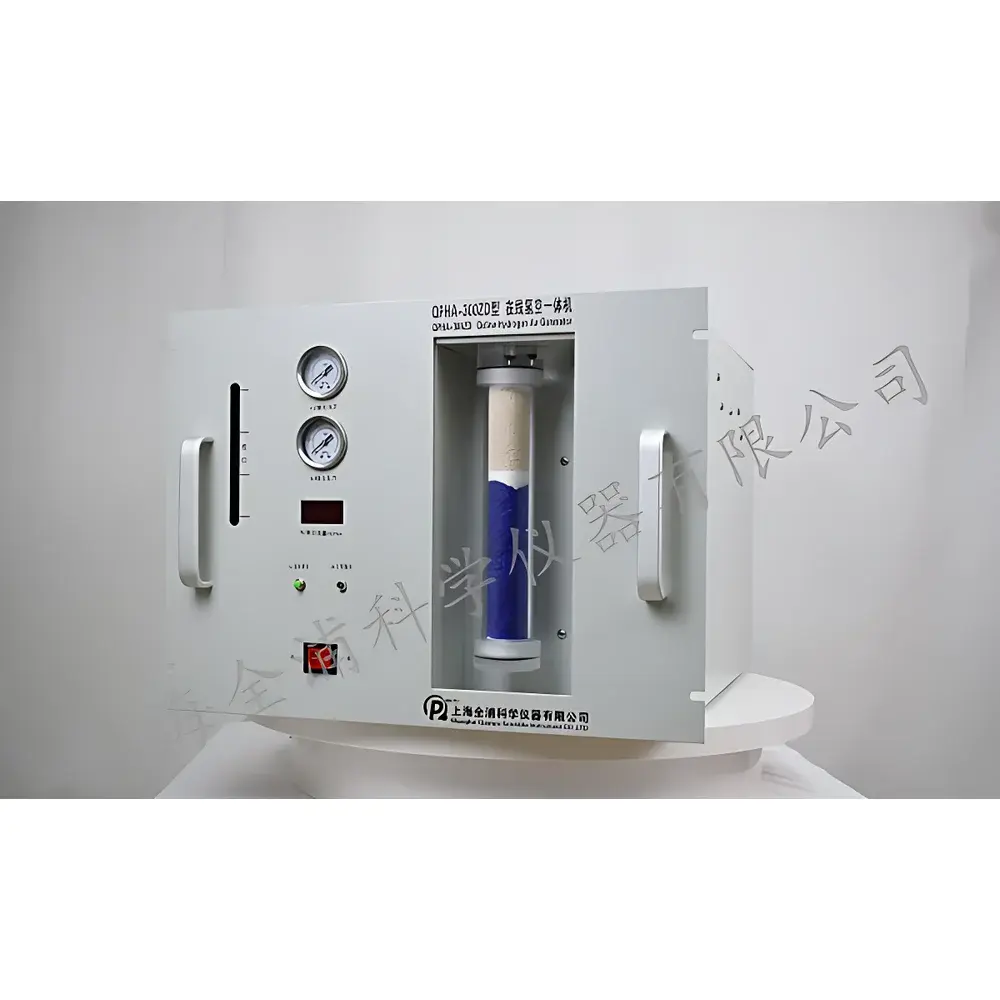
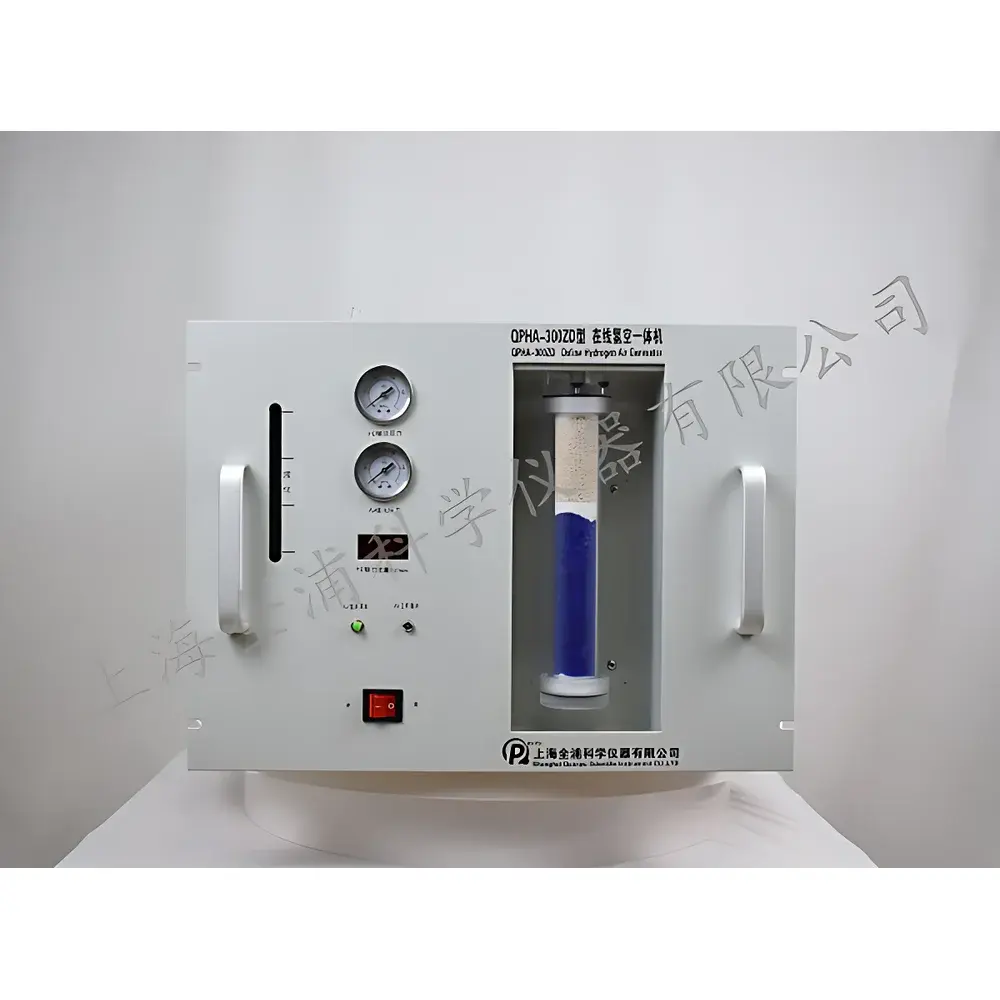
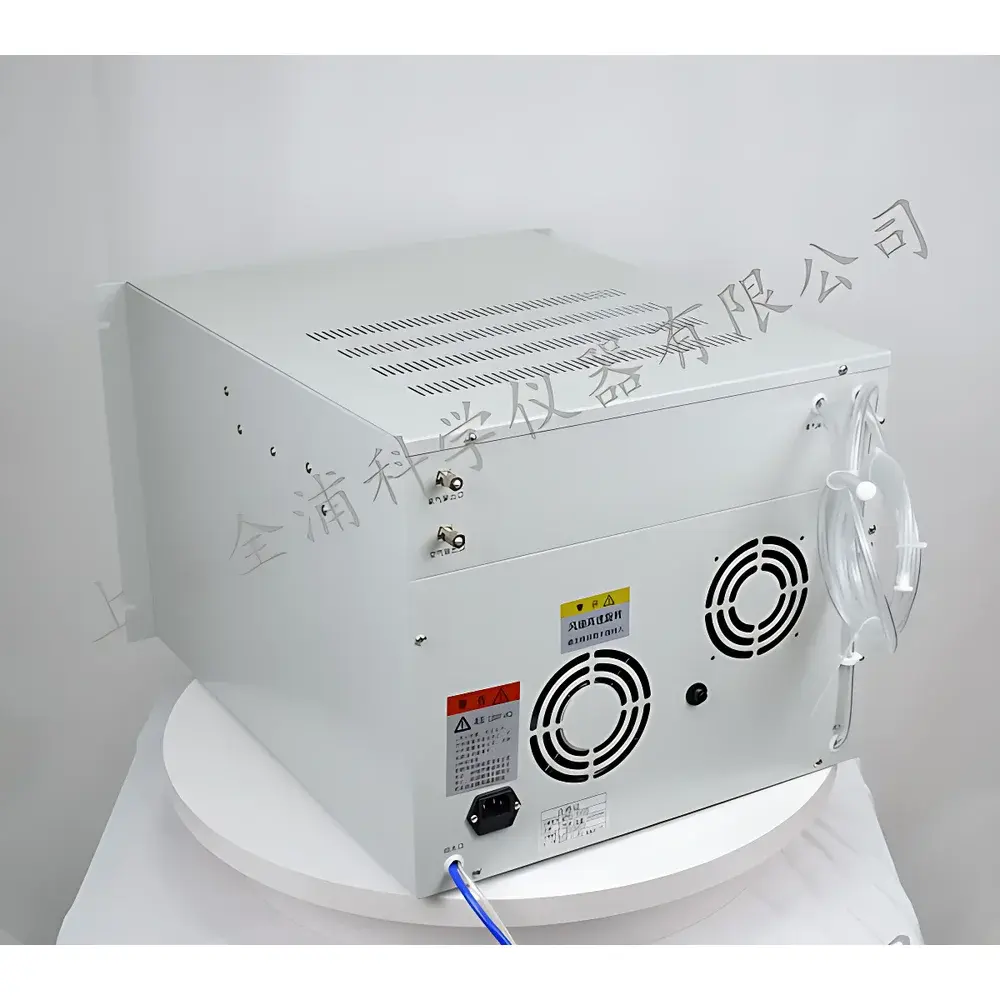
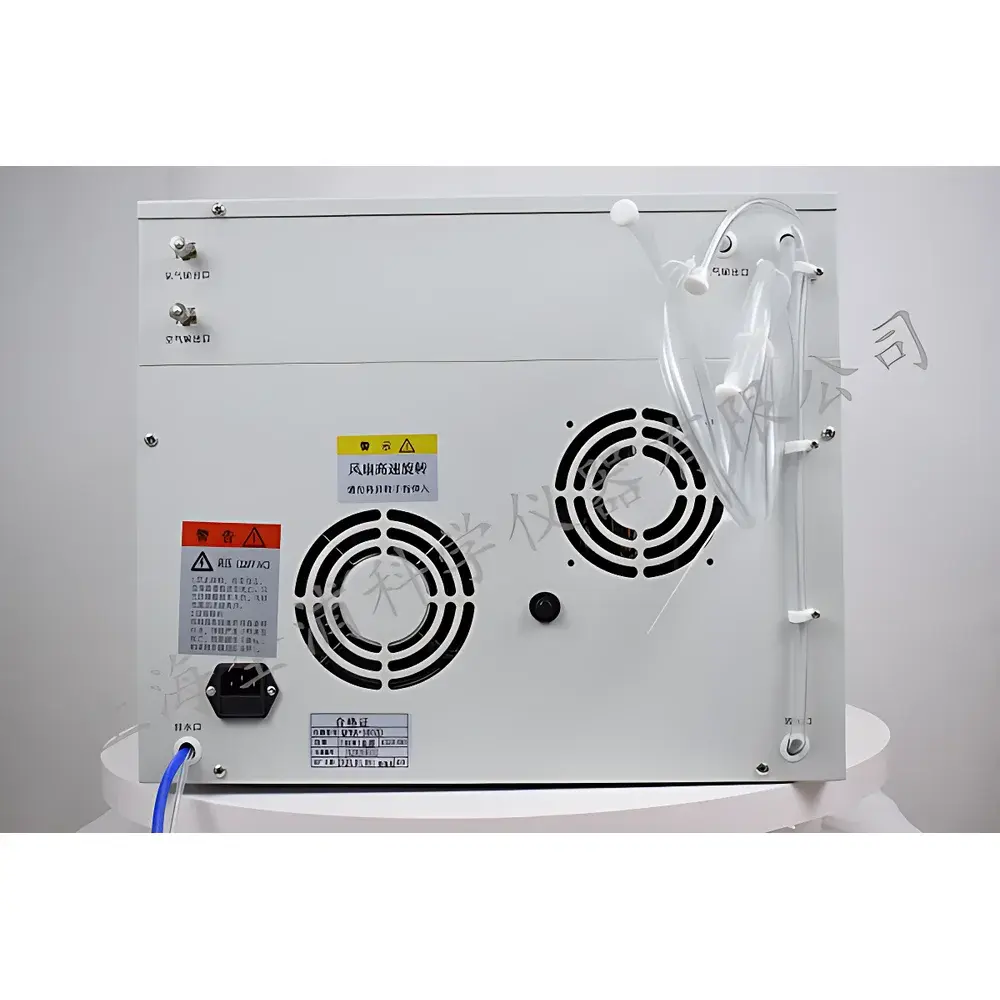
Quanpu QPT-300ZD Integrated Nitrogen-Hydrogen-Air Gas Generator
| Brand | Quanpu |
|---|---|
| Origin | Shanghai, China |
| Model | QPT-300ZD |
| Gas Purity | H₂ ≥ 99.999%, N₂ > 99.999% |
| Output Flow | H₂: 0–300 mL/min, Air: 0–2000 mL/min |
| Output Pressure | N₂: 0–0.5 MPa (factory-set at 0.4 MPa), H₂: 0–0.4 MPa (factory-set at 0.3 MPa), Air: 0–0.45 MPa (factory-set at 0.4 MPa) |
| Design | Integrated monoblock chassis |
| Control Mode | On/Off switch control |
| Power Supply | 220 V ±10%, 50 Hz ±5% |
| Max Power Consumption | 500 W |
| Operating Environment | 0–40 °C, RH ≤85%, non-corrosive, low-dust ambient |
| Dimensions (L×W×H) | 560 × 430 × 360 mm (excl. 30 mm mounting flange) |
Overview
The Quanpu QPT-300ZD Integrated Nitrogen-Hydrogen-Air Gas Generator is an engineered solution for continuous, on-demand supply of high-purity carrier, fuel, and combustion-support gases in analytical laboratories—specifically optimized for online volatile organic compound (VOC) monitoring systems such as GC-FID, GC-PID, and portable gas chromatographs. Unlike conventional high-pressure cylinder-based gas delivery, the QPT-300ZD employs membrane-separated alkaline electrolysis for hydrogen generation and pressure-swing adsorption (PSA) with dual-stage carbon molecular sieve (CMS) beds for nitrogen production, while compressed ambient air undergoes three-stage purification (coalescing filter, activated carbon adsorption, and desiccant drying) to yield oil-free, dry, particle-free air. Its fully integrated architecture eliminates inter-unit piping, reduces footprint, and supports unattended 24/7 operation—making it suitable for fixed-site environmental monitoring stations, industrial process control labs, and mobile analytical platforms requiring stable, traceable gas supply compliant with ISO 8573-1 Class 2:2:2 for compressed air and ASTM D6349 for generator-grade hydrogen.
Key Features
- Integrated monoblock design consolidates nitrogen, hydrogen, and zero-air generation into a single compact unit (560 × 430 × 360 mm), minimizing lab space requirements and installation complexity.
- Hydrogen generation via PEM-free alkaline electrolysis with stainless-steel electrodes and KOH-based electrolyte; achieves ≥99.999% purity (measured by residual oxygen and moisture content per ISO 8573-3 and ISO 8573-4).
- Nitrogen generation using dual-bed PSA technology with automated valve sequencing and real-time pressure balancing—ensuring consistent output purity >99.999% and minimal decay over extended operation.
- Three-stage air purification system: particulate pre-filter (1 µm), activated carbon bed (oil vapor & hydrocarbon removal), and desiccant dryer (dew point ≤ –40 °C at 0.4 MPa), meeting ISO 8573-1:2010 Class 2 for solid particles, Class 2 for water, and Class 2 for oil.
- Dual overpressure protection circuits for all gas streams—mechanical relief valves plus electronic pressure cut-off—combined with anti-backflow liquid traps in H₂/N₂ electrolytic cells to prevent electrolyte carryover.
- Auto-refill capability: external deionized water reservoir (gravity-fed, no inlet pressure required) maintains electrolyte level; initial fill requires manual addition of standardized KOH solution only once during commissioning.
- LED digital flow meters with real-time tracking for H₂ and air outputs; factory-calibrated pressure regulators ensure stable setpoints (N₂: 0.4 MPa, H₂: 0.3 MPa, Air: 0.4 MPa) across load variations.
Sample Compatibility & Compliance
The QPT-300ZD delivers gases compatible with flame ionization detectors (FID), photoionization detectors (PID), and thermal conductivity detectors (TCD) used in continuous emission monitoring systems (CEMS) and ambient air quality analyzers. Hydrogen purity meets USP <851> and ASTM D6349 specifications for detector fuel gas. Nitrogen output satisfies carrier gas requirements for GC methods per EPA Method TO-17 and ISO 16000-6. Air stream complies with ISO 8573-1 Class 2:2:2 for instrumental air in analytical instrumentation. The unit operates within GLP-compliant environments and supports audit-ready documentation when paired with optional data logging modules (not included). No hazardous gas storage is required—eliminating cylinder handling risks and enabling full integration into ISO/IEC 17025-accredited laboratory workflows.
Software & Data Management
The QPT-300ZD operates via hardware-level on/off switch control without embedded firmware or network connectivity. All operational parameters—including pressure setpoints, flow ranges, and safety thresholds—are hardwired and factory-calibrated. For integration into supervisory control and data acquisition (SCADA) or laboratory information management systems (LIMS), analog 0–10 VDC or 4–20 mA signals can be configured (via optional I/O module) to monitor outlet pressure and flow status. Internal event logs (e.g., overpressure trip, low-water alarm) are retained in non-volatile memory and accessible via front-panel diagnostic mode. While not FDA 21 CFR Part 11 compliant out-of-the-box, the unit supports traceability through mechanical pressure gauges, LED displays, and externally recorded calibration certificates per ISO/IEC 17025 Clause 6.5.
Applications
- Continuous VOC monitoring in ambient air, stack emissions, and indoor air quality (IAQ) networks.
- Mobile GC platforms for field-deployable environmental screening and emergency response units.
- QC/QA laboratories performing routine analysis per EPA Methods 8260, 8270, and ASTM D5504 where certified gas standards demand consistent baseline stability.
- Industrial process analyzers requiring uninterrupted fuel gas (H₂) and zero-air for calibration and span verification.
- Research facilities utilizing micro-GC systems where space constraints and safety protocols prohibit high-pressure gas cylinders.
FAQ
What maintenance is required for long-term reliability?
Routine maintenance includes quarterly visual inspection of filters, biannual replacement of the air coalescing filter and activated carbon cartridge, and annual CMS bed regeneration assessment. Electrolyte concentration should be verified annually using refractometry; top-up with deionized water only is performed automatically via the gravity-fed reservoir.
Can the unit operate in unconditioned environments?
The generator is rated for ambient temperatures between 0–40 °C and relative humidity ≤85%. Operation outside this range may affect dew point performance of the air dryer and electrolyte evaporation rate; climate-controlled housing is recommended for outdoor or industrial settings.
Is hydrogen generation safe in laboratory settings?
Yes—hydrogen is generated on-demand at sub-stoichiometric concentrations (<4% v/v in internal headspace), vented continuously through dedicated exhaust lines, and monitored by redundant pressure-relief mechanisms. No hydrogen storage occurs within the unit, eliminating explosion hazards associated with pressurized cylinders.
How does the auto-refill system interface with facility water supply?
The system requires a passive, gravity-fed deionized water source connected to the inlet port—no pump or pressurized line. A minimum 30 cm vertical head ensures consistent refill; inlet pressure must remain at 0 kPa gauge to prevent backflow into the electrolytic cell.
What certifications does the unit hold?
The QPT-300ZD conforms to CE marking requirements under the EU Machinery Directive 2006/42/EC and Electromagnetic Compatibility Directive 2014/30/EU. Electrical safety compliance is verified per IEC 61010-1:2010. Third-party gas purity validation reports are available upon request for ISO/IEC 17025-accredited calibration.
Related Products



