
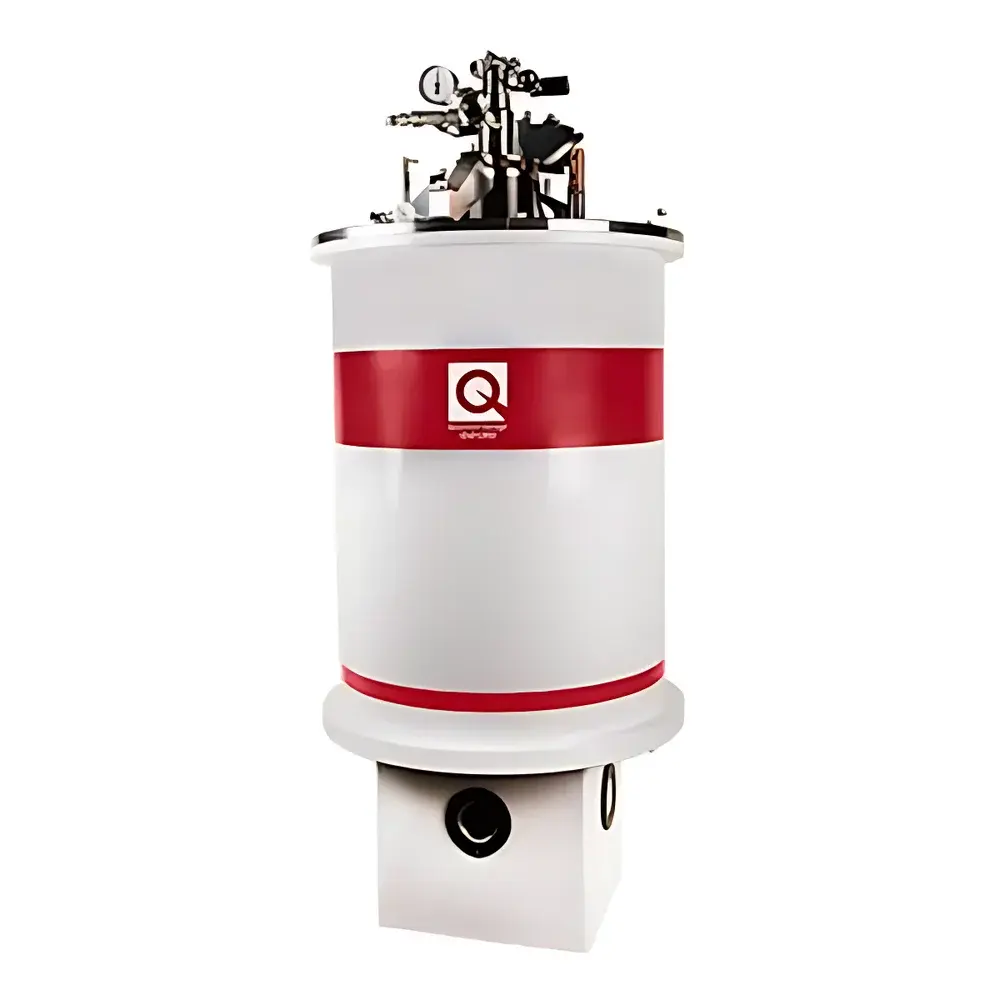
Quantum Design SpectromagPT Cryogen-Free Optical Access Superconducting Magnet System
| Brand | Quantum Design |
|---|---|
| Origin | USA |
| Manufacturer Type | Manufacturer |
| Origin Category | Imported |
| Model | SpectromagPT |
| Price | Upon Request |
Overview
The Quantum Design SpectromagPT is a cryogen-free, optical-access superconducting magnet system engineered for high-precision magneto-optical and low-temperature physical property characterization. Unlike conventional liquid helium–dependent systems, the SpectromagPT employs a split-coil superconducting magnet architecture integrated with a pulse-tube cryocooler, enabling stable operation across a continuous temperature range from 1.6 K to 300 K without consumable cryogens. Its core design principle leverages closed-cycle refrigeration to maintain a persistent 7 T magnetic field while delivering unobstructed optical access—both parallel and perpendicular to the field axis—within a 30 mm diameter sample space. This architecture eliminates reliance on helium liquefaction infrastructure, reduces operational overhead, and mitigates risks associated with gas handling, dewar refills, and thermal drift during long-duration experiments. The system is purpose-built for applications requiring simultaneous high magnetic fields, ultra-low temperatures, and high-fidelity optical coupling—particularly in quantum materials research, magneto-spectroscopy, and nanophotonic device characterization.
Key Features
- 7 T split-coil superconducting magnet with persistent mode operation and ≤60-minute field ramp-up time
- Cryogen-free operation: Achieves base temperature of ≤4 K via integrated two-stage pulse-tube refrigerator; no liquid helium or cryogenic transfer lines required
- Optimized optical access: Dual-axis (parallel & perpendicular) optical pathways with customizable window materials—including fused silica (VIS–MIR), CaF₂ and ZnSe (far-IR), sapphire and crystalline quartz (THz)
- Top-loading sample probe enables rapid sample exchange without warming the magnet or breaking vacuum
- Low-vibration mechanical design: Active and passive vibration isolation suppresses pulse-tube-induced microphonics to <50 nm RMS at the sample position
- Full-angle sample rotation capability (±180°) with encoder feedback for precise angular alignment in magneto-optical measurements
- Compact footprint with 30 mm clear bore and extended working distance optimized for integration with commercial Raman spectrometers, FTIR systems, fluorescence microscopes, and THz time-domain setups
Sample Compatibility & Compliance
The SpectromagPT accommodates diverse sample geometries—including bulk crystals, thin films on substrates, nanostructured devices, and microfabricated chips—via interchangeable sample holders and cold-finger adapters. Its vacuum-tight, multi-stage thermal shield design ensures minimal radiative loading and high thermal stability (±0.1 K over 24 h at fixed setpoint). All optical windows are hermetically sealed across temperature stages to prevent superfluid helium leakage and maintain UHV-compatible vacuum integrity (<1×10⁻⁷ mbar typical). The system complies with international safety standards for superconducting magnet operation (IEC 60404-14, ASTM F2733) and supports GLP/GMP-aligned workflows through audit-trail-capable control interfaces. Optional integration with Mercury iTC and Mercury iPS controllers enables full traceability of temperature and field parameters per FDA 21 CFR Part 11 requirements when configured with electronic signature modules.
Software & Data Management
The SpectromagPT is natively compatible with Quantum Design’s QD Software Suite, which provides synchronized control of temperature, magnetic field, sample rotation, and optional auxiliary instruments (e.g., lock-in amplifiers, photon counters). Real-time data logging records all sensor inputs—including RuO₂/Cernox resistance thermometers, Hall probes, and encoder positions—with timestamped metadata and user-defined annotation fields. Export formats include HDF5 and CSV, supporting direct ingestion into Python-based analysis pipelines (e.g., SciPy, Matplotlib, QuTiP) and MATLAB environments. Remote operation is supported via TCP/IP, USB, or RS-232; GPIB is available as an option. All Mercury iTC and Mercury iPS subsystems support SCPI command sets and offer programmable PID tuning, ramp profiling, and interlock monitoring for fail-safe experimental sequencing.
Applications
- Magneto-optical spectroscopy: Faraday rotation, magnetic circular dichroism (MCD), and Voigt effect measurements under high-field, low-temperature conditions
- Resonant Raman and photoluminescence studies of 2D materials (e.g., TMDCs, graphene heterostructures) and topological insulators
- THz transmission/reflection spectroscopy of correlated electron systems and superconducting thin films
- In-situ optical characterization of quantum dot arrays, spintronic devices, and magnonic waveguides
- High-resolution FTIR and synchrotron-based infrared microspectroscopy with field-dependent spectral mapping
- Low-temperature fluorescence lifetime imaging (FLIM) and time-resolved single-photon detection in solid-state quantum emitters
FAQ
Does the SpectromagPT require liquid helium for initial cooldown or operation?
No. The system operates entirely cryogen-free using a two-stage pulse-tube cryocooler; no liquid helium, nitrogen, or external cryogenic infrastructure is needed.
Can I perform optical alignment after sample exchange without realigning the entire setup?
Yes. The optical path is mechanically stabilized and decoupled from sample insertion mechanics; alignment remains invariant across multiple sample changes.
What is the typical cooling time from room temperature to 4 K?
Approximately 40 hours for the full system; the standard sample probe reaches <5 K in ~90 minutes after cold-head engagement.
Is remote operation and automation supported?
Yes. Full SCPI-compliant control is provided via Ethernet, USB, or RS-232; Python and LabVIEW drivers are available for custom automation sequences.
How is vibration minimized for high-resolution optical measurements?
Multi-stage passive damping combined with active vibration cancellation at the cold head interface reduces transmitted microphonics to sub-50 nm RMS at the sample plane.



