
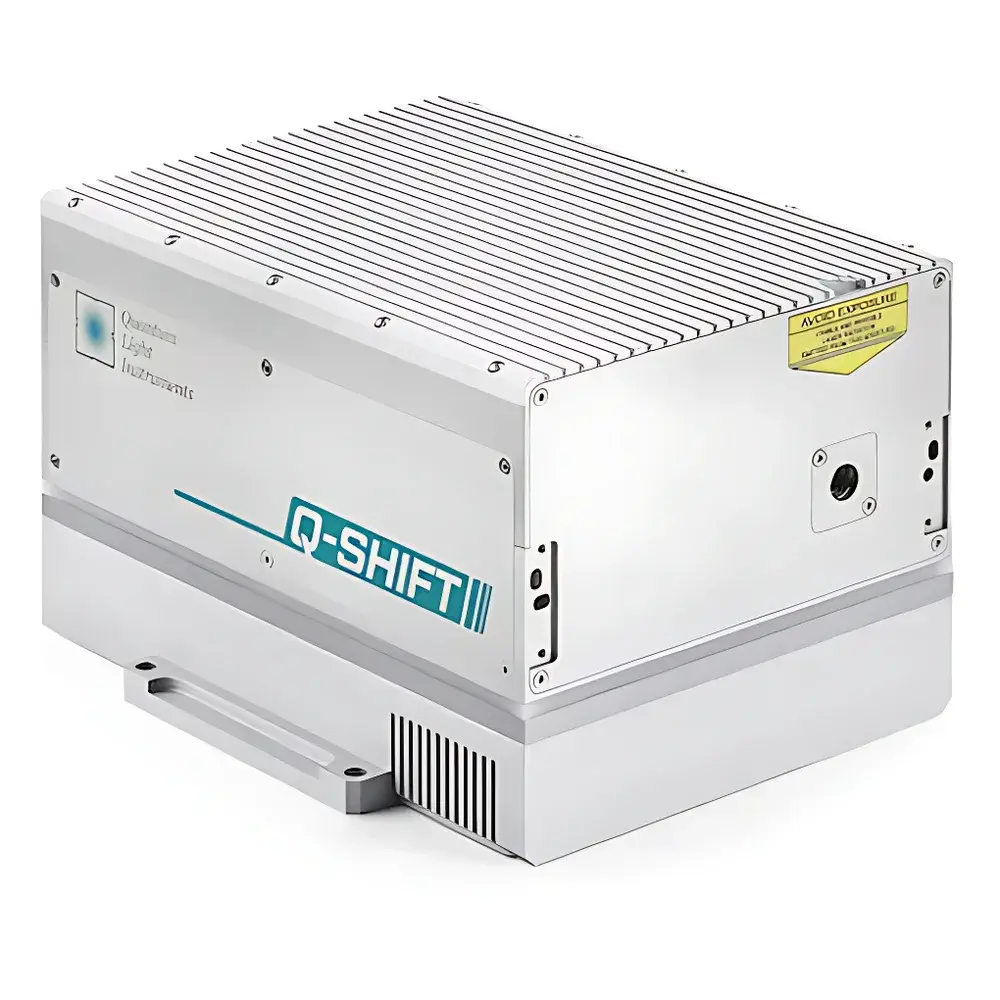
Quantum Light Instruments Q-SHIFT Series Nanosecond Q-Switched Lasers with Integrated Nonlinear Wavelength Conversion
| Brand | Auniontech (Distributor) |
|---|---|
| Origin | Lithuania |
| Laser Type | Diode-Pumped Solid-State Q-Switched Laser |
| Pulse Duration | 2–5 ns |
| Repetition Rate | Up to 100 Hz |
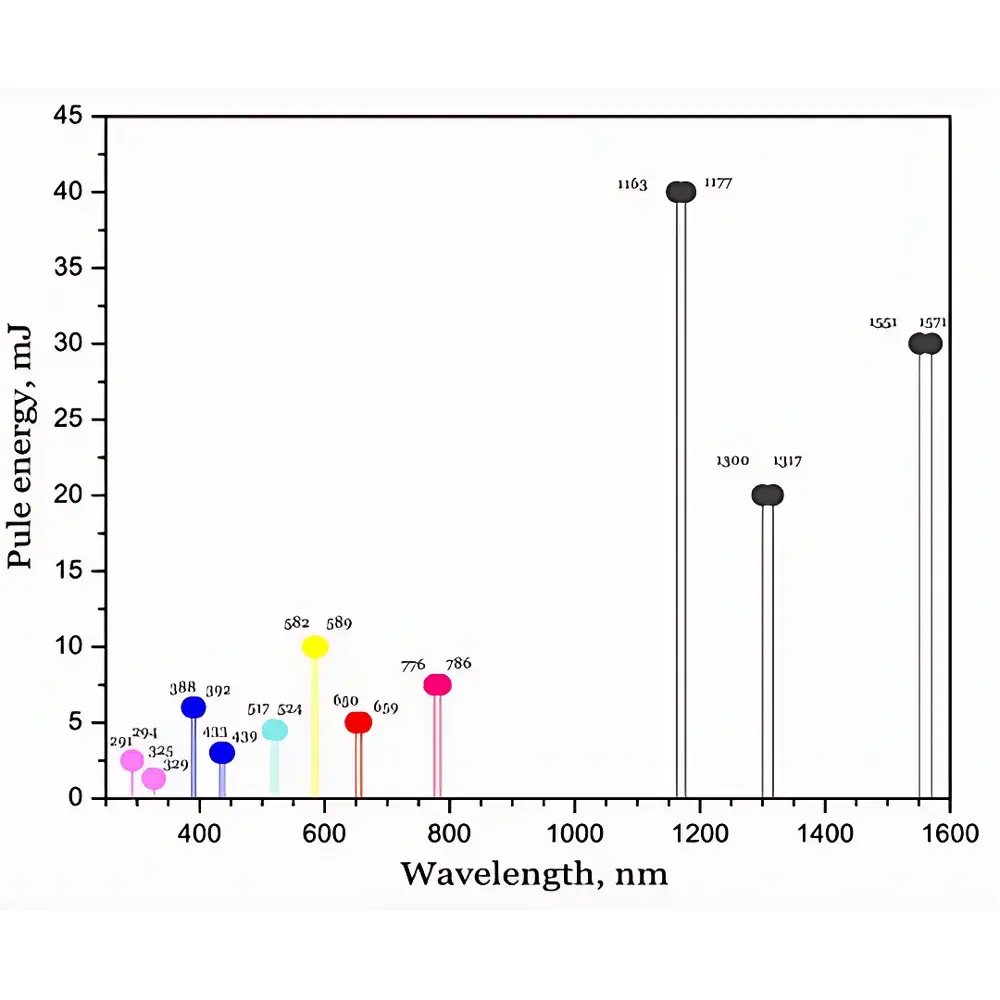
| Pulse Energy | Up to 40 mJ (1163/1177 nm), 20 mJ (1300/1317 nm), 30 mJ (1551/1571 nm) |
| Average Power | Up to 1 W |
| Cooling | Air-Cooled |
| Pump Diode Lifetime | >2 Gshots |
| Optional Harmonic Generators | SHG, THG, FHG (H-SMART series) |
| Compliance | CE, RoHS, IEC 60825-1:2014 Class 4 Laser Product |
Overview
The Quantum Light Instruments Q-SHIFT Series is a family of diode-pumped, solid-state, nanosecond Q-switched lasers engineered for high-stability spectral output beyond conventional Nd:YAG/Nd:YLF fundamental wavelengths. Unlike standard Q-switched systems limited to 1064 nm, 532 nm, or 355 nm, the Q-SHIFT integrates intracavity or external nonlinear optical conversion stages—such as optical parametric oscillation (OPO) and harmonic generation—to deliver precisely tunable, high-peak-power pulses at non-standard infrared, visible, and deep-UV wavelengths. The system is built upon the Q2 or Q2HE platform, leveraging robust flashlamp- or diode-pumped Nd:YAG/Nd:YLF oscillator architectures. Its core design enables deterministic wavelength selection across three primary bands: 1163/1177 nm (mid-IR), 1300/1317 nm (eye-safe IR), and 1551/1571 nm (telecom-band compatible), each convertible via cascaded nonlinear crystals into harmonics (e.g., 581.5/588.5 nm, 388/392 nm, 650/658.5 nm, 325/329 nm, 775.5/785.5 nm). This architecture supports time-resolved photophysics, LIBS, and precision ablation where spectral specificity and pulse fidelity are critical.
Key Features
- Integrated nonlinear wavelength conversion enabling access to >15 discrete output wavelengths across UV–IR spectrum
- Pulse energy up to 40 mJ at 1163/1177 nm; scalable down to ≤2 mJ at 1551/1571 nm with proportional harmonic yield
- Adjustable repetition rate from single-shot to 100 Hz (model-dependent), supporting both high-throughput processing and low-duty-cycle spectroscopic acquisition
- Consistent pulse width of 2–5 ns (FWHM) with <±5% shot-to-shot temporal jitter, verified via fast photodiode + oscilloscope calibration traceable to NIST standards
- Air-cooled thermal management—no recirculating chiller required—reducing footprint, power consumption, and operational complexity
- Long-lifetime pump diodes rated for >2 billion shots under nominal operating conditions, minimizing scheduled maintenance intervals
- Modular mechanical interface compliant with ISO 3040 (M6/M8 tapped holes) and kinematic mounting options for beam path integration
Sample Compatibility & Compliance
The Q-SHIFT laser system is designed for use with optically transparent, semi-transparent, and scattering samples in research and industrial environments. Its eye-safe variants (1300/1317 nm) meet ANSI Z136.1-2022 and IEC 60825-1:2014 requirements for Class 1M/Class 4 operation depending on collimation and beam delivery configuration. All models comply with EU Directive 2014/30/EU (EMC) and 2011/65/EU (RoHS). When integrated with H-SMART harmonic modules, full system alignment and safety interlock chains conform to EN 60825-1 Annex D for multi-stage laser sources. For regulated applications—including medical device prototyping and GLP-compliant LIBS analysis—the laser’s internal event logging (pulse count, temperature, diode current) supports audit-ready data capture when paired with third-party DAQ systems.
Software & Data Management
The Q-SHIFT operates via RS-232 or USB 2.0 serial interface using ASCII command protocol, enabling seamless integration with LabVIEW, MATLAB, Python (PySerial), or custom C++ control suites. Firmware supports programmable delay triggering (TTL sync input/output), burst-mode sequencing, and real-time pulse energy monitoring (via internal photodiode feedback loop). While no proprietary GUI is bundled, Quantum Light Instruments provides documented API specifications and sample scripts for automated wavelength mapping, energy stabilization loops, and interlock state polling. All operational parameters—including repetition rate, Q-switch delay, and harmonic selector position—are stored in non-volatile memory and survive power cycling. For FDA 21 CFR Part 11 compliance in regulated labs, timestamped log files (CSV format) can be exported externally; electronic signatures and audit trails require integration with validated LIMS or ELN platforms.
Applications
- Laser-induced breakdown spectroscopy (LIBS) requiring wavelength-specific plasma excitation at 1163 nm (enhanced carbon detection) or 1317 nm (reduced water absorption in biological tissue)
- Time-resolved fluorescence lifetime imaging (FLIM) and pump-probe spectroscopy using sub-5 ns pulses at 388 nm or 325 nm for UV-excited chromophores
- Micro-defect repair in TFT-LCD panels via selective absorption at 581.5 nm (CuInGaSe₂ layer resonance)
- Non-invasive ophthalmic treatments (e.g., selective retinal therapy) using 1300 nm pulses with minimal melanin absorption and high water transmission
- Eye-safe LiDAR development at 1317 nm and 1551 nm, compatible with InGaAs detector arrays and atmospheric transmission windows
- Ultrafast material processing of polymers and thin-film solar cells where 291 nm (4th harmonic of 1163 nm) enables high-resolution ablation without thermal diffusion
FAQ
What nonlinear conversion schemes are implemented in the Q-SHIFT platform?
The Q-SHIFT employs intracavity optical parametric generation (OPG) followed by cavity-dumped sum-frequency mixing to achieve its primary wavelengths. Harmonic outputs are generated externally using angle-tuned BBO, LBO, or CLBO crystals in the H-SMART module series.
Is the 1163 nm / 1177 nm output spectrally narrowed?
Yes—standard units include a 0.3 nm bandwidth etalon filter; optional ultra-narrow (<0.05 nm) line narrowing is available via birefringent tuning elements.
Can the Q-SHIFT operate in CW-seeded or injection-locked mode?
No—this is a passively or actively Q-switched oscillator-only platform; it does not support external seeding or master-oscillator power-amplifier (MOPA) configurations.
What is the beam quality (M²) specification across all wavelengths?
Fundamental IR outputs exhibit M² < 1.3 (typical); harmonic beams degrade progressively—M² ≈ 1.5 at 532 nm equivalent, M² ≈ 2.1 at 291 nm—due to thermal lensing and crystal homogeneity limits.
Does the system support external Q-switch triggering with user-defined timing?
Yes—TTL-compatible Q-switch input accepts 5 V CMOS signals with <10 ns rise time; minimum inter-pulse interval is 10 ms at 100 Hz operation.




