
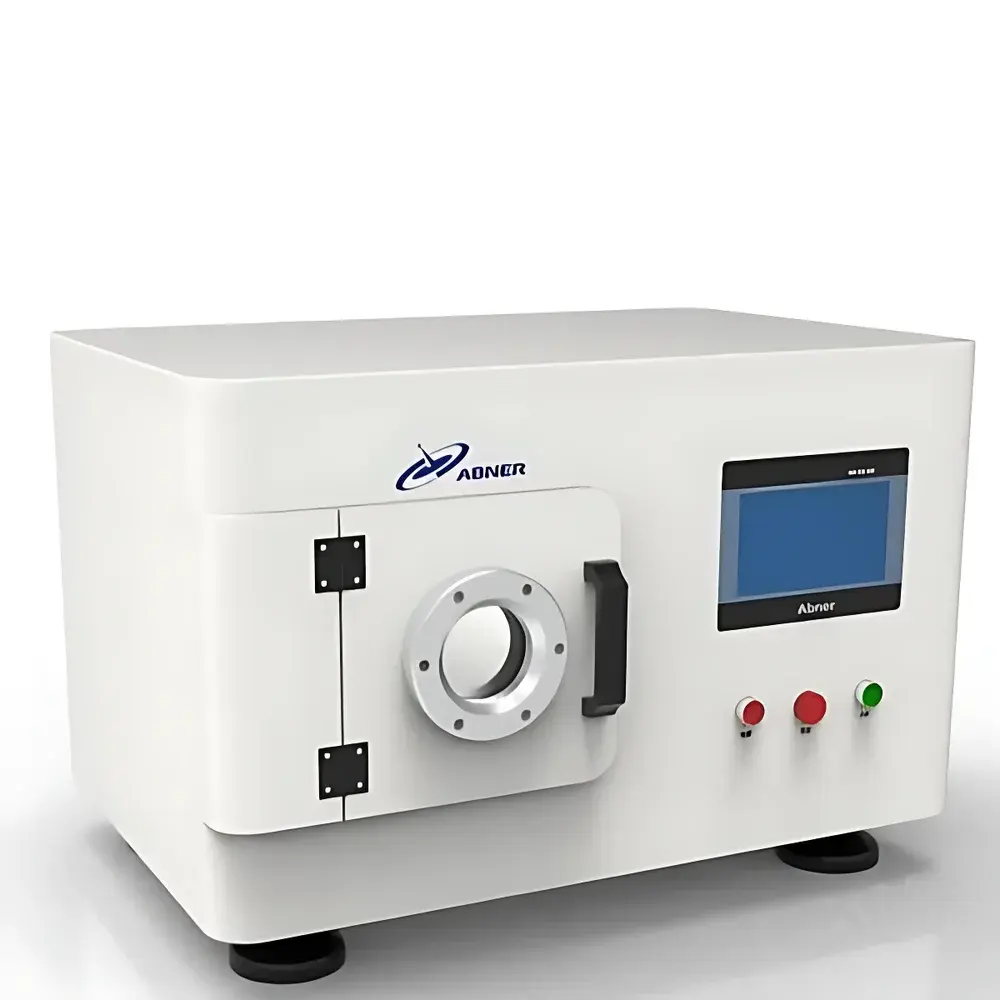
Quartz Vacuum Plasma Cleaner ABN-PCM-001
| Brand | Abner |
|---|---|
| Origin | Jiangsu, China |
| Model | ABN-PCM-001 |
| Instrument Type | Benchtop Low-Temperature RF Plasma Surface Treater |
| Working Gases | Dual-Channel (Ar, O₂, N₂, H₂, CF₄ compatible) |
| Control Method | Dual-Independent Mass Flow Control |
| Chamber Material | Fused Quartz |
| Vacuum System | Integrated Rotary Vane Pump (Ultimate Pressure ≤ 5 × 10⁻² mbar) |
| RF Power Supply | 13.56 MHz, 0–100 W Adjustable |
| Chamber Volume | 8 L |
| Operating Temperature | Ambient to 60 °C (non-thermal plasma regime) |
Overview
The Abner ABN-PCM-001 Quartz Vacuum Plasma Cleaner is a benchtop low-temperature radiofrequency (RF) plasma surface treatment system engineered for precision cleaning, activation, and functionalization of solid substrates under controlled vacuum conditions. It operates on the principle of capacitively coupled RF plasma generation (13.56 MHz), where process gases—such as argon, oxygen, nitrogen, hydrogen, or fluorinated mixtures—are ionized within a fused quartz chamber to produce reactive species (ions, electrons, radicals, and UV photons). These species interact physically and chemically with surface contaminants—including organic residues, hydrocarbons, native oxides, and adsorbed moisture—without thermal damage to temperature-sensitive substrates. Unlike wet chemical methods, this dry, solvent-free process eliminates rinse-induced particulates, interfacial stress, and hazardous waste streams. The ABN-PCM-001 is optimized for laboratory-scale R&D, pre-deposition surface conditioning, and quality-critical sample preparation in environments requiring high reproducibility and traceable process control.
Key Features
- Fused quartz reaction chamber: Ensures optical transparency for in-situ process observation, excellent RF coupling uniformity, and exceptional resistance to plasma erosion and chemical corrosion.
- Dual-channel mass flow controller (MFC): Enables independent, real-time regulation of two process gases with proportional mixing capability—critical for tuning plasma chemistry (e.g., O₂/Ar for oxidation, H₂/Ar for reduction).
- 13.56 MHz RF generator with 0–100 W power range: Delivers stable, low-power plasma suitable for delicate substrates (e.g., polymers, 2D materials, biofunctionalized surfaces) while maintaining high ion density and radical flux.
- Integrated vacuum system: Rotary vane pump achieves base pressure ≤ 5 × 10⁻² mbar; chamber pressure is continuously monitored and adjustable between 0.1–10 Pa during operation.
- Touchscreen HMI interface: Displays real-time parameters (power, pressure, gas flow rates, treatment time), supports recipe storage (up to 20 user-defined protocols), and provides event logging with timestamping.
- Ambient-temperature operation: No external heating required; surface temperature rise remains < 15 °C during typical 60–300 s treatments—validated per ASTM F2614 for thermal sensitivity assessment.
Sample Compatibility & Compliance
The ABN-PCM-001 accommodates substrates up to Ø150 mm (6-inch wafers) and thicknesses ≤ 25 mm, including rigid (Si/SiO₂ wafers, fused silica optics, stainless steel coupons), flexible (PET, PI, PDMS), and biologically relevant surfaces (tissue culture polystyrene, glass slides, Ti-6Al-4V implants). Chamber geometry supports planar, curved, and patterned topographies with consistent plasma exposure. The system complies with IEC 61000-6-3 (EMC emissions) and IEC 61000-6-2 (immunity). While not certified for GMP production, its parameter logging, password-protected settings, and audit-ready operation logs align with GLP documentation requirements. Process validation can be performed per ISO 13485 Annex C for medical device surface modification and USP guidelines for analytical instrument qualification.
Software & Data Management
The embedded control firmware records all operational parameters—including RF forward/reflected power, chamber pressure, MFC setpoints and actual flows, elapsed time, and system status flags—at 1 Hz resolution. Data are exportable via USB to CSV format for post-processing in MATLAB, Python (Pandas), or statistical analysis platforms. Optional Ethernet connectivity enables remote monitoring and integration into LabArchives or ELN systems. All user actions (login, recipe selection, start/stop commands) are timestamped and attributed, satisfying basic FDA 21 CFR Part 11 requirements for electronic records when paired with institutional IT governance policies.
Applications
- Semiconductor & MEMS fabrication: Native oxide removal prior to ALD/PECVD, photoresist descumming, sidewall passivation of etched features.
- Optical coating preparation: Cleaning of anti-reflection coated lenses, laser cavity mirrors, and interferometric substrates to reduce scatter and improve adhesion of subsequent thin films.
- Biomaterial surface engineering: Increasing hydrophilicity of PDMS microfluidic channels, enhancing protein adsorption on ELISA plates, and activating Ti implants for improved osseointegration.
- Advanced materials research: Edge-functionalization of graphene and MoS₂ monolayers, surface grafting of silanes on silica nanoparticles, and defect healing in perovskite thin films.
- Adhesion promotion: Pre-treatment of polyolefins (PP, PE), composites, and thermoplastics prior to plasma spray coating, adhesive bonding, or inkjet printing—validated per ASTM D2093 and ISO 8510-2.
FAQ
What vacuum level is required for stable plasma ignition?
Stable capacitive RF plasma ignition occurs reliably at pressures between 0.5–5 Pa; optimal cleaning uniformity is achieved at 1.5–3 Pa using Ar/O₂ mixtures.
Can the system operate with reactive gases like CF₄ or SF₆?
Yes—provided appropriate gas handling accessories (corrosion-resistant MFCs, stainless steel lines, and exhaust scrubbing) are installed per local safety regulations.
Is quartz chamber cleaning required between runs?
No routine cleaning is needed; residual polymer deposits are removed in situ during O₂ plasma cycles. Quartz transparency degradation is monitored visually and replaced only after >2,000 h cumulative operation.
How is process repeatability ensured across different operators?
By enforcing recipe-based operation, disabling manual parameter overrides outside administrator mode, and archiving all run logs with operator ID and timestamp.
Does the system support automated batch processing?
Not natively—the ABN-PCM-001 is designed for single-batch R&D use. For sequential processing, manual loading/unloading between cycles is required; integration with robotic handlers necessitates custom API development and third-party motion control hardware.



