
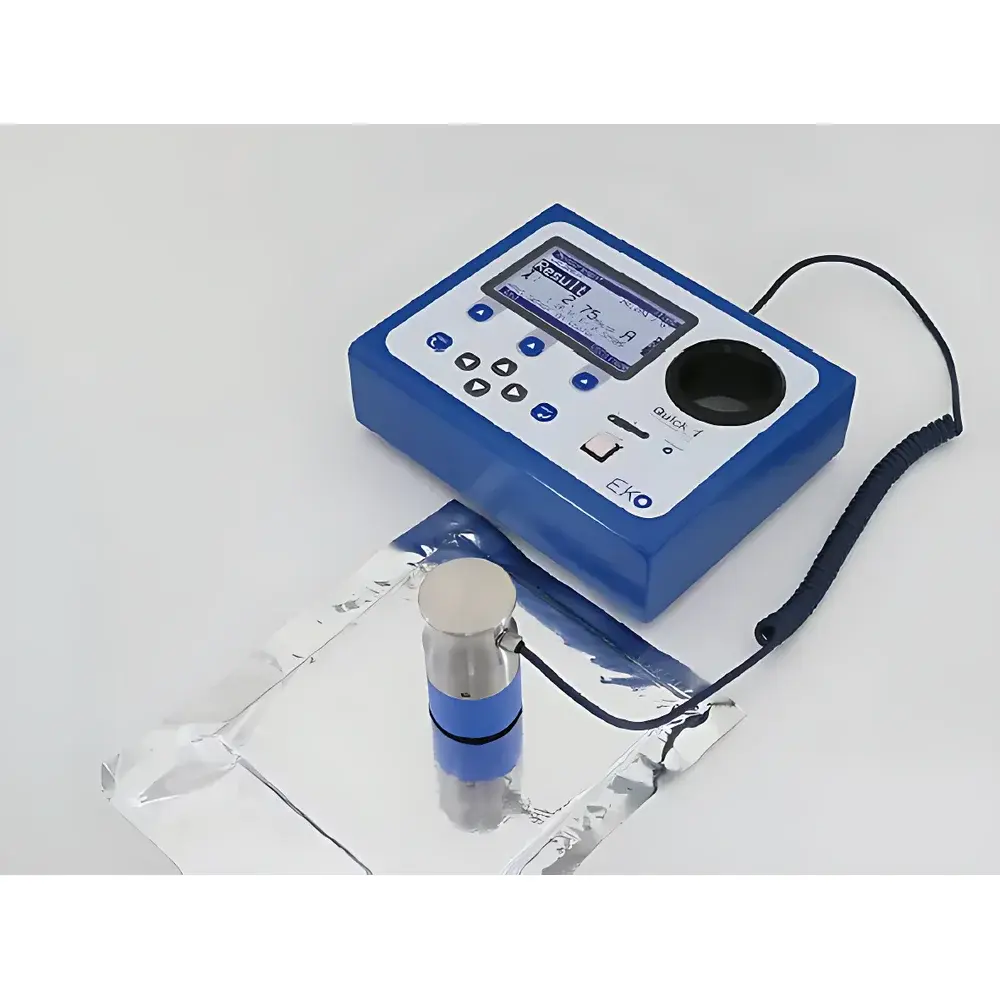
QUICK 1 Portable Thermal Conductivity Analyzer
| Origin | Germany |
|---|---|
| Manufacturer Type | Authorized Distributor |
| Origin Category | Imported |
| Model | QUICK 1 |
| Pricing | Upon Request |
| Thermal Conductivity Range (VIP samples) | 0.001–0.015 W/(m·K) |
| Thermal Conductivity Range (Homogeneous samples) | 0.03–10.0 W/(m·K) |
| Repeatability (VIP) | ±5% or ±0.001 W/(m·K), whichever is greater |
| Repeatability (Homogeneous) | ±5% |
| Accuracy | Traceable to NIST-traceable reference standards |
| Operating Temperature | +5 °C to +40 °C |
| Measurement Time | ≤60 s per sample |
| Data Storage Capacity | 99 measurements |
| Power Supply | AC adapter, 100–240 V AC, 50/60 Hz |
| Dimensions | 250 × 200 × 90 mm |
| Weight | 4 kg |
Overview
The QUICK 1 Portable Thermal Conductivity Analyzer is a compact, handheld instrument engineered for rapid, non-destructive thermal conductivity assessment of solid and composite materials under ambient laboratory or field conditions. It operates on the transient plane source (TPS) method—a standardized technique defined in ISO 22007-2—where a dual-function sensor acts simultaneously as both heat source and temperature detector. A controlled current pulse generates a localized temperature rise; the resulting thermal response is recorded with microsecond resolution, enabling calculation of thermal conductivity via analytical solution of the heat diffusion equation. Designed specifically for quality control, R&D screening, and incoming material verification, the QUICK 1 delivers traceable, repeatable results without requiring sample cutting, surface polishing, or vacuum chambers—making it uniquely suited for on-site evaluation of vacuum insulation panels (VIPs), elastomers, technical ceramics, float glass, aluminum alloys, and other thermally heterogeneous or low-conductivity substrates.
Key Features
- Single-shot measurement capability: Full thermal conductivity determination completed within ≤60 seconds, minimizing throughput bottlenecks in high-volume testing environments.
- Dual-range sensor architecture: Automatically adapts measurement sensitivity and excitation power to accommodate both ultra-low-conductivity VIPs (0.001–0.015 W/(m·K)) and high-conductivity metals (up to 10.0 W/(m·K)), eliminating manual range switching.
- Integrated pass/fail evaluation mode (G/NG): Enables real-time compliance verification against user-defined specification limits—ideal for production line go/no-go decisions.
- NIST-traceable calibration support: Supplied with certified reference materials (e.g., Pyroceram® 9606, copper, and expanded polystyrene blocks) and documented uncertainty budgets compliant with ISO/IEC 17025 requirements.
- Robust mechanical design: IP52-rated enclosure, shock-absorbing housing, and reinforced sensor probe tip ensure operational reliability during transport and repeated field use.
Sample Compatibility & Compliance
The QUICK 1 accommodates flat, solid specimens ≥25 mm × 25 mm × 3 mm (minimum thickness), including flexible VIPs with metallized barrier films, vulcanized rubber sheets, sintered alumina tiles, annealed soda-lime glass, and extruded aluminum profiles. Surface roughness must not exceed Ra 10 µm; no clamping or thermal interface paste is required due to the instrument’s self-loading contact mechanism. All measurements conform to ASTM D5470 (thermal transmission properties of thermally conductive electrical insulation materials) and ISO 22007-2 (plastics—determination of thermal conductivity and thermal diffusivity—Part 2: Transient plane heat source method). Device firmware supports audit trail logging and user access control, aligning with GLP and GMP documentation requirements per FDA 21 CFR Part 11 when used in regulated manufacturing settings.
Software & Data Management
The QUICK 1 interfaces via USB-C to the proprietary QUICKView PC software (Windows 10/11 compatible), which provides full data visualization, statistical analysis (mean, SD, CV%), batch reporting, and PDF export with embedded metadata (operator ID, timestamp, environmental conditions, calibration certificate ID). Raw time-temperature curves are stored in .csv format for third-party modeling. The onboard memory retains up to 99 measurement records with timestamps and operator tags; all entries include checksum validation to prevent data corruption. Software updates and calibration certificate renewals are delivered through a secure, password-protected vendor portal—no internet connectivity required during routine operation.
Applications
- Quality assurance of vacuum insulation panels in cold-chain packaging and building envelope systems.
- Rapid screening of thermal interface materials (TIMs) and elastomeric gaskets in electronics thermal management.
- Batch-to-batch consistency verification of ceramic substrates used in high-power LED modules and semiconductor packaging.
- Incoming inspection of architectural glazing and insulated glass units (IGUs) for compliance with EN 673 and ISO 10292.
- Material substitution studies in automotive lightweighting programs involving aluminum-matrix composites and polymer-metal hybrids.
FAQ
Does the QUICK 1 require periodic recalibration?
Yes—annual recalibration against certified reference standards is recommended and supported by accredited calibration laboratories in Europe and North America. Calibration certificates include measurement uncertainty statements compliant with ISO/IEC 17025.
Can the QUICK 1 measure anisotropic materials such as fiber-reinforced composites?
It provides bulk thermal conductivity values perpendicular to the sample surface. For directional characterization, orthogonal measurements on cut cross-sections are advised, though the device does not resolve in-plane vs. through-plane anisotropy intrinsically.
Is the sensor probe replaceable in the field?
Yes—the TPS sensor module is a user-swappable component with factory pre-alignment; replacement requires no tools and takes <90 seconds.
What environmental conditions affect measurement accuracy?
Ambient temperature fluctuations >±2 °C during measurement may introduce drift; the device includes internal thermal stabilization but assumes stable lab-grade conditions (ISO 29553). Relative humidity should remain below 80% RH non-condensing.
How is traceability to international standards maintained?
Each QUICK 1 ships with a calibration report referencing NIST SRM 1470a (Pyroceram) and SRM 2457 (copper), with uncertainty contributions from sensor geometry, timing electronics, and thermal contact resistance explicitly quantified.



