
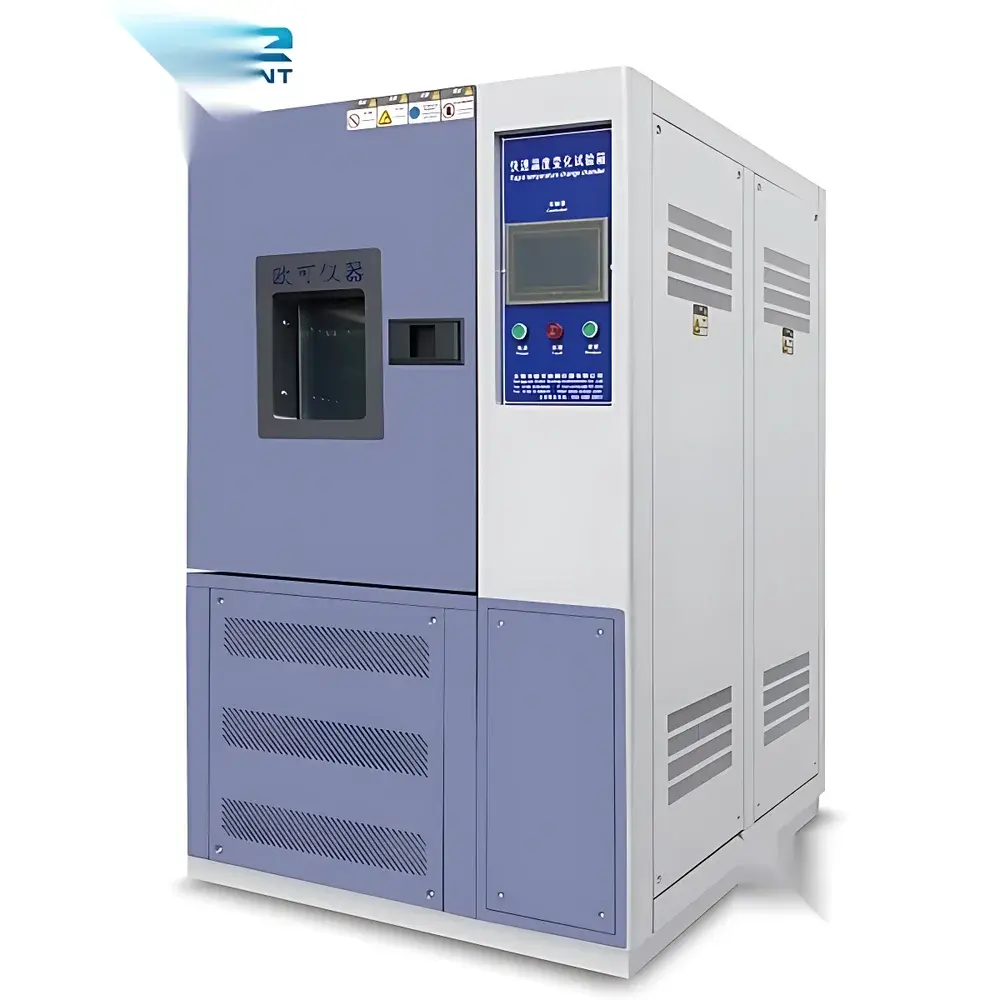
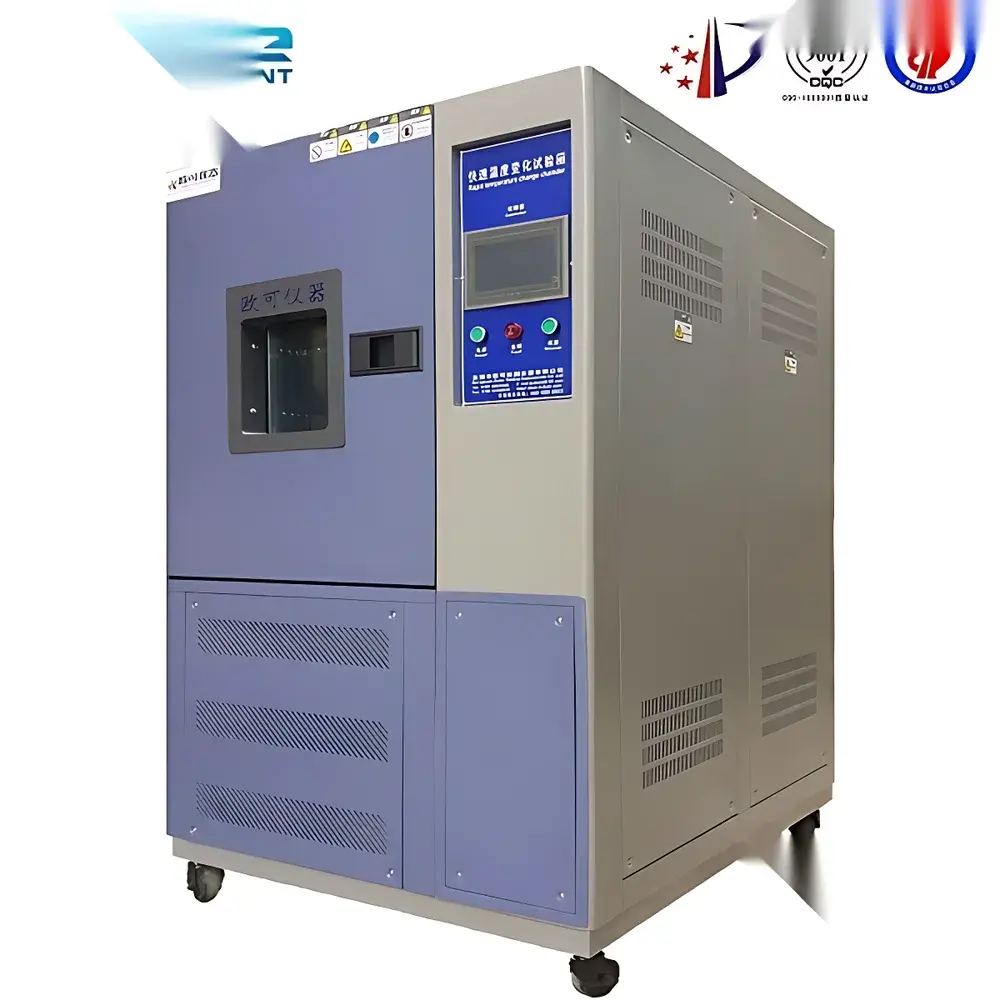
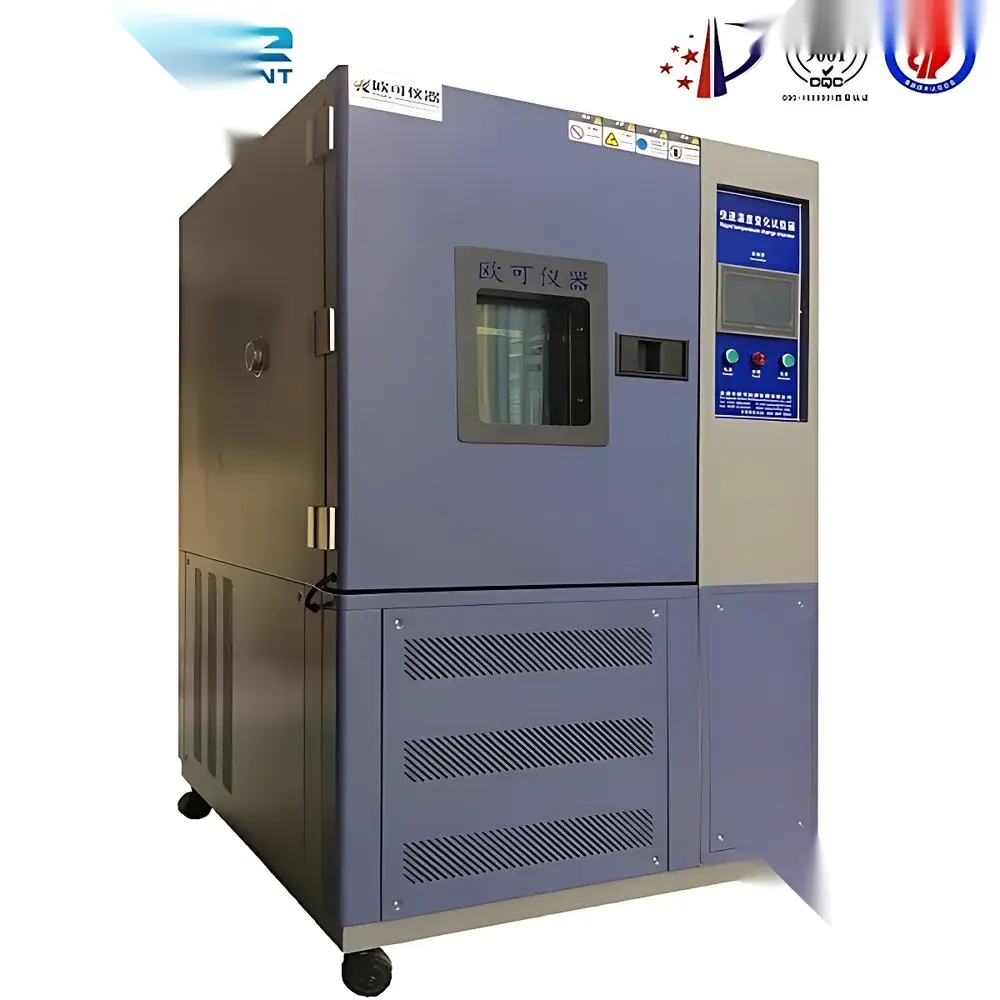
Quick-Temperature-Change Environmental Test Chamber
| Brand | Other Brands |
|---|---|
| Origin | Imported |
| Manufacturer Type | General Distributor |
| Price | USD 2,700 (FOB, ex-works |
| Temperature Range | –70 °C to +180 °C |
| Ramp Rate | Up to 15 °C/min (typical, dependent on load and chamber volume) |
| Internal Construction | SUS304 Stainless Steel |
| External Construction | Cold-Rolled Steel with Powder-Coated Finish |
| Insulation | High-Density Polyurethane Foam (≥100 mm thickness) |
| Cooling System | Water-Cooled |
| Compressor | Tecumseh (France) or Bitzer (Germany) |
| Power Supply | AC 380 V, 3-phase 5-wire, 50/60 Hz |
| Weight | 950–2300 kg (model-dependent) |
Overview
The Quick-Temperature-Change Environmental Test Chamber is an engineered climatic simulation system designed for accelerated thermal stress testing of electronic components, automotive modules, aerospace subsystems, and industrial materials. It operates on the principle of forced-air convection combined with a high-efficiency refrigeration cycle, enabling precise, repeatable, and programmable transitions between extreme temperature extremes. Unlike standard thermal chambers, this system implements dynamic PID control with adaptive gain scheduling—specifically optimized for non-steady-state thermal transients—ensuring stable ramp rate fidelity across the full operating range (–70 °C to +180 °C). Its architecture complies with the thermal test requirements defined in IEC 60068-2-1 (Cold), IEC 60068-2-2 (Dry Heat), IEC 60068-2-14 (Change of Temperature), MIL-STD-810H Method 503.5, and GJB 150.3A–2009 / GJB 150.4A–2009. The chamber is validated per GB/T 10589–2008 (Low-Temperature Test Chambers) and GB/T 10586–2006 (Humidity Test Chambers), with thermal performance verified against GB/T 2423.1–2023 and GB/T 2423.2–2023.
Key Features
- Multistage variable-speed air circulation system with optimized duct geometry and laminar flow diffusers—enabling uniform temperature distribution (±1.5 °C at 100 L/min airflow, per IEC 60068-3-5)
- Adaptive ramp-rate control: user-selectable linear or nonlinear temperature profiles with continuous adjustment from 1 °C/min to 15 °C/min (no step-change limitation)
- Dynamic PID algorithm with real-time thermal inertia compensation—maintains setpoint tracking accuracy within ±0.3 °C during transient phases
- Touchscreen programmable controller (7″ TFT-LCD) with built-in data logging (10,000-point memory), RS232/RS485 interface, and optional Ethernet module for remote monitoring
- Energy-optimized refrigeration circuit featuring dual-stage compression, hot-gas bypass modulation, and intelligent compressor load management—reducing power consumption by up to 22% versus fixed-capacity systems
- Redundant safety architecture: high/low refrigerant pressure switches, overtemperature cutout (mechanical & electronic), phase failure detection, water flow interlock, and audible/visual fault indication
- Modular split-system design: separate refrigeration unit and chamber body—facilitating installation in constrained lab spaces and simplifying logistics for large-volume models
Sample Compatibility & Compliance
The chamber accommodates test specimens up to 1.2 m³ (customizable internal volumes available), with standard configurations supporting payloads up to 50 kg under rapid thermal cycling conditions. It meets ISO/IEC 17025 calibration traceability requirements when operated with NIST-traceable reference sensors. All electrical interfaces comply with IEC 61000-4-2 (ESD immunity) and IEC 61000-4-3 (radiated RF immunity). For regulated industries, the controller firmware supports audit trail generation, user access levels (admin/operator/guest), and electronic signature capability—aligning with FDA 21 CFR Part 11 and EU Annex 11 expectations for GxP environments. Humidity control is not integrated; this model is strictly a dry thermal cycling platform, eliminating condensation-related artifacts during rapid transitions.
Software & Data Management
The embedded controller runs proprietary firmware compliant with IEC 62443-3-3 cybersecurity principles. Data export is supported via CSV over USB or serial link. Optional PC-based software (Windows 10/11 compatible) provides real-time graphing, multi-channel trend analysis, alarm history review, and automated report generation (PDF/Excel). All logged data includes timestamp (UTC), chamber sensor readings (Tc, Ts, ΔT), setpoint trajectory, and system status flags—enabling full test reproducibility and root-cause analysis per ISO 9001 clause 8.5.2. Raw data files are stored with SHA-256 checksums to ensure integrity verification.
Applications
This chamber is routinely deployed in reliability engineering labs for HALT (Highly Accelerated Life Testing), thermal shock screening per JEDEC JESD22-A104, solder joint fatigue assessment (IPC-9701), and qualification of PCBAs under automotive AEC-Q200 stress profiles. It supports military-grade environmental stress screening (ESS) protocols, including temperature cycling per MIL-STD-2164A and burn-in validation per MIL-PRF-38534. Academic users apply it to polymer crystallinity studies, battery electrolyte stability evaluation, and MEMS package thermo-mechanical characterization.
FAQ
What is the maximum achievable temperature ramp rate for a 100 L chamber loaded with a 20 kg aluminum mass?
Typical ramp rates under that condition range from 8–12 °C/min, depending on starting/ending temperatures and ambient cooling water supply stability.
Does the system support custom thermal profiles with dwell, ramp, and hold segments?
Yes—up to 99 programmable steps per profile, with independent ramp rate, dwell time, and setpoint definition for each segment.
Is third-party calibration certification included with delivery?
Factory calibration certificate (traceable to NIM China) is provided; ISO/IEC 17025-accredited calibration is available as an optional service.
Can the chamber be integrated into a central lab monitoring network?
Yes—via optional Modbus TCP or OPC UA gateway modules, enabling SCADA integration and centralized alarm management.
What maintenance intervals are recommended for the refrigeration system?
Compressor oil and filter drier replacement every 36 months or 6,000 operational hours; annual inspection of refrigerant charge and heat exchanger cleanliness.



