
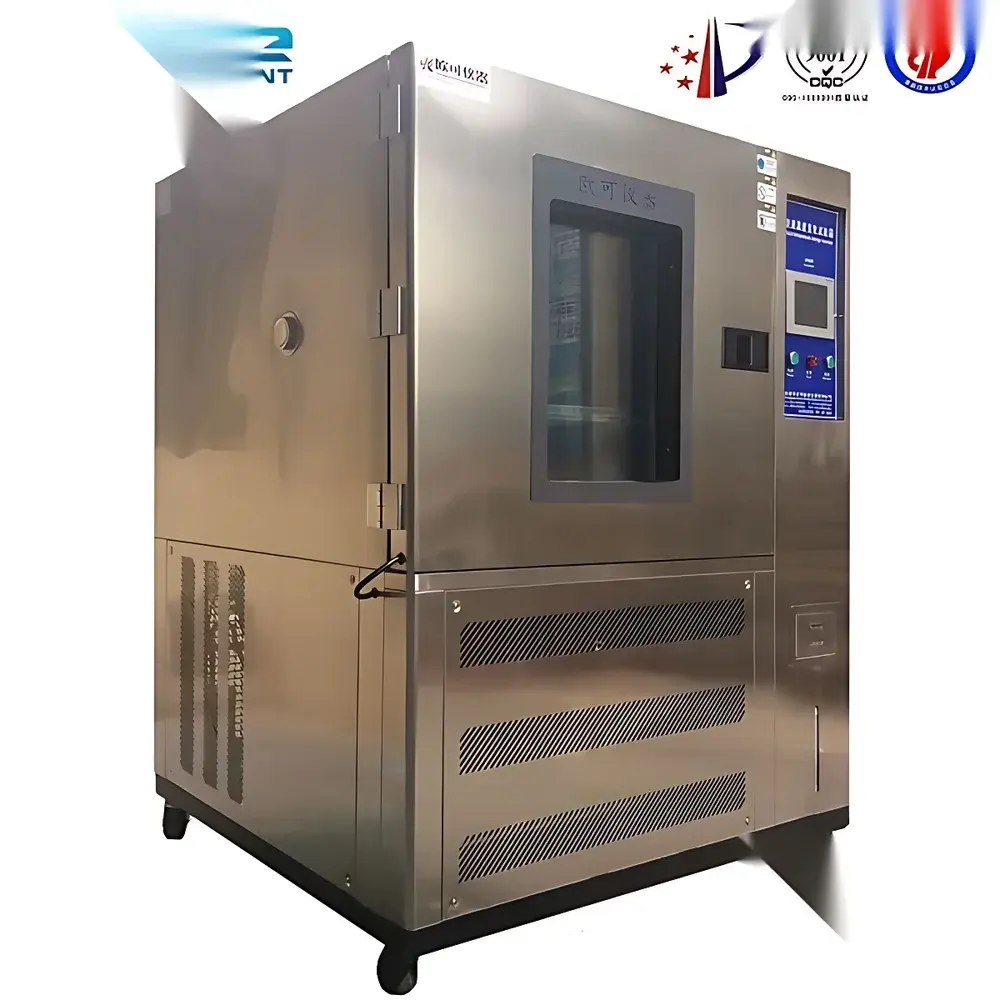
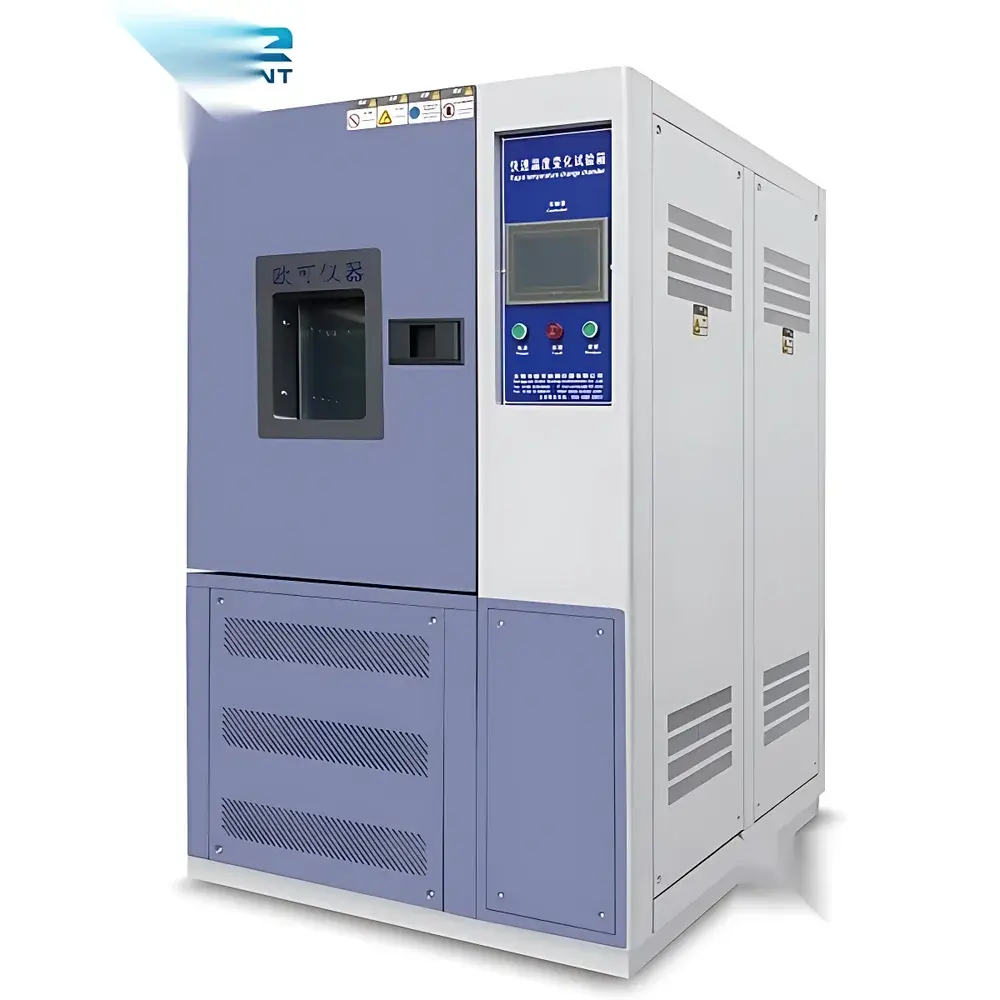
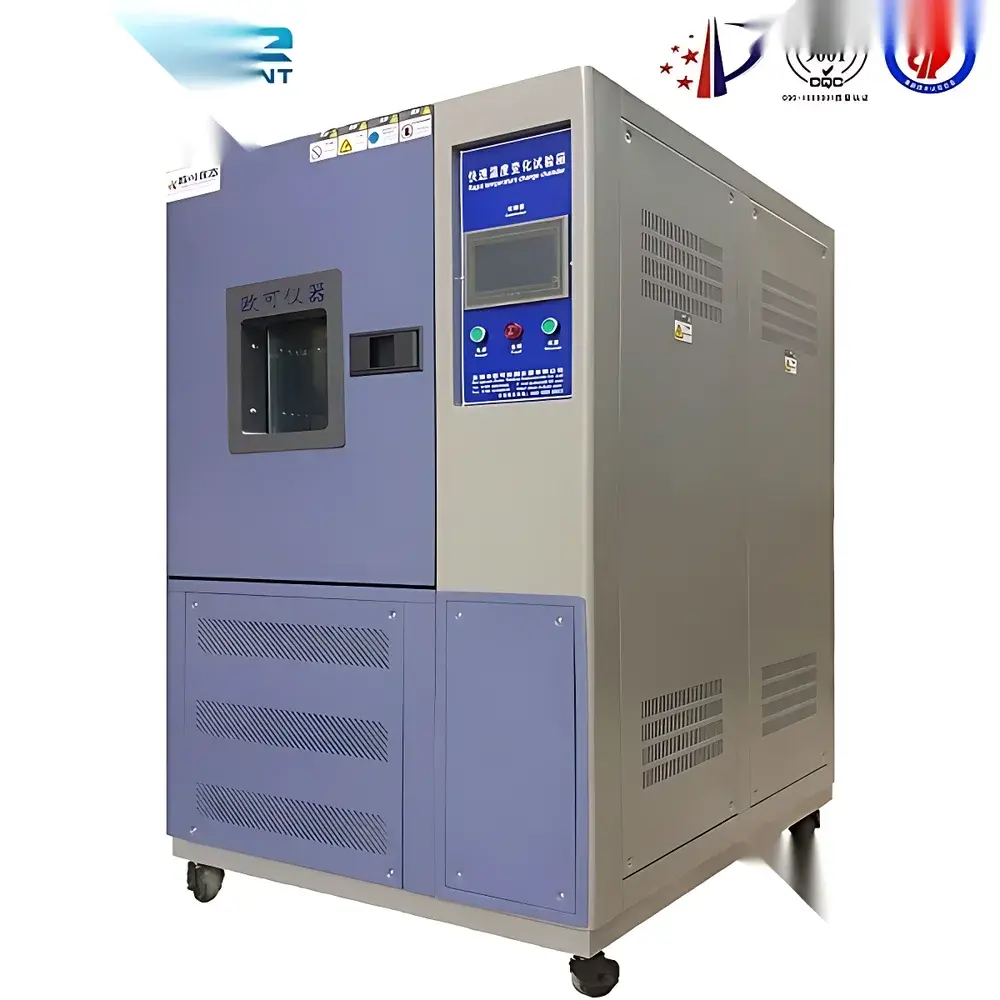
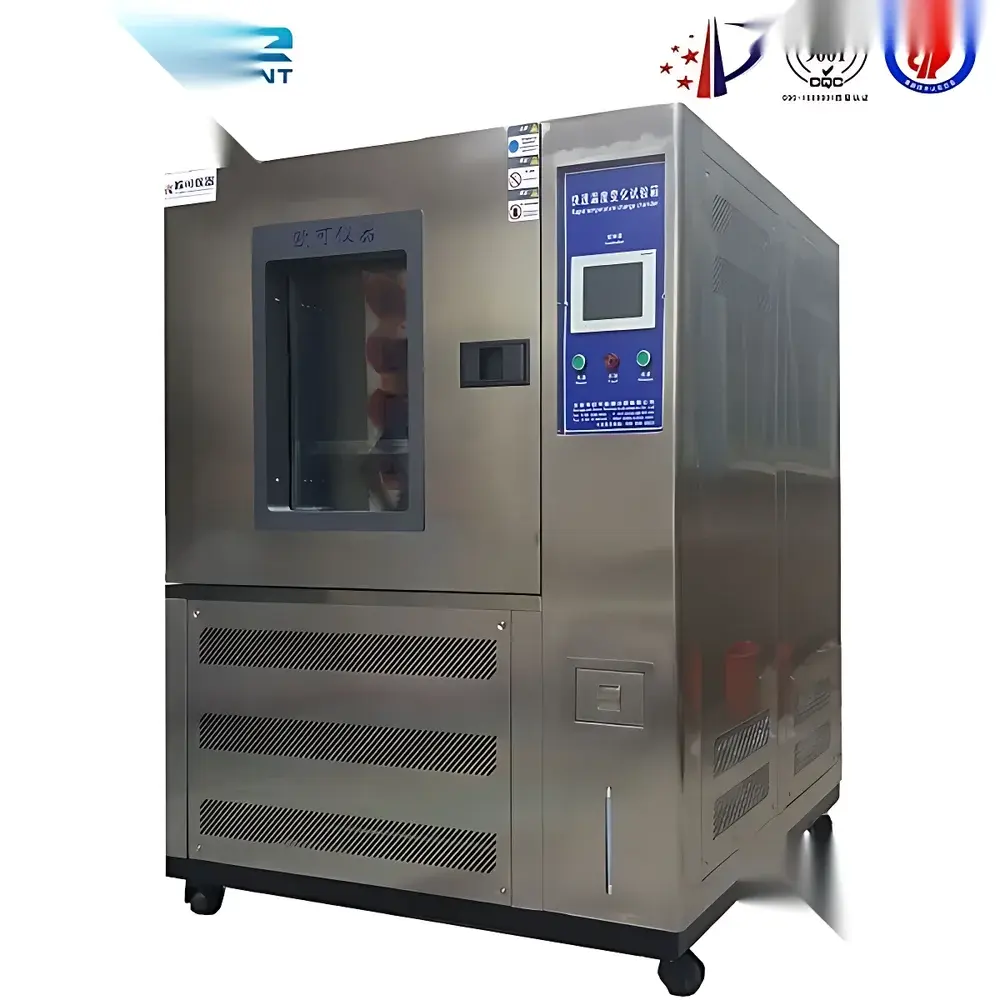
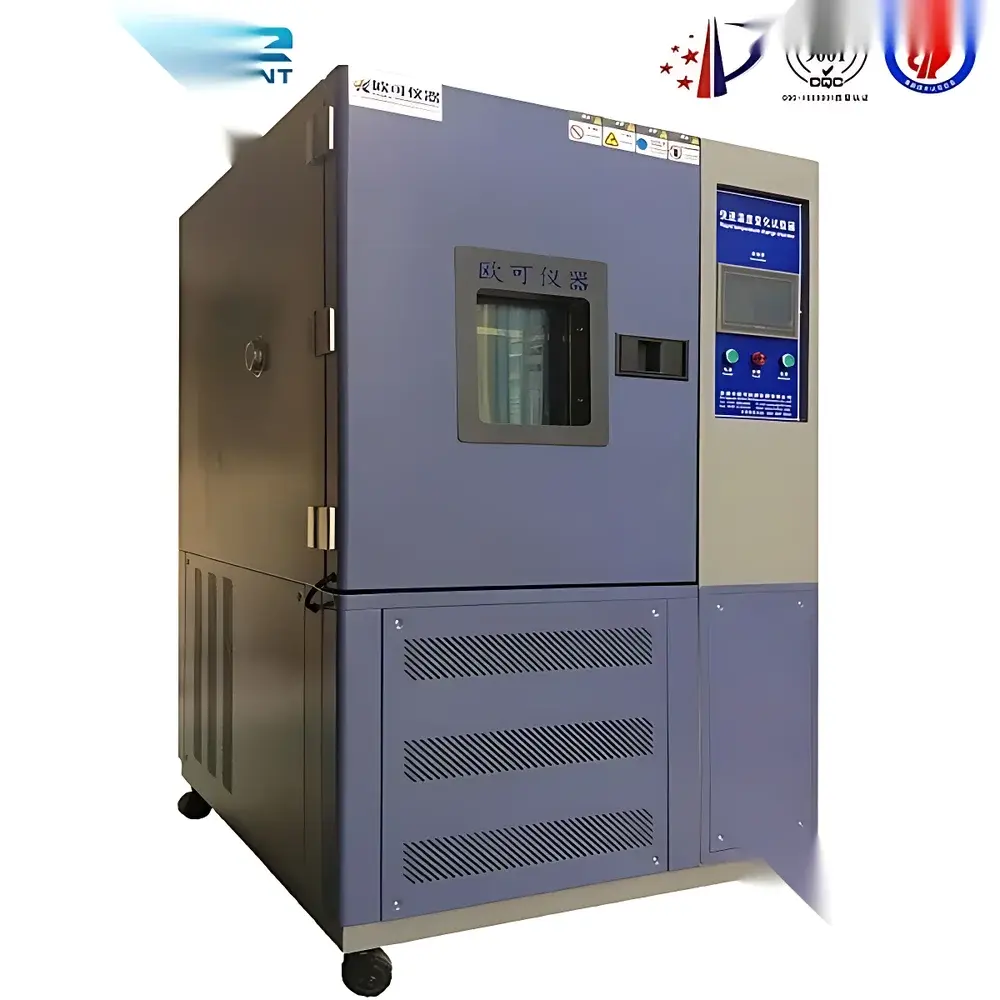
Quick-Temperature-Change Humidity & Thermal Cycling Chamber
| Brand | OEM / Custom Brand |
|---|---|
| Origin | Imported |
| Manufacturer Type | Authorized Distributor |
| Price | USD 14,000 (FOB) |
| Temperature Range | −70 °C to +150 °C |
| Humidity Range | 20–98% RH (optional: 5–98% RH) |
| Rapid Temperature Transition Rates | 5–25 °C/min (selectable) |
| Temperature Uniformity | ±2 °C |
| Temperature Stability | ±0.5 °C |
| Humidity Uniformity | ±3.0% RH (at ≥75% RH) |
| Humidity Stability | ±2.5% RH |
| Internal Dimensions (W×H×D, cm) | 50×75×60 |
| Construction Material | SUS304 Stainless Steel |
| Refrigeration System | Dual-stage cascade refrigeration with HFC-507/R23 eco-friendly refrigerants |
| Control Interface | 7-inch color LCD touch panel, bilingual (English/Chinese) |
| Power Supply | AC 380 V ±5%, 50 Hz ±0.5 Hz, 3-phase 5-wire |
| Test Port | Ø50 mm on left side wall |
| Compliance Standards | GB/T 2423.1, GB/T 2423.2, GB/T 2423.22, GJB 150.3, GJB 150.4, GB/T 10589, GB/T 11158, GB/T 10592 |
Overview
The Quick-Temperature-Change Humidity & Thermal Cycling Chamber is an engineered environmental simulation system designed for accelerated reliability testing of electronic components, automotive modules, aerospace subsystems, and high-performance materials under dynamically varying thermal and hygrothermal stress conditions. Based on dual-stage cascade refrigeration architecture and precision PID-controlled steam-humidification with direct expansion cooling, the chamber delivers repeatable, traceable, and standards-compliant thermal shock and humidity cycling profiles. Its core function is to replicate real-world operational extremes—including rapid ambient transitions (e.g., aircraft cabin pressurization cycles, outdoor electronics exposure during diurnal shifts), condensation-prone storage environments, and combined temperature-humidity aging—enabling failure mode identification, qualification validation per MIL-STD-810 or IEC 60068, and design margin verification prior to field deployment.
Key Features
- High-fidelity temperature transition capability: Programmable ramp rates from 5 °C/min up to 25 °C/min across the full operating range (−70 °C to +150 °C), enabling precise emulation of thermal shock severity levels defined in IEC 60068-2-14.
- Stable and uniform humidification: Steam generator with deionized water feed ensures consistent 20–98% RH control; optional extended range (5–98% RH) supports low-RH desiccation testing and condensation boundary mapping.
- Industrial-grade control architecture: 7-inch capacitive-touch LCD controller with embedded PLC logic, supporting up to 96 independent test programs, cycle counts from 1 to 999, and dwell durations up to 999 hours 59 minutes. All setpoints, actual values, and real-time trend curves are displayed in English or Chinese with timestamped logging.
- Robust mechanical design: Seamless SUS304 stainless steel interior with insulated double-wall construction, reinforced door gasketing, and non-corrosive chamber hardware ensure long-term dimensional stability and resistance to condensate accumulation.
- Comprehensive safety integration: Multi-layer protection includes compressor high-pressure/low-pressure cutouts, phase-sequence monitoring, overtemperature/overhumidity alarms, ground-fault circuit interruption (GFCI), and redundant thermal fuses—all independently monitored and latched via hardwired safety relays.
- Modular service access: Front-accessible refrigeration components, quick-disconnect humidifier tanks, and standardized electrical interfaces simplify preventive maintenance and reduce mean time to repair (MTTR).
Sample Compatibility & Compliance
The chamber accommodates test specimens up to 100 cm × 100 cm × 100 cm (KS-TH-1000 model), with a standard Ø50 mm external access port for signal/power cabling and in-situ sensor monitoring. It meets structural and performance requirements of multiple international and national standards, including GB/T 2423.1 (cold), GB/T 2423.2 (dry heat), GB/T 2423.22 (temperature change), GJB 150.3/150.4 (military environmental testing), and GB/T 10592 (general specification for environmental test chambers). While not certified to ISO/IEC 17025 as a calibration laboratory, its temperature and humidity sensors are calibrated traceable to NIST-equivalent national metrology institutes upon factory commissioning. Optional IQ/OQ documentation packages support GLP/GMP-regulated validation workflows.
Software & Data Management
The embedded controller records all operational parameters—including chamber air temperature, relative humidity, refrigerant pressures, heater/humidifier duty cycles, and alarm events—at user-configurable intervals (1 s to 60 min). Data export is supported via USB 2.0 to CSV format for post-processing in MATLAB, Excel, or statistical analysis platforms. Remote supervision is enabled via Ethernet (TCP/IP) using Modbus TCP protocol, allowing integration into centralized lab management systems. Audit trail functionality logs all operator actions (e.g., program edits, manual overrides, calibration resets) with user ID and timestamp—supporting compliance with FDA 21 CFR Part 11 when paired with external identity authentication infrastructure.
Applications
- Qualification testing of printed circuit board assemblies (PCBAs) per IPC-9701 for CTE-induced solder joint fatigue.
- Accelerated moisture resistance evaluation of conformal coatings and encapsulants under cyclic condensation (JESD22-A101).
- Thermal stress screening of MEMS sensors, battery packs, and power converters used in electric vehicles.
- Material compatibility studies involving polymer composites, adhesives, and optical lenses subjected to combined thermal-hygric loading.
- Environmental stress screening (ESS) for avionics line-replaceable units (LRUs) per RTCA DO-160 Section 4 and 5.
FAQ
What is the minimum dwell time between temperature transitions?
The system supports dwell times as short as 1 minute at target temperature before initiating the next ramp phase, subject to load mass and thermal inertia constraints.
Can the chamber perform non-uniform temperature profiles (e.g., gradient testing)?
No—it is optimized for uniform chamber-wide conditioning; spatial gradients require supplemental fixtures or external airflow manipulation.
Is R404A still used in current production units?
R404A has been phased out in favor of HFC-507/R23 cascade blends, compliant with EU F-Gas Regulation (EU) No 517/2014 and EPA SNAP Program requirements.
Does the controller support data encryption or role-based access control?
Basic user/password authentication is provided; advanced cybersecurity features (e.g., TLS, LDAP) require integration with third-party SCADA or MES platforms.
What is the typical recalibration interval for temperature and humidity sensors?
Annual recalibration is recommended under continuous operation; intervals may be extended to 18 months with documented in-house verification using NIST-traceable reference probes.



