
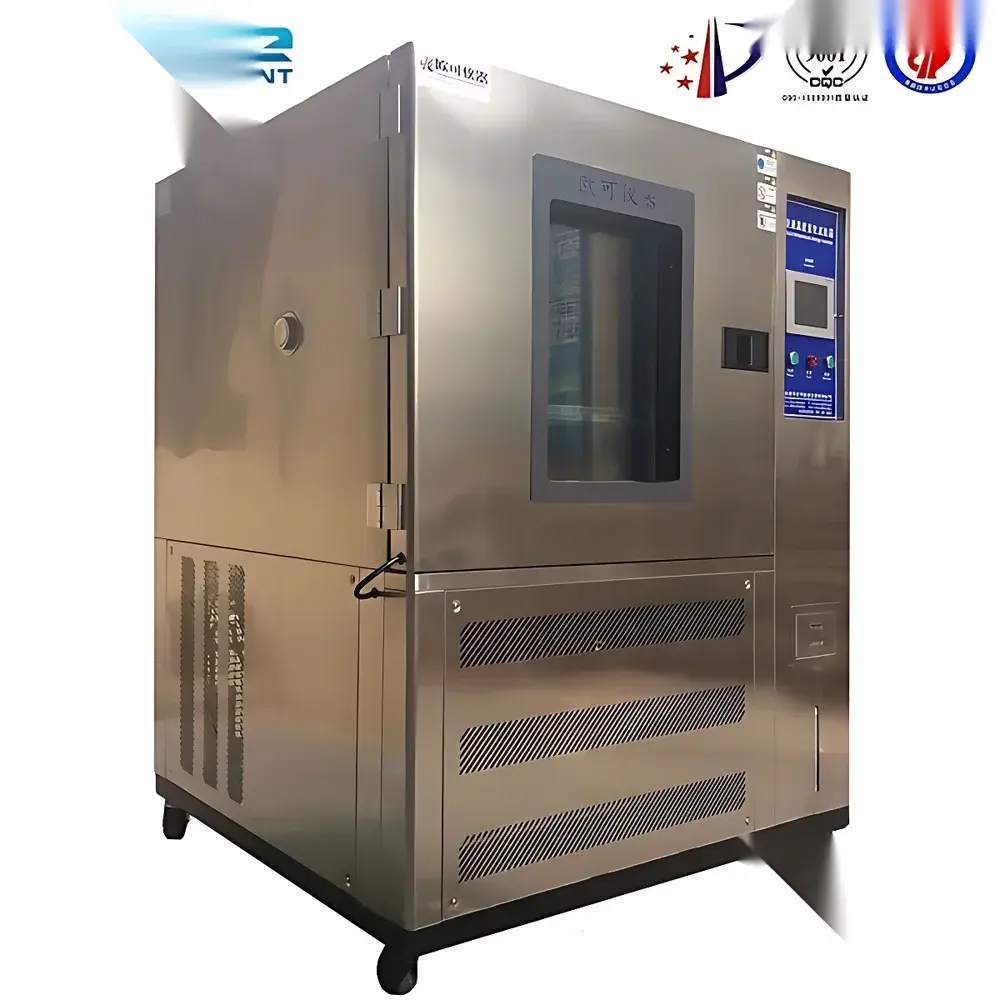
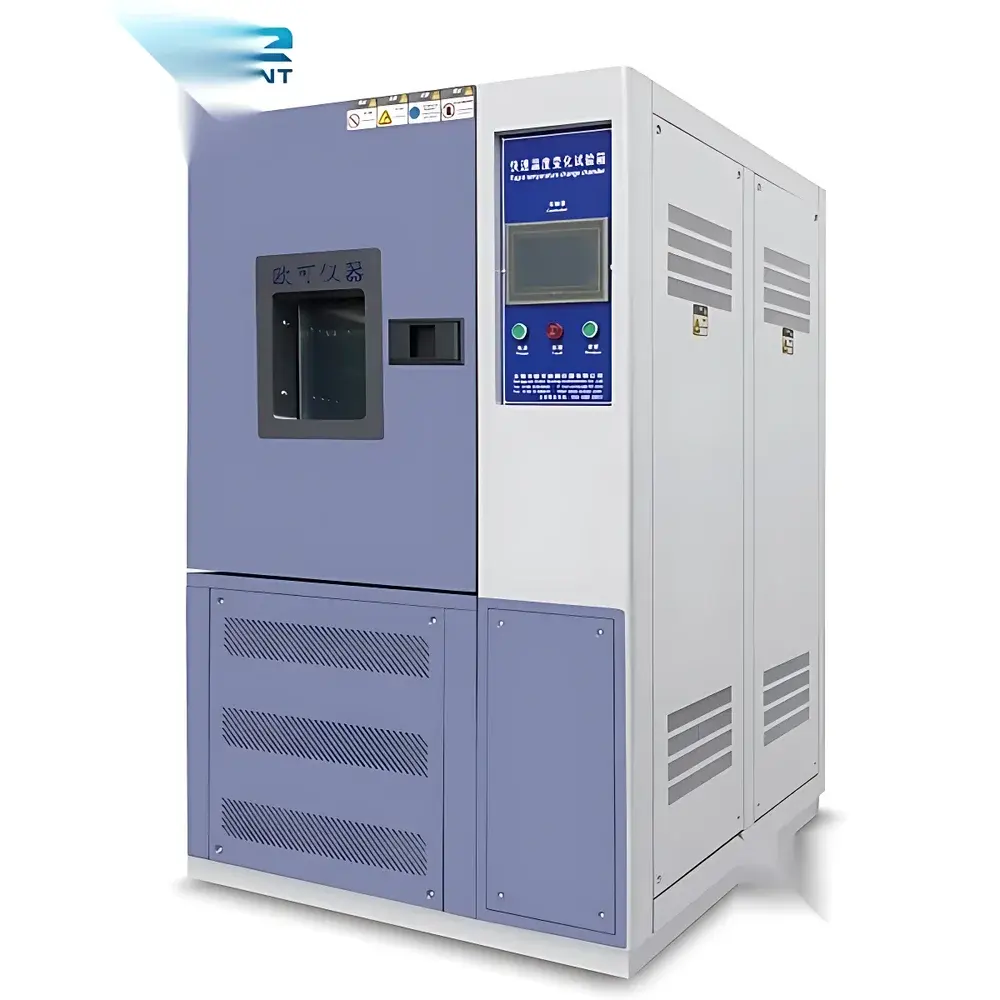
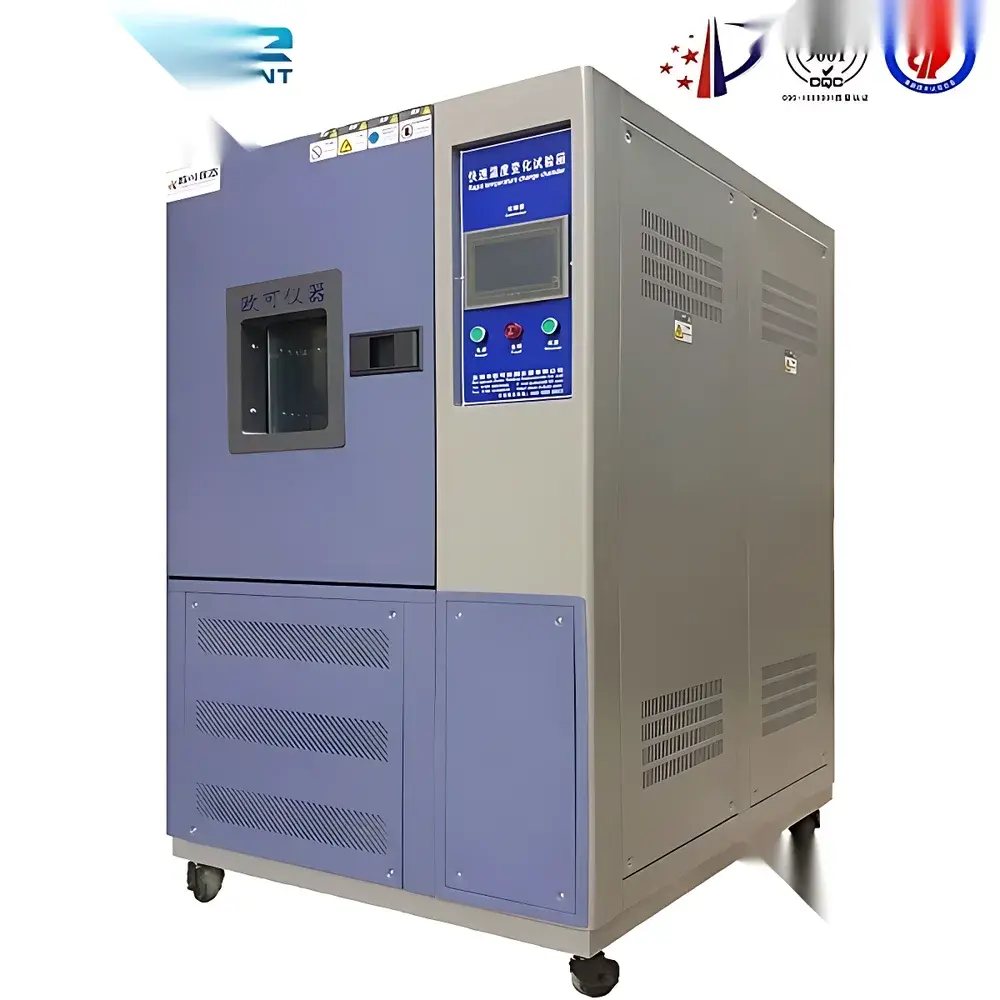
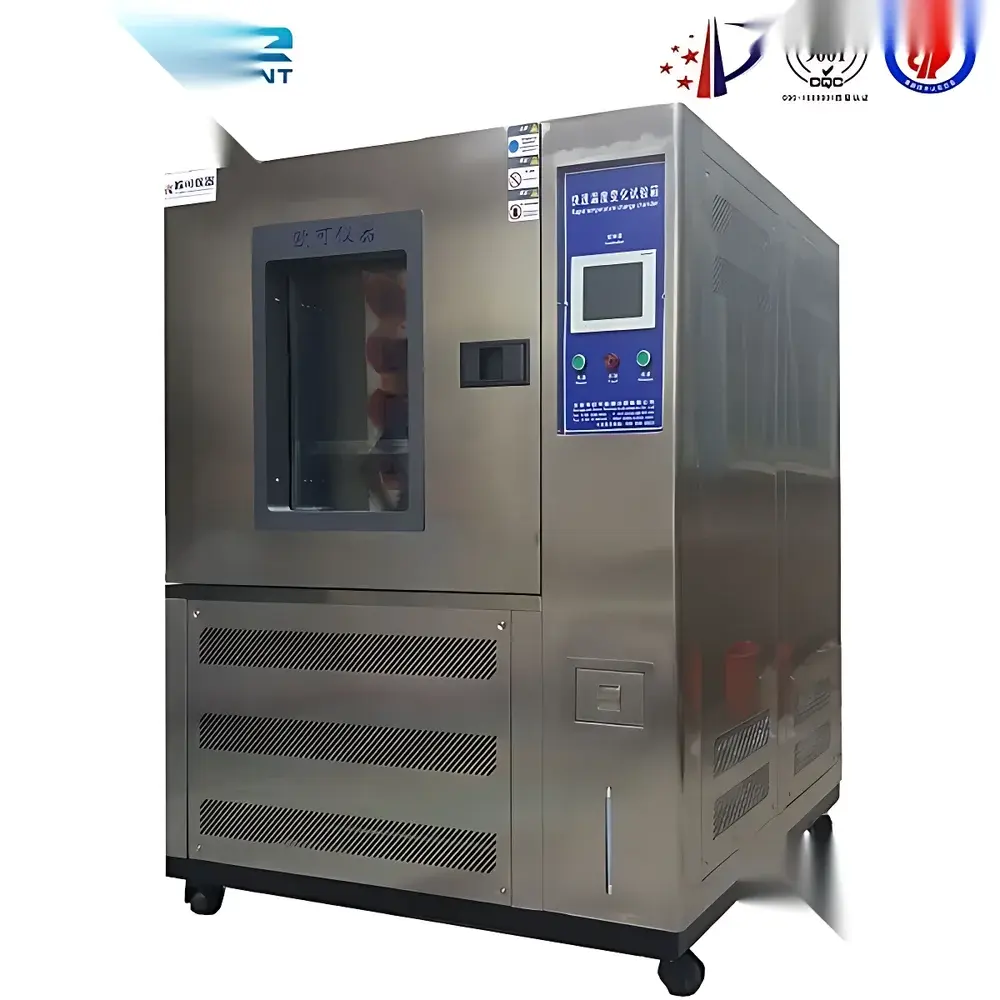
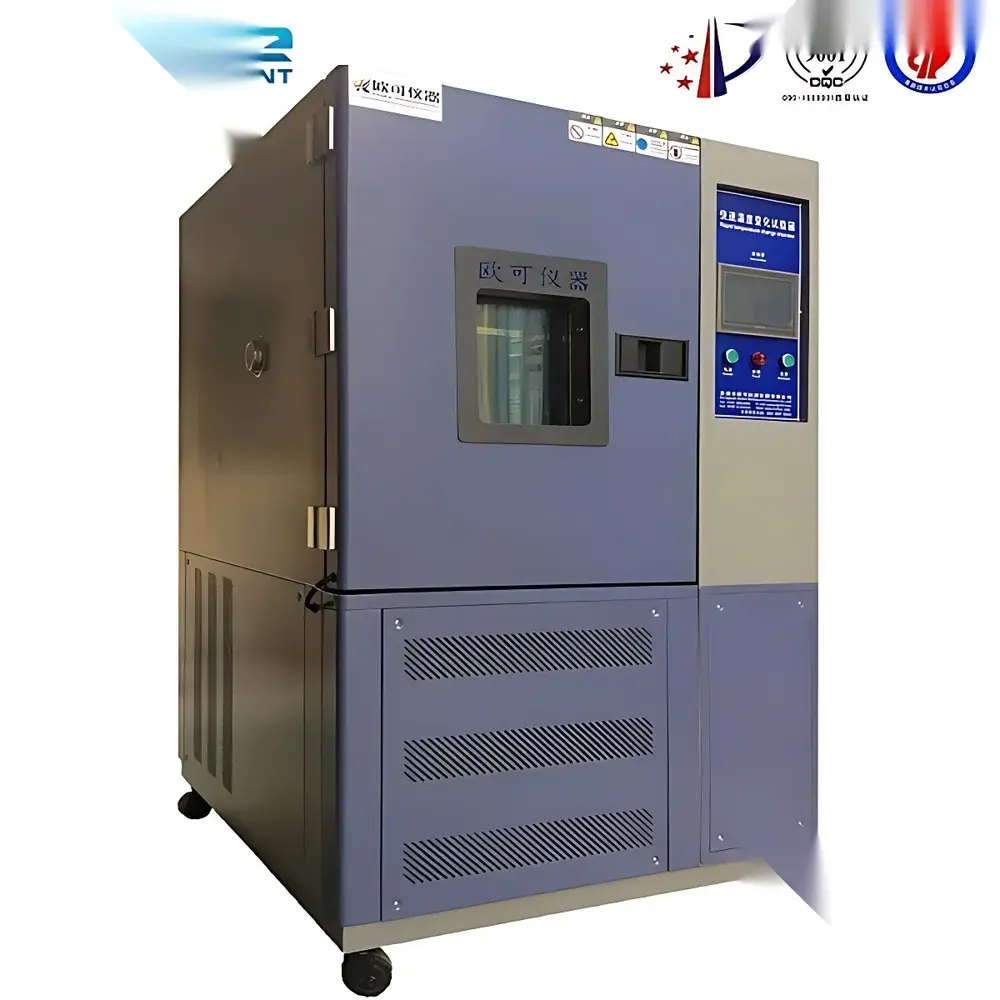
Quick Temperature Change Test Chamber
| Brand | Custom OEM |
|---|---|
| Origin | Imported |
| Manufacturer Type | Authorized Distributor |
| Price | USD 14,000 (FOB) |
| Temperature Range | −70 °C to +150 °C |
| Humidity Range | 20–98% RH (optional: 5–98% RH) |
| Rapid Thermal Transition Rates | 5–25 °C/min (selectable) |
| Temperature Uniformity | ±2 °C |
| Temperature Fluctuation | ±0.5 °C |
| Humidity Uniformity | ±3.0% RH (≥75% RH) |
| Humidity Fluctuation | ±2.5% RH |
| Internal Dimensions (W×H×D, cm) | 50×75×60 |
| Construction Material | SUS#304 Stainless Steel |
| Refrigeration System | Fully Enclosed, Low-Noise, Dual-Stage Compressor with Eco-Friendly Refrigerants (R404A/R23) |
| Controller | 7-inch Color LCD Touchscreen Interface with Bilingual (English/Chinese) Support |
| Compliance | GB/T 2423.1, GB/T 2423.2, GB/T 2423.22, GJB 150.3–150.5, GB 10589, GB 11158, GB 10592 |
Overview
The Quick Temperature Change Test Chamber is an engineered environmental simulation system designed for high-fidelity thermal stress evaluation of electronic components, automotive modules, aerospace assemblies, and precision optical devices. It operates on a dual-chamber air-circuit switching principle—separating high-temperature storage, low-temperature storage, and test zones—to enable rapid, repeatable thermal transitions without mechanical movement of the DUT (Device Under Test). Unlike conventional single-chamber thermal cycling systems, this architecture eliminates thermal inertia lag and ensures precise control over ramp rates, dwell times, and transition profiles. The chamber supports programmable thermal shock protocols compliant with MIL-STD-810G, IEC 60068-2-14, and JESD22-A104, making it suitable for reliability qualification, HALT/HASS pre-screening, and accelerated life testing in R&D and production QA environments.
Key Features
- Dual-zone thermal reservoir design with independent hot/cold air storage chambers and pneumatic air-path switching for sub-second thermal transition initiation
- Adjustable ramp rate selection from 5 °C/min to 25 °C/min (standard), calibrated per IEC 60068-3-5 and traceable to NIST-traceable reference sensors
- 7-inch full-color TFT-LCD touchscreen controller with real-time graphical curve display, multi-language UI (English/Chinese), and built-in data logging (10,000-point memory)
- 96 preloaded test profiles conforming to GB/T, GJB, and IEC standards; user-definable cycles (1–999), dwell durations (0.1–999 h 59 min), and automatic start/stop scheduling
- SUS#304 stainless steel interior and insulated double-wall construction with polyurethane foam (≥120 mm thickness) for thermal efficiency and long-term dimensional stability
- Environmentally compliant refrigeration system featuring dual-stage hermetic compressors and blended eco-refrigerants (R404A/R23), meeting EU F-Gas Regulation (EU) No 517/2014
- Integrated safety interlocks including over-temperature cut-off, refrigerant pressure monitoring, door safety switch, and emergency power-off circuit
Sample Compatibility & Compliance
This chamber accommodates static DUTs up to 100 cm × 100 cm × 100 cm (KS-TH-1000 model), with customizable internal configurations for fixtures, cable ports, and sensor feedthroughs. It meets the physical and operational requirements of ISO/IEC 17025-accredited laboratories and supports GLP/GMP documentation workflows. All thermal profiles are auditable via time-stamped event logs, supporting FDA 21 CFR Part 11 compliance when paired with validated software extensions. Certified conformance includes GB/T 2423.1 (cold), GB/T 2423.2 (dry heat), GB/T 2423.22 (temperature change), GJB 150.3–150.5 (military environmental testing), and GB 10592 (general specifications for climate chambers).
Software & Data Management
The embedded controller firmware supports CSV export of temperature/humidity time-series data via USB port or optional Ethernet interface (Modbus TCP). Optional PC-based software provides advanced analysis tools—including deviation mapping, cycle repeatability statistics (±0.3 °C max variation across 10 consecutive cycles), and automated report generation aligned with ISO/IEC 17025 clause 7.8. Audit trails record all parameter changes, user logins, and alarm events with immutable timestamps. Remote monitoring is available via secure HTTPS API for integration into enterprise MES or LIMS platforms.
Applications
- Thermal shock validation of PCBAs, solder joints, and wafer-level packages per JESD22-A104 and A106
- Qualification testing of EV battery modules under extreme ambient cycling (−40 °C ↔ +85 °C, 15 °C/min)
- Material compatibility screening for adhesives, encapsulants, and conformal coatings exposed to rapid humidity-temperature coupling
- Environmental stress screening (ESS) of avionics hardware per DO-160 Section 4 (Temperature Variation)
- Calibration verification of infrared sensors, thermocouples, and RTDs under dynamic thermal gradients
- Reliability growth testing of medical imaging subsystems operating in variable-climate field deployments
FAQ
What is the minimum dwell time between temperature extremes?
The system supports configurable dwell times from 1 minute to 999 hours 59 minutes per segment, with typical thermal shock protocols specifying ≥10 minutes for stabilization prior to transition.
Can the chamber operate in humidity-only or combined temperature-humidity modes?
Yes—the KS-TH series supports standalone humidity control (20–98% RH), temperature-only cycling, and simultaneous temperature/humidity profiling (subject to selected configuration and optional humidification/dehumidification modules).
Is third-party calibration certification included with delivery?
Standard delivery includes factory calibration reports traceable to national metrology institutes; ISO/IEC 17025-certified calibration with uncertainty budgets is available as an add-on service.
What power supply requirements apply for the KS-TH-800 model?
AC 380 V ±5%, 50 Hz ±0.5 Hz, 3-phase 5-wire configuration; dedicated grounding resistance ≤4 Ω is mandatory for electromagnetic compatibility and personnel safety.
How is system performance verified after installation?
On-site IQ/OQ protocol execution—including uniformity mapping (9-point grid), ramp rate validation at three load conditions (empty, 50% load, full load), and alarm response testing—is conducted by certified field engineers prior to handover.



