
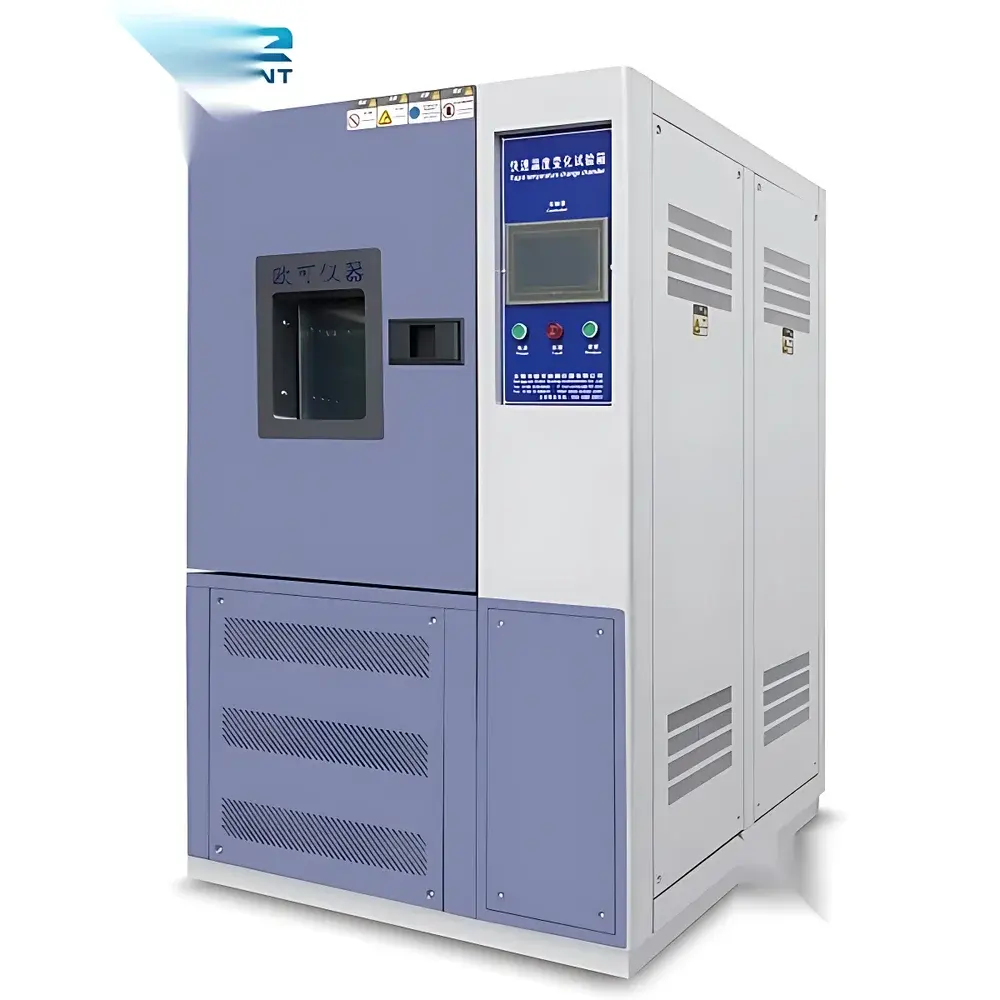
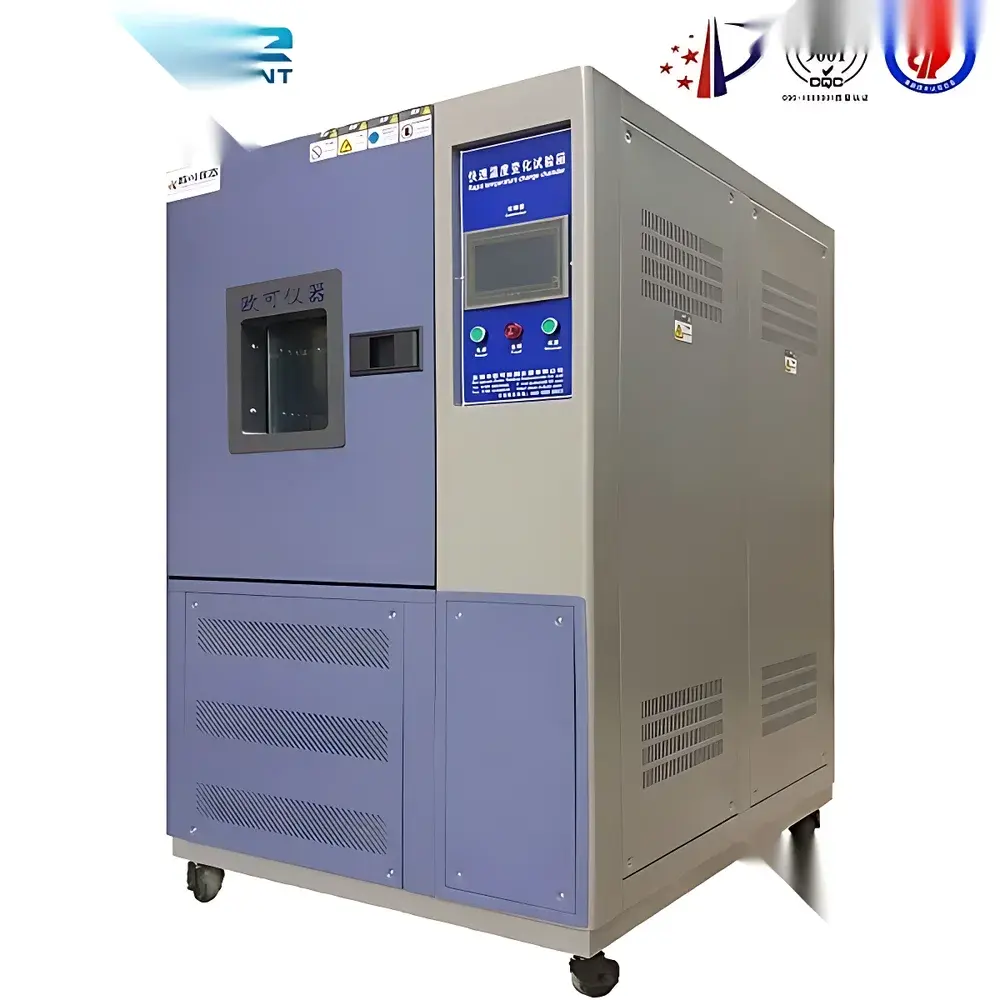
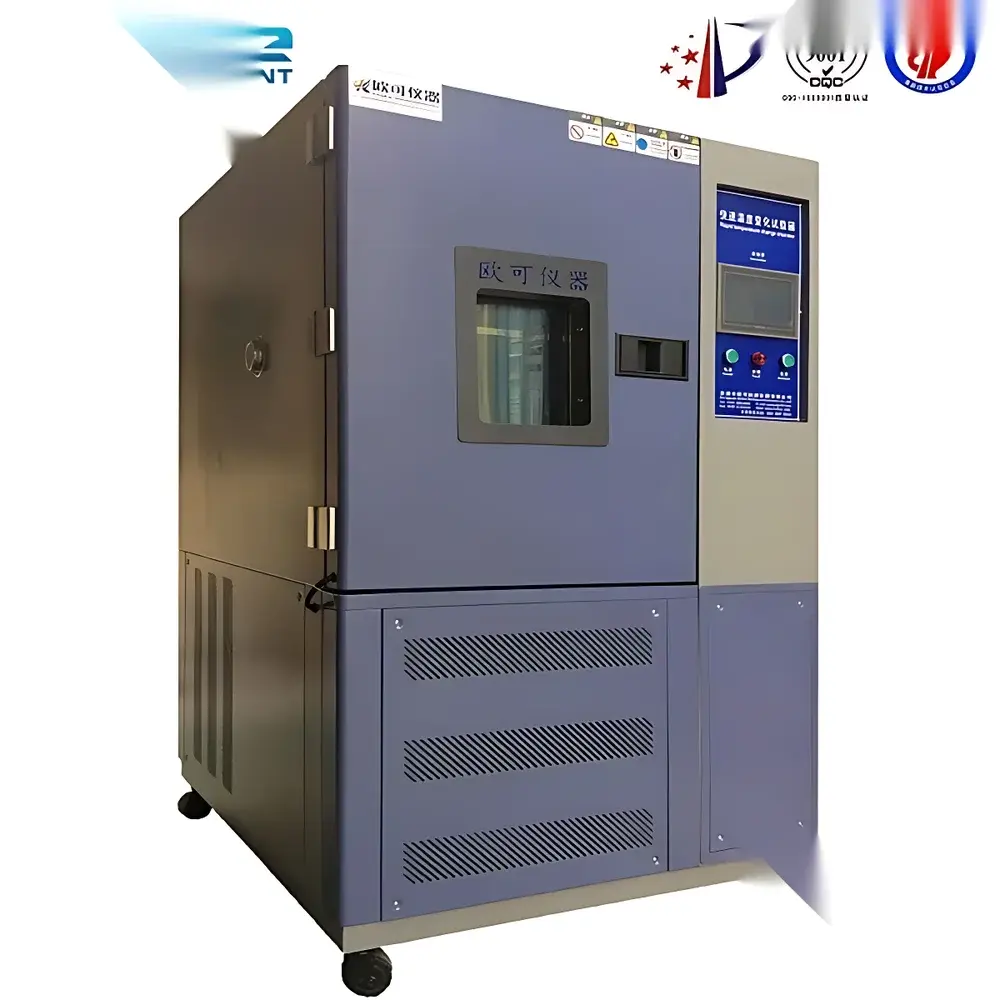
Quick Temperature Ramp Environmental Test Chamber
| Brand | Other Brands |
|---|---|
| Origin | Imported |
| Manufacturer Type | Authorized Distributor |
| Price | USD 14,500 (FOB) |
| Internal Dimensions (mm) | KS-TH-100: 450×450×500 |
| KS-TH-225 | 500×600×750 |
| KS-TH-500 | 700×800×900 |
| KS-TH-800 | 800×1000×1000 |
| KS-TH-1000 | 1000×1000×1000 |
| Temperature Range | −70 °C to +150 °C |
| Ramp Rate | Up to 10 °C/min (typical, load-dependent) |
| Uniformity | ±0.5 °C (at steady state, per IEC 60068-3-5) |
| Stability | ±0.3 °C |
| Control System | Fuzzy PID programmable controller with RS232 interface |
| Refrigerant | R-404A (ozone-friendly, non-CFC) |
| Air Circulation | Forced convection via high-efficiency EBM centrifugal blower and annular airflow duct |
| Safety Features | Independent overtemperature limiter, leakage current protection, door-open alarm, power-failure recovery, sensor fault detection |
Overview
The Quick Temperature Ramp Environmental Test Chamber is an engineered thermal stress testing platform designed for precise, repeatable, and accelerated temperature cycling across demanding industrial and R&D environments. Based on forced-convection air circulation and dual-stage refrigeration architecture, it delivers controlled thermal profiles compliant with key international environmental test standards—including IEC 60068-2-1 (cold), IEC 60068-2-2 (dry heat), IEC 60068-2-14 (change of temperature), and MIL-STD-810H Method 503.5. Its core function is to subject electronic components, aerospace subsystems, polymer materials, automotive ECUs, and pharmaceutical packaging to rapid thermal transients—enabling evaluation of thermal expansion mismatch, solder joint integrity, seal performance, and long-term reliability under cyclic thermal loading. Unlike standard constant-temperature chambers, this system prioritizes dynamic response: optimized compressor staging, high-mass airflow design, and low-thermal-inertia chamber walls collectively support ramp rates up to 10 °C/min under defined load conditions—critical for HALT (Highly Accelerated Life Testing) pre-screening and qualification-level thermal shock simulation.
Key Features
- Annular airflow duct system with EBM high-static-pressure centrifugal blower ensures uniform temperature distribution (±0.5 °C per IEC 60068-3-5) and minimizes vertical/horizontal gradients across all chamber volumes.
- Programmable fuzzy PID temperature controller with 30-segment ramp-soak capability, real-time deviation tracking, and user-configurable alarm thresholds for overtemperature, sensor failure, and door status.
- Dual independent safety layers: primary controller + hardware-based mechanical overtemperature limiter (settable, non-software-reliant), certified to UL 61010-1 and IEC 61000-6-2.
- Standard 45 mm diameter access ports (left/right), precision-machined and fitted with silicone grommets to maintain thermal integrity during in-situ monitoring or signal feedthrough.
- Modular interior with adjustable stainless-steel shelves—tool-free height repositioning supports flexible sample configuration without compromising airflow symmetry.
- R-404A refrigerant system integrated with high-efficiency condenser fans and finned-tube electric heaters enables stable operation from −70 °C to +150 °C while meeting global ozone-depletion potential (ODP = 0) and global warming potential (GWP) regulatory frameworks.
Sample Compatibility & Compliance
The chamber accommodates a broad range of physical sample forms—from PCB assemblies and molded plastic housings to sealed medical device packages and battery modules—without requiring custom fixtures. Internal dimensions scale from 100 L (KS-TH-100) to 1000 L (KS-TH-1000), supporting both component-level validation and full-system environmental screening. All models are designed and verified per ISO/IEC 17025-aligned calibration traceability protocols. Temperature uniformity and stability data are generated using NIST-traceable PT100 sensors placed at nine standardized locations (per IEC 60068-3-5 Annex B). The system meets electromagnetic compatibility requirements per EN 61326-1 and is suitable for use in GLP-compliant laboratories where audit-ready documentation (including calibration certificates, IQ/OQ templates, and uncertainty budgets) is required.
Software & Data Management
Equipped with RS232 serial interface and bundled Windows-compatible control software (Windows 10/11 x64), the chamber supports remote test sequencing, real-time parameter logging (temperature, setpoint, ramp rate, alarm status), and CSV export for post-test statistical analysis. Software features include multi-user permission levels, electronic signature support for 21 CFR Part 11 compliance (when deployed with validated IT infrastructure), audit trail generation for all critical events (e.g., program edits, manual overrides, calibration actions), and automatic timestamped report generation. Optional Ethernet or USB-to-RS232 adapters enable integration into centralized MES or LIMS platforms for automated test record archiving and cross-instrument correlation.
Applications
- Thermal cycling qualification of avionics modules per DO-160 Section 4.5 and RTCA/DO-160G.
- Material coefficient-of-thermal-expansion (CTE) mismatch assessment in multi-layer semiconductor packaging.
- Accelerated aging studies for lithium-ion battery cells under variable charge/discharge thermal profiles.
- Validation of hermetic seal integrity in implantable medical devices per ISO 11607-1.
- Pre-compliance screening for automotive electronics per AEC-Q200 and ISO 16750-4.
- Stability testing of active pharmaceutical ingredients (APIs) and final drug products per ICH Q1A(R2) and USP .
FAQ
What temperature ramp rates are achievable across different chamber sizes?
Ramp performance is load- and setpoint-dependent. Under no-load conditions, typical ramp rates range from 8–10 °C/min (−40 °C to +85 °C) for KS-TH-100 and 5–7 °C/min for KS-TH-1000. Published specifications assume aluminum thermal mass equivalent to 20% chamber volume.
Is the chamber compatible with nitrogen purge or inert atmosphere operation?
Standard configuration does not include gas inlet/outlet ports or pressure-rated construction. Custom variants with welded gas ports, pressure relief valves, and O₂ monitoring can be supplied upon request and require separate risk assessment per ISO 10523.
Does the system support automated calibration verification?
Yes—the controller includes built-in self-diagnostic routines for sensor linearity and heater response time. Full external calibration (per ISO/IEC 17025) requires third-party accredited service; factory-provided calibration certificates include measurement uncertainty budgets.
Can test programs be password-protected and version-controlled?
Yes. The PC software supports role-based access control (administrator/operator), encrypted program storage, and automatic revision timestamping. Exported test logs retain embedded metadata for forensic traceability.
What maintenance intervals are recommended for long-term reliability?
Compressor oil and refrigerant levels should be verified annually. Condenser coils require cleaning every 6 months in non-cleanroom environments. Blower motor bearings are rated for 30,000 hours; replacement is advised at 25,000 hours under continuous operation.



