
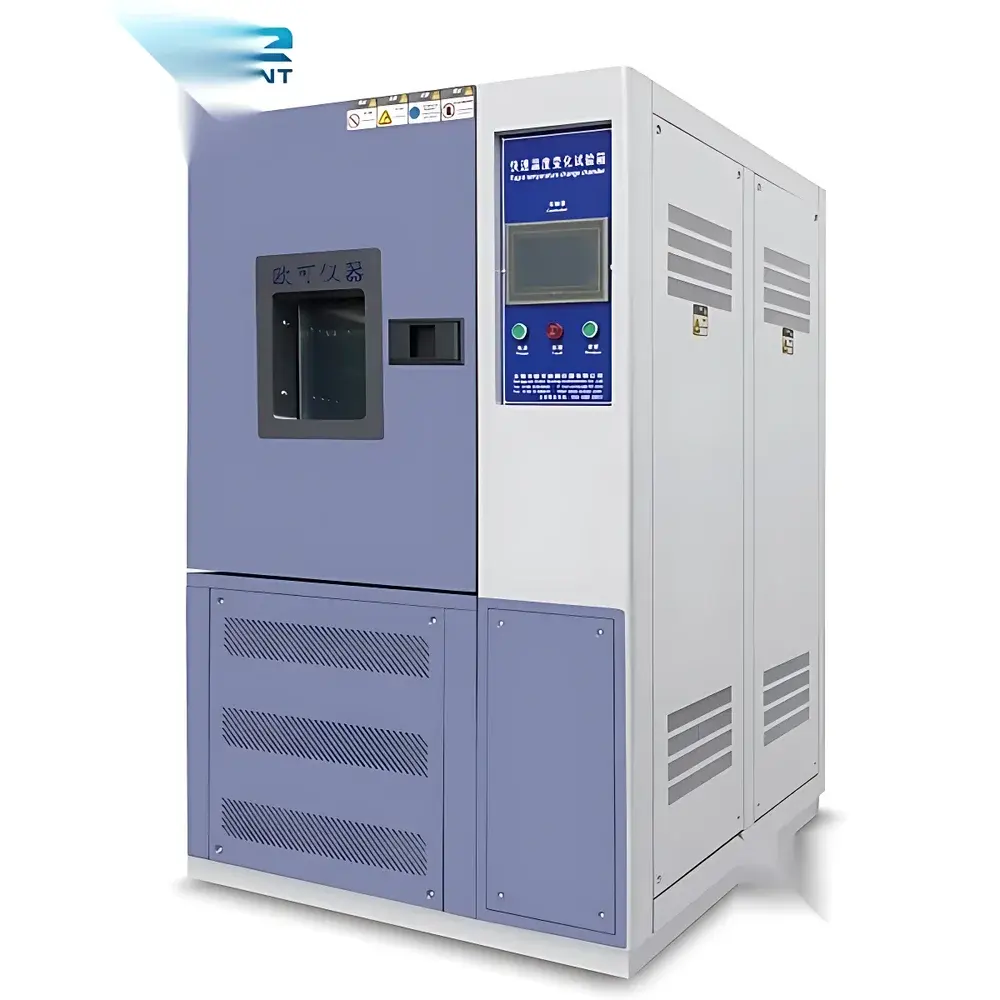
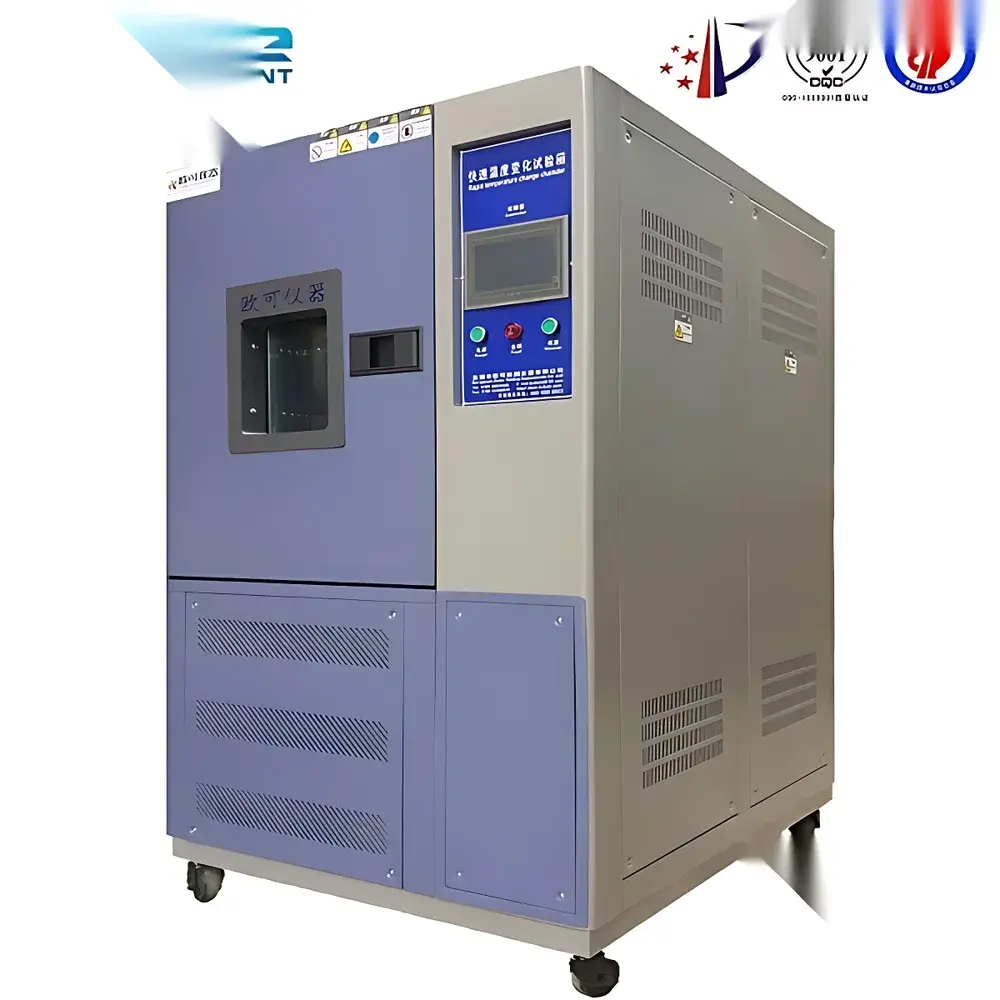
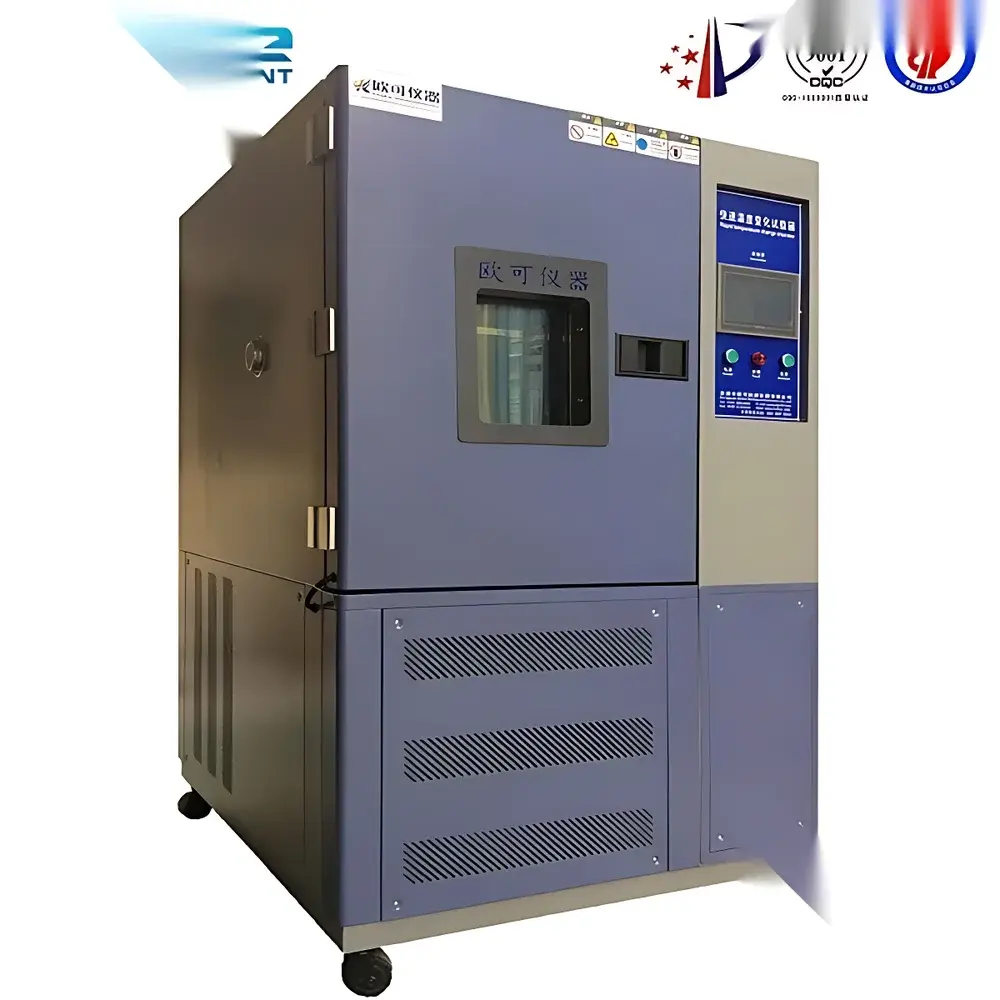
Quick Temperature Transition Environmental Test Chamber – Dual-Zone Rapid Thermal Cycling Chamber
| Brand | OEM / Custom-Built |
|---|---|
| Origin | Imported |
| Manufacturer Type | Authorized Distributor |
| Price Range | USD 14,000–16,500 (FOB) |
| Temperature Range (High Zone) | +80°C to +200°C |
| Temperature Range (Low Zone) | −10°C to −70°C |
| Operational Test Range | −40°C to +150°C |
| Control Accuracy | ±2.0°C |
| Resolution | 0.01°C |
| High-Zone Ramp Rate (RT → +150°C) | ≤40 min |
| Low-Zone Ramp Rate (RT → −70°C) | ≤100 min |
| Test Zone Temperature Recovery Time | 3–5 min |
| Internal Dimensions (W×H×D) | 600 × 500 × 500 mm |
| External Dimensions (W×H×D) | 1500 × 2100 × 2250 mm |
| Construction | Dual-chamber (hot/cold) + test chamber |
| Inner/Outer Material | SUS304 stainless steel (polished finish) |
| Insulation | High-density glass wool + rigid polyurethane (PU) foam |
| Anti-sweat System | K-type thermocouple-based thermal energy redistribution |
| Sealing | High-tensile elastomeric packing (−200°C to +400°C) |
| Actuation | Pneumatic damper control for zone isolation |
| Accessories | Two adjustable stainless-steel test shelves |
Overview
The Quick Temperature Transition Environmental Test Chamber is a dual-zone rapid thermal cycling system engineered for high-fidelity evaluation of material and component reliability under extreme, dynamically alternating thermal stress. Unlike conventional single-chamber chambers, this unit employs a three-compartment architecture—comprising independent high-temperature, low-temperature, and test zones—to enable precise, repeatable thermal shock profiles in accordance with IEC 60068-2-14, MIL-STD-810H Method 503.4, and JESD22-A104D. The system utilizes forced-air convection with optimized airflow distribution and pneumatic damper actuation to achieve sub-5-minute temperature recovery within the test zone—critical for simulating real-world thermal transients experienced by aerospace electronics, automotive ECUs, battery modules, and hermetically sealed optoelectronic assemblies.
Key Features
- Dual-zone thermal reservoirs: Independent hot zone (+80°C to +200°C) and cold zone (−10°C to −70°C), each equipped with dedicated compressors, heating elements, and PID-controlled air circulation systems.
- Test zone isolation: Physically separated from thermal reservoirs; maintains stable ambient conditions during zone switching via pneumatically actuated stainless-steel dampers with <0.5 s response time.
- High-resolution thermal control: Microprocessor-based controller with 0.01°C resolution and ±2.0°C uniformity across the 60 L test volume (600 × 500 × 500 mm).
- Rapid transition performance: Achieves RT → +150°C in ≤40 minutes (hot zone); RT → −70°C in ≤100 minutes (cold zone); test zone recovers target setpoint within 3–5 minutes post-switch.
- Robust mechanical construction: Full SUS304 stainless-steel interior and exterior panels; 120 mm total insulation thickness (glass wool + rigid PU foam, λ ≈ 0.022 W/m·K).
- Anti-condensation engineering: Integrated anti-sweat circuit using K-type thermocouple feedback to redistribute residual thermal energy along chamber perimeters, eliminating moisture accumulation on viewports and sensor housings.
- Compliance-ready interface: RS-485 Modbus RTU and Ethernet TCP/IP ports support integration with centralized lab monitoring systems and audit-trail-capable data loggers compliant with FDA 21 CFR Part 11 requirements.
Sample Compatibility & Compliance
This chamber accommodates samples up to 45 kg (static load) on two adjustable 304 stainless-steel shelves with 25 mm vertical spacing increments. It supports non-vented, sealed, and partially vented enclosures—including PCB assemblies, molded plastic housings, lithium-ion pouch cells, and MEMS sensors—without requiring sample repositioning between cycles. All thermal profiles are programmable with up to 99 segments per cycle, including dwell, ramp, and hold phases. The system meets ISO/IEC 17025 calibration traceability requirements when paired with NIST-traceable Class A PT100 sensors (optional). It is routinely validated per IQ/OQ protocols aligned with GMP Annex 15 and ASTM E2293-21 for environmental simulation equipment qualification.
Software & Data Management
Bundled Windows-based control software provides full-cycle programming, real-time graphing (up to 8 channels), and automated report generation (PDF/CSV). All setpoints, actual temperatures, alarm states, and damper positions are timestamped with millisecond precision and stored locally on an embedded industrial SSD. Audit trail functionality records user login/logout events, parameter changes, and manual overrides—enabling full compliance with GLP and 21 CFR Part 11 electronic record integrity mandates. Remote monitoring is supported via secure HTTPS web interface or OPC UA server configuration.
Applications
- Thermal shock testing of avionics components per DO-160 Section 4.5 and RTCA/DO-160G.
- Accelerated life testing of power semiconductor packages (IGBTs, SiC MOSFETs) under repeated −55°C/+125°C cycling.
- Qualification of EV battery module thermal management systems under dynamic load-following conditions.
- Reliability screening of medical device PCBs prior to ISO 13485 certification.
- Material coefficient-of-thermal-expansion (CTE) mismatch analysis in multi-layer ceramic capacitors (MLCCs) and chip-scale packages.
- Validation of hermetic seal integrity in TO-can and QFN packages using thermal gradient-induced leak detection.
FAQ
What is the difference between two-box and one-box thermal shock configurations?
The dual-zone (two-box) design physically isolates hot and cold reservoirs from the test chamber, minimizing thermal inertia and enabling faster transitions. The one-box variant uses internal baffles and directional airflow—but cannot match the thermal recovery speed or uniformity of the true three-compartment architecture.
Can this chamber perform humidity-assisted thermal shock?
No—this is a dry thermal cycling system only. Humidity control requires integration with a separate vapor generator and corrosion-resistant chamber modifications (e.g., stainless-steel humidification ducts, dew-point sensors), available as a custom-engineered option.
Is calibration documentation included with shipment?
Yes—a factory calibration certificate (traceable to NIST standards) is provided for all primary temperature sensors. On-site IQ/OQ validation support and annual recalibration services are available through authorized service partners in North America, EMEA, and APAC.
What safety interlocks are implemented?
Redundant hardware interlocks include door-open cutoff, overtemperature cutout (dual-stage), compressor high-pressure shutdown, and emergency stop with mechanical latch. All alarms trigger audible/visual alerts and automatic system halt with event logging.
Does the controller support custom profile scripting?
Yes—the embedded controller accepts ASCII-based profile files (.PRF) with user-defined ramp rates, dwell durations, and conditional branching logic. Advanced scripting (e.g., loop counters, external trigger inputs) is enabled via optional LabVIEW or Python API drivers.



