
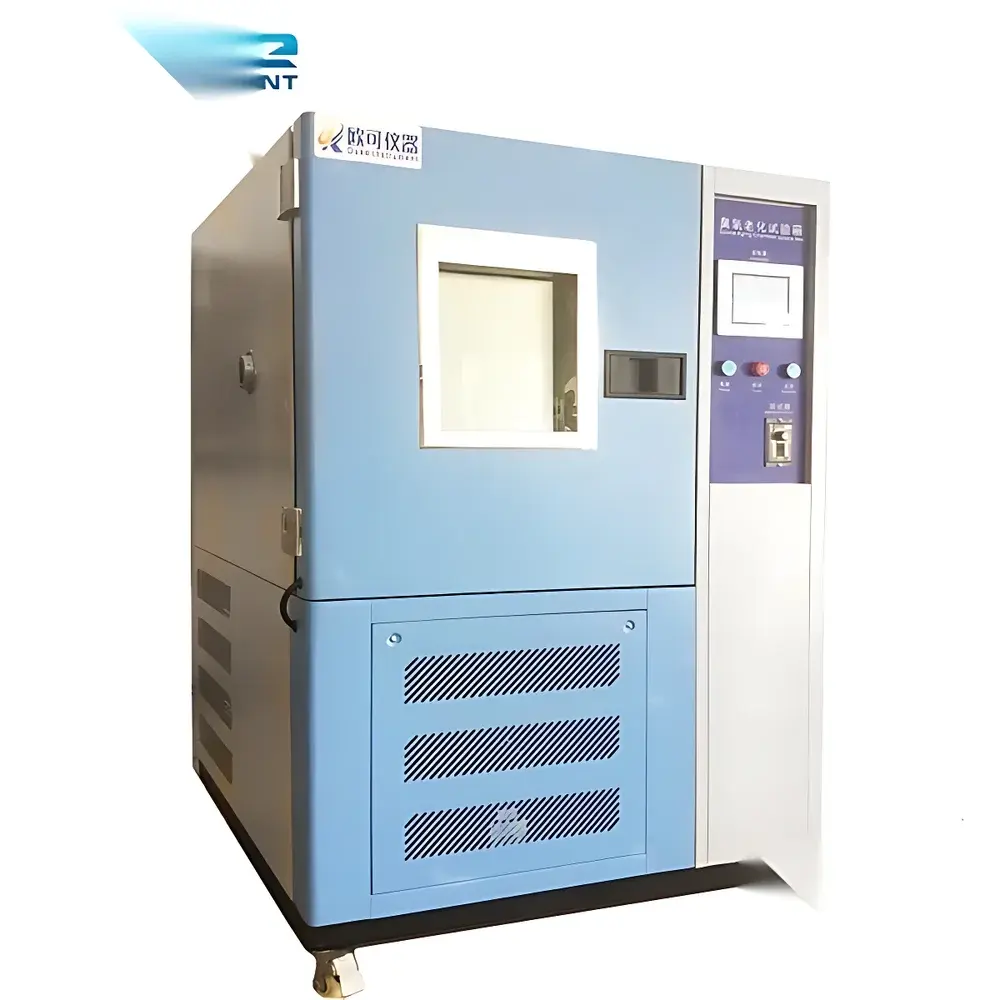
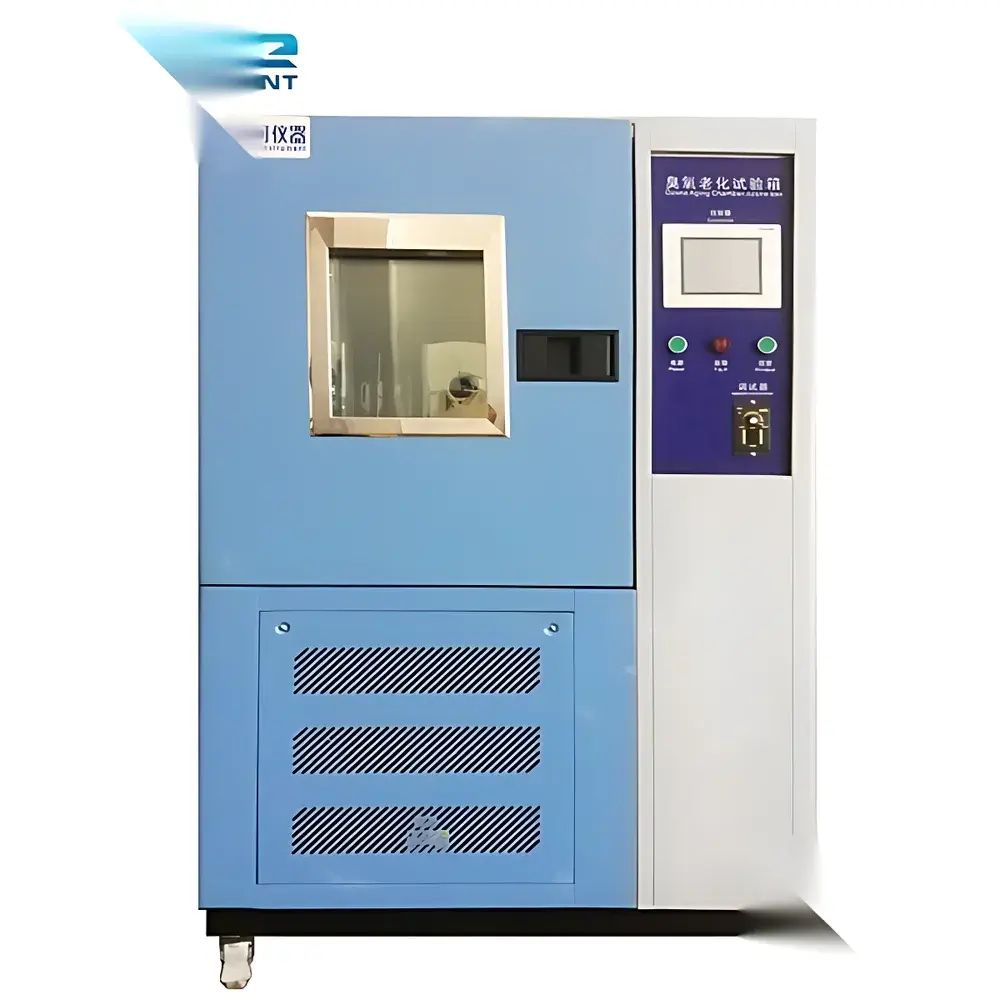
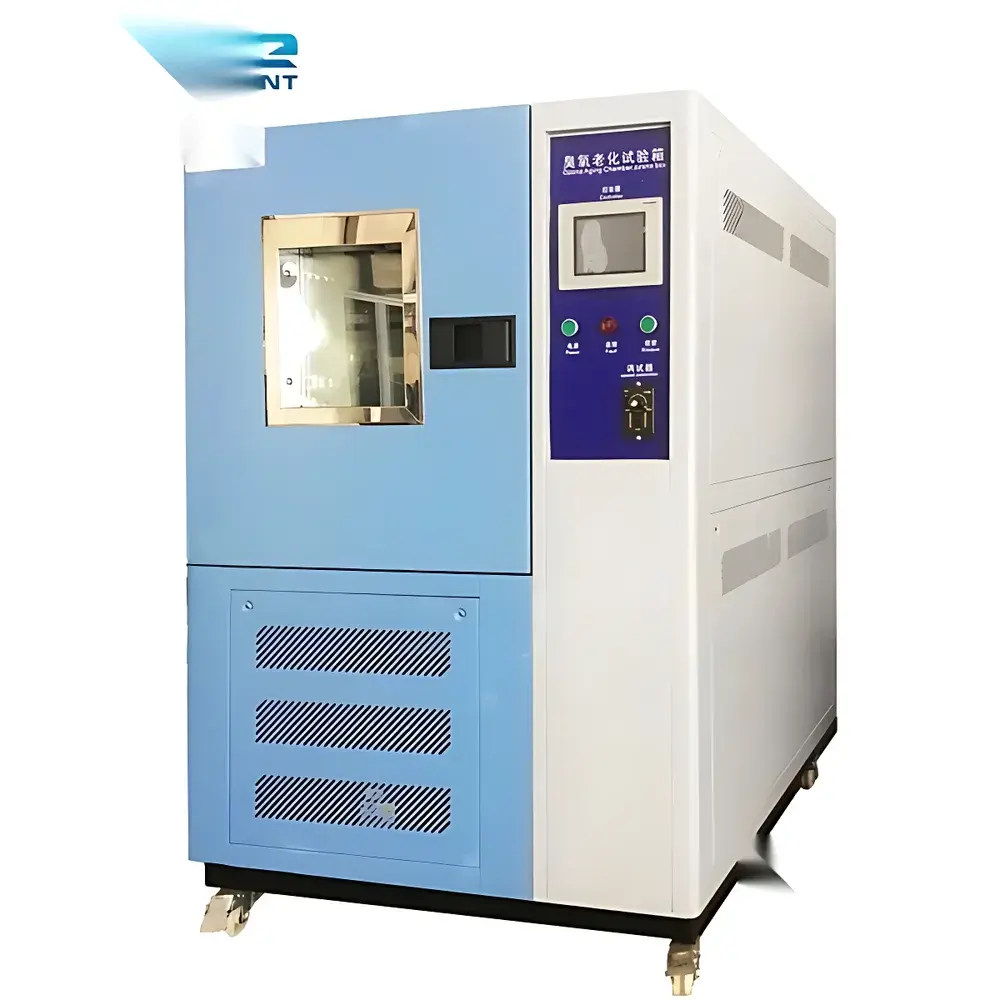
OK-QY-100 Ozone Aging Test Chamber
| Brand | OEM |
|---|---|
| Origin | Imported |
| Manufacturer Type | Authorized Distributor |
| Model | OK-QY-100 |
| Ozone Concentration Range | 50–1500 ppm (pphm) |
| Temperature Range | 25–40 °C |
| Temperature Uniformity | ±0.5 °C |
| Humidity Range | 30–65 % RH |
| Sample Rack | 360° continuous rotation at 1 rpm |
| Gas Flow Velocity | 8–16 mm/s |
| Control System | Siemens PLC + Weintek color touchscreen HMI |
| Ozone Detection | Non-dispersive UV absorption analyzer (≥5 yr service life) |
| Compliance Standards | GB/T 7762–2003, GB/T 2951.21–2008, GB/T 11206–2009, ISO 1431-1:2004 |
Overview
The OK-QY-100 Ozone Aging Test Chamber is an engineered environmental test system designed to accelerate and quantify ozone-induced degradation in elastomeric materials—particularly natural rubber, SBR, CR, NBR, and EPDM compounds. Operating on the principle of controlled atmospheric simulation, the chamber generates precise, stable ozone concentrations within a sealed stainless-steel reaction chamber, enabling standardized evaluation of crack initiation and propagation under dynamic or static mechanical strain. Unlike general-purpose climate chambers, this instrument integrates calibrated ozone generation (via silent discharge), real-time UV-based concentration monitoring, and programmable sample actuation—ensuring traceable, repeatable exposure conditions aligned with internationally recognized aging protocols.
Key Features
- Stainless-steel test chamber conforming to ISO 1431-1:2004 dimensional and material requirements, fully sealed to prevent ozone leakage and operator exposure.
- Adjustable ozone concentration range from 50 to 1500 ppm (pphm), digitally regulated via closed-loop feedback control using a non-dispersive ultraviolet (NDUV) ozone sensor with ≥5-year operational lifespan.
- Programmable sample rack drive system: 360° continuous rotation at 1 rpm (static mode optional), engineered to replicate cycloidal motion for uniform surface exposure and stress distribution across specimens.
- Integrated Siemens S7-1200 PLC and Weintek cMT Series color touchscreen HMI, supporting PID auto-tuning for temperature and ozone setpoint stability, with data logging capability.
- Dual-parameter control interface: independent setpoints for ozone concentration, temperature (25–40 °C), and relative humidity (30–65 % RH), each with real-time deviation monitoring and alarm thresholds.
- Calibration-ready architecture: built-in metrology ports for third-party verification of ozone output and sensor linearity; all gas pathways are leak-tested per ASTM D1149 Annex A1.
Sample Compatibility & Compliance
The OK-QY-100 accommodates standard dumbbell-shaped, ring, or strip specimens per ISO 1431-1 and GB/T 7762. Specimen holders are configurable for tensile strain application (0–20 % elongation) during testing, supporting both static and dynamic aging assessments. The chamber meets essential safety and metrological requirements for laboratory-grade ozone exposure systems: ozone generation and detection occur within a fully recirculated, hermetically sealed loop; electrical components comply with IEC 61000-6-2/6-4 EMC standards; and the enclosure includes redundant safety interlocks (over-temperature cutoff, ozone leak detection, motor overcurrent protection). All firmware and control logic support audit trails compliant with GLP documentation practices.
Software & Data Management
Control software provides real-time graphical display of ozone concentration (pphm), chamber temperature (°C), and humidity (% RH), with configurable sampling intervals down to 1 second. Historical datasets are exportable in CSV format via USB or RS232 interface. The system supports 4–20 mA analog output for integration into centralized lab monitoring networks (e.g., LabVantage, Siemens Desigo). For regulatory environments, optional firmware upgrade enables 21 CFR Part 11-compliant user access control, electronic signatures, and immutable audit logs—including timestamps for all parameter changes, alarm events, and calibration interventions.
Applications
- Evaluation of ozone resistance in automotive sealing systems (door gaskets, window channels, engine mounts).
- Comparative assessment of antiozonant efficacy (e.g., p-phenylenediamine derivatives) in compound development labs.
- Quality assurance testing for wire & cable insulation (per GB/T 2951.21–2008 and IEC 60811-501).
- Accelerated aging validation for medical-grade elastomers used in tubing and diaphragms.
- Failure analysis of field-failed rubber components to correlate crack morphology with laboratory-simulated exposure profiles.
FAQ
What ozone concentration accuracy is guaranteed across the 50–1500 ppm range?
The NDUV sensor maintains ±5 ppm or ±3 % of reading (whichever is greater) after factory calibration; annual recalibration is recommended per ISO/IEC 17025 guidelines.
Can the chamber operate continuously for extended test durations (e.g., 168 hours)?
Yes—the silent discharge ozone generator and cooling system are rated for uninterrupted operation up to 30 days, with thermal management validated per IEC 60068-2-14.
Is static tensile testing supported without sample rotation?
Yes—user-selectable static mode disables rack rotation while maintaining constant strain fixation and ozone exposure; fixture kits for ISO-standard dumbbell clamps are available as accessories.
Does the system include traceable calibration certificates?
A factory-issued calibration report (NIST-traceable ozone reference standard, temperature/humidity probes) is supplied with each unit; on-site calibration services are available upon request.
How is ozone destruct handled at test conclusion?
An integrated catalytic ozone destructor (MnO₂-based) reduces residual ozone to ambient oxygen prior to chamber opening, meeting OSHA PEL limits (<0.1 ppm time-weighted average).



