
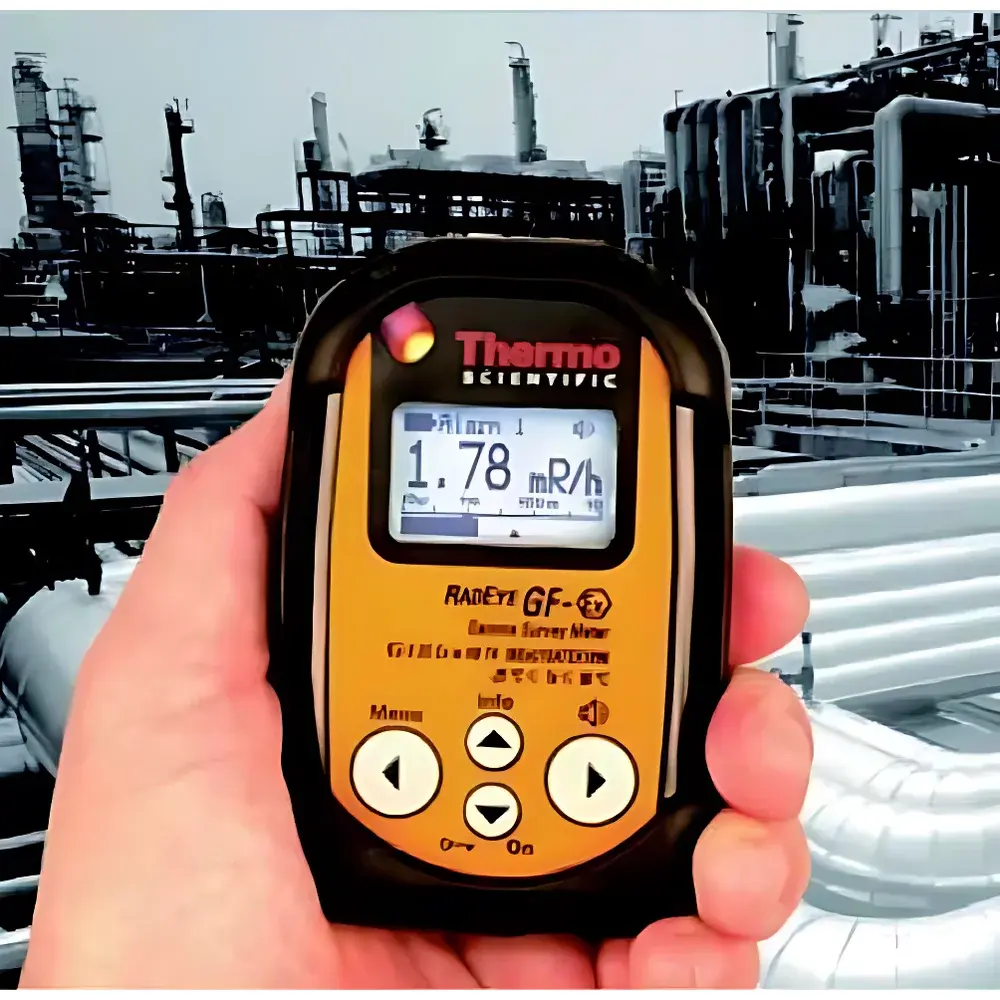
RadEye CD Portable Contraband and Radiation Detection System
| Brand | Thermo Fisher Scientific |
|---|---|
| Origin | USA |
| Manufacturer | Thermo Fisher Scientific |
| Product Type | Portable Radiation and Contraband Detection System |
| Model | RadEye CD |
| Detector Type | RadEye SX with NaI(Tl) Scintillation Detector |
| Measurement Capability | Simultaneous detection of concealed contraband (e.g., tobacco, explosives, alcohol) and radioactive materials |
| Measurement Range | 5–10 cps (background), 50–100 cps (contraband presence) |
| Sensitivity | ≥5 cps minimum detectable signal above background |
| Analysis Channels | Dual-channel spectral analysis |
| Typical Background Count Rate | 5 cps |
| Effective Measurement Time | 1 second per acquisition |
| Regulatory Compliance | Designed for customs, border security, and port-of-entry applications in accordance with IAEA TS-G-1.2 and ANSI N42.34 standards |
Overview
The RadEye CD Portable Contraband and Radiation Detection System is a dual-modality field-deployable instrument engineered for rapid, non-intrusive screening at border crossings, customs checkpoints, and high-security logistics facilities. Unlike conventional single-purpose radiation survey meters, the RadEye CD integrates gamma-ray spectroscopy with passive neutron-induced gamma emission analysis—leveraging the inherent nuclear signatures of common illicit materials. Its core detection architecture centers on a high-efficiency NaI(Tl) scintillation detector housed within the RadEye SX platform, coupled with a dual-channel pulse-height analyzer optimized for simultaneous energy discrimination and count-rate correlation. The system operates on the principle that organic compounds such as explosives, tobacco, and ethanol exhibit characteristic prompt gamma emissions when exposed to low-intensity neutron flux from a sealed 133Ba calibration source (included). Concurrently, it monitors ambient gamma radiation in real time using standard spectroscopic techniques, enabling parallel assessment of both radiological threats and concealed contraband in a single 1-second measurement cycle.
Key Features
- True dual-channel detection architecture: independent spectral processing for contraband signature identification and radiation dose rate quantification
- Integrated 133Ba neutron-activation reference source for consistent response calibration and material-specific signature validation
- Ruggedized portable design compliant with MIL-STD-810G for shock, vibration, and environmental exposure in field operations
- Real-time dual-display interface showing contraband probability index and ambient gamma dose rate (µSv/h) side-by-side
- Auto-thresholding algorithm calibrated against IAEA-defined threat material libraries (including RDX, PETN, ammonium nitrate, and ethanol)
- Onboard data logging with timestamped spectral records, supporting post-acquisition reanalysis and audit trail generation
Sample Compatibility & Compliance
The RadEye CD is validated for detection of concealed organic contraband within vehicle cavities, cargo containers, and luggage—without requiring physical access or active scanning. It does not emit ionizing radiation beyond the sealed calibration source and complies with IEC 62401:2017 for radiation detection instrumentation used in security applications. The system meets the performance criteria outlined in ANSI N42.34-2022 for handheld radiation detectors and supports GLP-compliant operation through configurable user authentication, electronic signature, and tamper-evident data storage. All firmware and spectral libraries are updatable via secure USB interface, ensuring alignment with evolving IAEA guidance documents and national regulatory frameworks governing border security instrumentation.
Software & Data Management
The embedded firmware provides real-time spectral deconvolution using least-squares fitting against preloaded nuclide and contraband signature libraries. Raw spectra and processed results are stored in IEEE 1588-compliant timestamped binary format (.rad), exportable via USB to Thermo Fisher’s optional RadEye Data Manager desktop application. This software enables spectral comparison across shifts, statistical trending of background variability, and generation of PDF reports compliant with ISO/IEC 17025 documentation requirements. Audit logs record all operator actions, configuration changes, and calibration events—including source verification cycles—with cryptographic hashing to satisfy FDA 21 CFR Part 11 and EU Annex 11 data integrity expectations.
Applications
- Primary inspection at international land, sea, and air ports for rapid triage of suspect vehicles and containers
- Secondary screening in mobile command units during counter-smuggling operations
- Verification of declared cargo contents against manifest discrepancies in bonded warehouses
- Support for nuclear security assistance programs under IAEA INFCIRC/225 guidelines
- Training and proficiency testing for customs officers using standardized contraband test samples
FAQ
Does the RadEye CD require external power or charging during extended field deployment?
No—it operates continuously for up to 12 hours on a single charge of its integrated Li-ion battery pack, with hot-swappable battery support for uninterrupted operation.
Can the system distinguish between naturally occurring radioactive material (NORM) and illicit radiological sources?
Yes—the dual-channel analysis enables isotopic identification via gamma-ray energy peaks (e.g., 40K at 1461 keV vs. 137Cs at 662 keV), supported by library-matched peak area ratios.
Is the 133Ba source replaceable or serviceable in the field?
No—the source is hermetically sealed and certified for 10-year functional lifetime; replacement requires factory recalibration and regulatory re-certification.
What training resources accompany the RadEye CD upon delivery?
Thermo Fisher provides instructor-led on-site training, bilingual operator manuals (EN/ES/FR), and access to the online RadEye Academy portal with scenario-based simulations and certification modules.
How does the system handle high-background environments such as near medical radioisotope facilities?
Adaptive background subtraction algorithms dynamically update baseline spectra every 30 seconds, maintaining detection sensitivity without manual intervention or threshold adjustment.







