
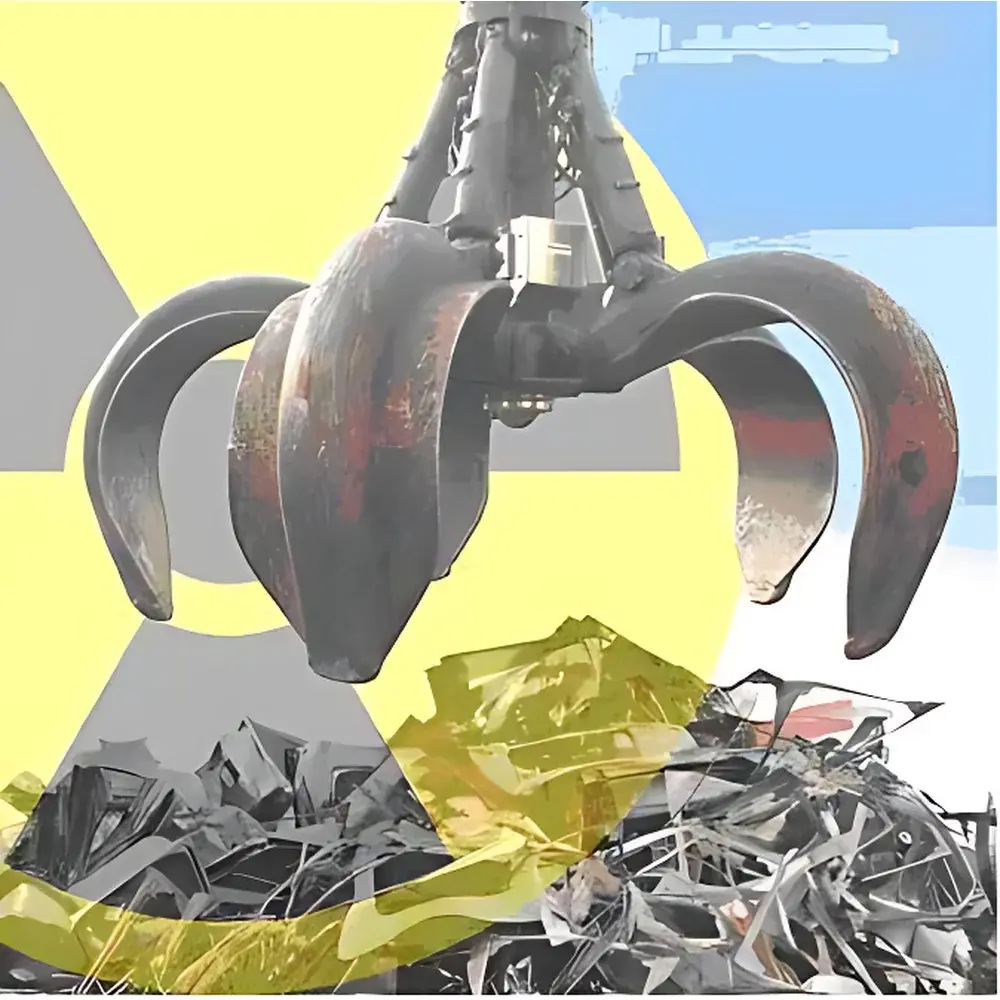
RadEye GR Grab-Handled Radiation Monitoring System
| Brand | Thermo Fisher |
|---|---|
| Origin | USA |
| Manufacturer | Thermo Fisher Scientific |
| Model | RadEye GR |
| Instrument Type | Portable Dose Rate Meter |
| Detector Type | Sodium Iodide (NaI) Scintillator |
| Wireless Range | 100 m |
| Detector Battery Life | 1300 h |
| Display Unit (RadEye R) Battery Life | 600 h |
| Operating Temperature | –25 °C to +50 °C |
| Compliance | Meets ANSI N42.33, IEC 60846-1:2014, and EU Directive 2013/59/Euratom for portable radiation monitoring devices |
Overview
The RadEye GR Grab-Handled Radiation Monitoring System is a ruggedized, purpose-engineered solution for real-time gamma radiation dose rate measurement in high-risk scrap metal handling environments—particularly at open-air recycling yards, scrap processing facilities, and metal sorting stations where unshielded radioactive sources may inadvertently enter the waste stream. Built upon Thermo Fisher Scientific’s proven RadEye platform, the system employs a high-efficiency sodium iodide (NaI) scintillation detector optimized for sensitivity across the 50 keV–3 MeV energy range. Its core measurement principle relies on pulse-height analysis of scintillation light generated by gamma photon interactions within the NaI(Tl) crystal, enabling accurate ambient dose equivalent rate (H*(10)) estimation per IEC 60846-1:2014. The grab-handle mechanical design allows operators to position the detector directly into scrap loads—such as steel bales or shredded metal containers—without requiring fixed mounting or external power infrastructure. This operational paradigm supports rapid screening protocols mandated under national regulatory frameworks for scrap metal clearance, including U.S. NRC guidance (NUREG-1556, Vol. 9) and the European Basic Safety Standards Directive (2013/59/Euratom).
Key Features
- Ruggedized grab-handle form factor engineered for repeated mechanical impact, dust ingress, and thermal cycling in outdoor industrial settings
- High-sensitivity NaI(Tl) scintillation detector with isotropic angular response (±15% deviation over 4π solid angle), ensuring consistent readings regardless of source orientation
- True wireless telemetry architecture: bidirectional 2.4 GHz RF link between detector unit and RadEye R display module, certified for reliable operation up to 100 m line-of-sight
- Extended battery autonomy: 1300 hours of continuous operation for the detector head and 600 hours for the RadEye R display unit—both powered by standard, field-replaceable AA alkaline cells
- Integrated data logging with timestamped H*(10) records (1-second resolution), stored internally (≥10,000 entries) and exportable via USB or Bluetooth to compliant laboratory information management systems (LIMS)
- IP65-rated enclosure for both detector and display units, providing protection against water jets and particulate contamination during rain, snow, or dusty operations
Sample Compatibility & Compliance
The RadEye GR is validated for direct exposure to heterogeneous metallic matrices—including ferrous scrap, stainless steel fragments, aluminum alloys, and mixed demolition debris—without signal quenching or spectral distortion attributable to self-absorption. Its NaI detector exhibits minimal energy dependence in the critical 60–1500 keV range relevant to common orphan sources (e.g., 137Cs, 60Co, 192Ir). Regulatory compliance extends to ASTM E2512-21 (Standard Test Method for Calibration of Hand-Held Instruments Used to Measure Gamma Radiation Dose Rates), ISO 4037-3:2019 (X- and gamma-reference radiations), and fulfills technical requirements for inclusion in U.S. Department of Transportation (DOT) Hazardous Materials Regulations (49 CFR §172.403) radiation warning programs. Device firmware supports audit-ready configuration locking and user-access-level control per GLP/GMP-aligned operational procedures.
Software & Data Management
Data acquisition and reporting are managed through Thermo Fisher’s RadEye Configuration Utility v3.x—a Windows-based desktop application supporting secure firmware updates, calibration coefficient import (traceable to NIST SRM 2262), and customizable alarm thresholds (dose rate, accumulated dose, count rate). All logged measurements include embedded metadata: GPS coordinates (when enabled via optional external module), operator ID, inspection lot number, and environmental temperature. Export formats comply with ASTM E2982-22 (Standard Practice for Electronic Data Exchange in Radiation Protection), supporting CSV, XML, and PDF report generation. Audit trails record all configuration changes, calibrations, and user logins—fully compatible with FDA 21 CFR Part 11 electronic signature and record retention requirements when deployed in regulated scrap certification workflows.
Applications
- Pre-sorting radiation screening of inbound ferrous scrap at recycling facilities prior to furnace charging
- Mobile verification of radiation clearance for decommissioned industrial equipment (e.g., radiography cameras, level gauges)
- Border and port-of-entry inspection of containerized metal shipments under IAEA Code of Conduct on the Safety and Security of Radioactive Sources
- Field validation of remediation effectiveness at legacy metal storage sites contaminated with naturally occurring radioactive material (NORM)
- Integration into automated scrap handling lines via optional analog/digital I/O interface for real-time process interlock signaling
FAQ
What gamma-emitting isotopes can the RadEye GR reliably detect in scrap metal?
It provides quantitative dose rate response to 137Cs (662 keV), 60Co (1173 & 1332 keV), 192Ir (300–612 keV), and 241Am (59.5 keV), with energy compensation calibrated per IEC 60846-1 Annex B.
Does the system support multi-point dose mapping during grab sampling?
Yes—the RadEye R display unit enables manual geotagging of each reading; combined with optional Bluetooth GPS receivers, it generates spatially referenced dose profiles compatible with GIS platforms.
Is calibration traceable to national standards?
All factory calibrations are performed using NIST-traceable 137Cs and 60Co reference sources, with full calibration certificates issued per ISO/IEC 17025:2017 requirements.
Can the detector be decontaminated after contact with radioactive dust?
The IP65-rated NaI housing permits wipe-down decontamination with mild detergent and water; no disassembly is required, and performance remains stable following standard radiological hygiene protocols.
How does the system handle electromagnetic interference near induction furnaces or welding equipment?
The detector electronics incorporate shielded signal paths and digital filtering algorithms validated per IEC 61000-4-3 (radiated immunity) and IEC 61000-4-6 (conducted immunity) up to 10 V/m and 10 V respectively.
Related Products







