
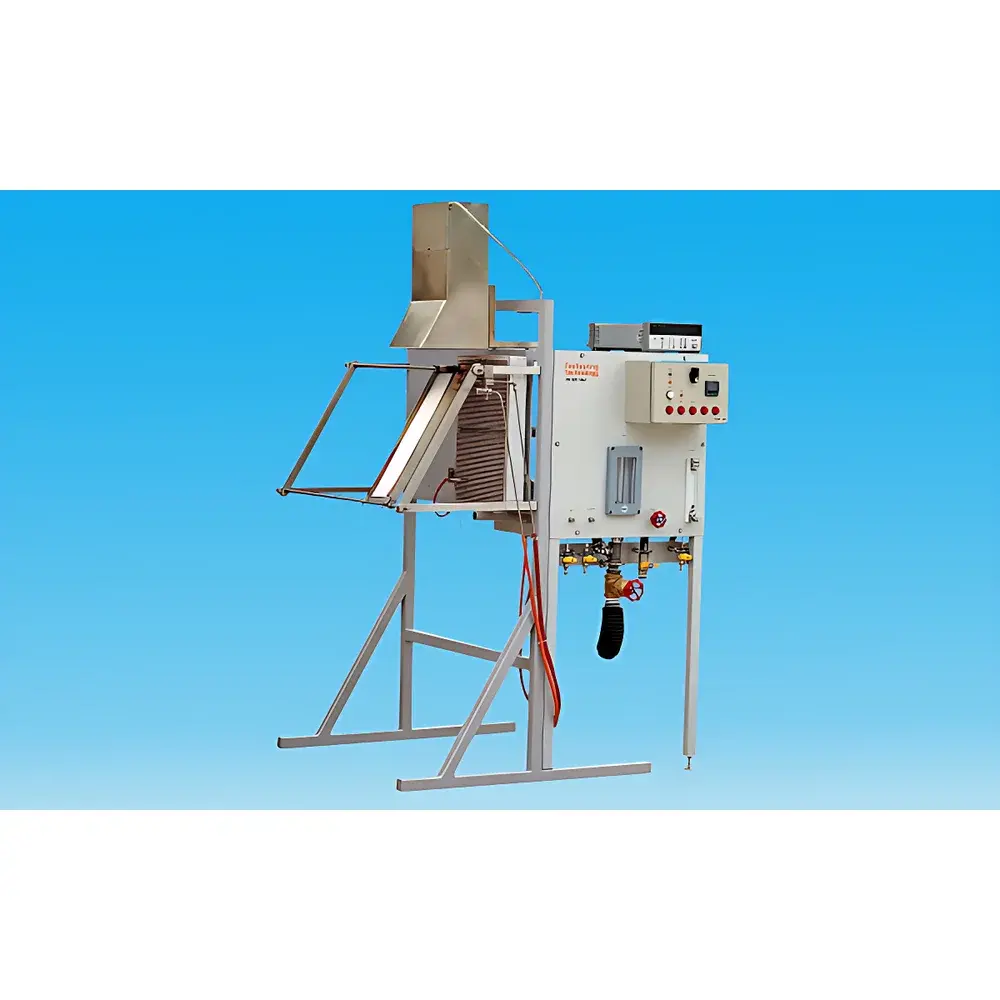
Radiant Panel Flame Spread Apparatus (FTT Model RP-FSA)
| Brand | FTT |
|---|---|
| Origin | United Kingdom |
| Model | Radiant Panel Flame Spread Apparatus |
| Compliance Standards | ASTM E162, ASTM D3675 |
| Radiation Panel Dimensions | 12 in × 18 in (305 mm × 457 mm) |
| Panel Material | Porous cement and cast iron |
| Ignition System | Electronic spark igniter with auto-shutdown safety monitoring |
| Sample Holder | Stainless steel, calibrated at 3-inch (76 mm) intervals for flame front observation |
| Thermocouple Array | Eight calibrated stainless steel thermocouples integrated into exhaust duct |
| Surface Temperature Measurement | Calibrated high-temperature pyrometer with mounting fixture |
| Gas Control | Precision methane flowmeter and adjustable gas mixture valve |
| Exhaust System | Removable-panel stainless steel ducting for maintenance access |
| Safety Systems | Interlocked gas shutoff valve and circuit-breaker activated by flame failure or overtemperature |
Overview
The Radiant Panel Flame Spread Apparatus (RP-FSA) by FTT is a precision-engineered bench-scale fire testing instrument designed to quantify the surface flammability behavior of flat, solid materials under controlled radiant heat exposure. Operating on the principle of steady-state radiant heating—where a calibrated gas-fired ceramic or porous cement–cast iron panel emits uniform thermal radiation—the apparatus measures the rate and extent of flame propagation along the exposed surface of test specimens. This method directly implements the test protocols defined in ASTM E162 (Standard Test Method for Surface Flammability of Materials Using a Radiant Heat Energy Source) and ASTM D3675 (Standard Test Method for Surface Flammability of Flexible Cellular Materials—Radiant Panel Test). The resulting Flame Spread Index (FSI) is a dimensionless, empirically derived value that integrates both the linear progression of the flame front and the relative heat release profile during combustion. As such, the FSI serves as a critical performance metric in regulatory evaluations for interior finish materials used in mass transit vehicles—including railcars, buses, and aircraft cabins—where low flame spread and delayed ignition are mandated by NFPA 130, EN 45545-2, and similar transport-sector fire safety standards.
Key Features
- Thermally stable radiant panel assembly comprising dual-material construction: porous cement faceplate bonded to a cast iron backing, ensuring uniform emissivity and long-term thermal integrity across repeated test cycles.
- Electronic spark ignition system with real-time flame presence monitoring and automatic gas cutoff within 2 seconds of flame extinction or panel overheating—fully compliant with ASTM E162 Section 7.3.2 safety requirements.
- Stainless steel sample holder engineered for repeatable specimen alignment; features precisely spaced observation markers at 3-inch (76 mm) intervals along the vertical axis to enable manual or video-based tracking of flame front advancement.
- Integrated eight-point thermocouple array mounted within the exhaust duct, positioned per ASTM E162 Figure 3 geometry to capture longitudinal temperature gradients and validate thermal plume development during testing.
- Dedicated high-accuracy pyrometer (±1.5 °C up to 900 °C), supplied with rigid mounting bracket and NIST-traceable calibration certificate, for continuous verification of radiant panel surface temperature prior to and during each test run.
- Regulated methane supply system including laminar-flow meter, dual-stage pressure regulator, and fail-safe solenoid valve—all housed within an interlocked control cabinet meeting IEC 61000-6-2 EMC and UL 508 industrial control standards.
Sample Compatibility & Compliance
The RP-FSA accommodates rectangular specimens measuring 24 in × 12 in (610 mm × 305 mm) with thicknesses ranging from 0.04 in to 2 in (1 mm to 50 mm), covering rigid boards, semi-rigid foams, laminated composites, and coated textiles. Specimen mounting follows strict orientation requirements outlined in ASTM E162 Section 6.2 (vertical mounting with bottom edge 1.5 in above radiant panel surface) and ASTM D3675 Section 6.3 (horizontal mounting for flexible cellular materials). All mechanical and thermal subsystems are validated against ISO/IEC 17025:2017 general requirements for competence of testing and calibration laboratories. Instrument-level traceability is maintained through annual third-party calibration of thermocouples, pyrometer, flowmeter, and gas pressure transducers—documentation provided in accordance with GLP audit readiness protocols.
Software & Data Management
While the RP-FSA operates as a manually supervised physical test platform, its measurement workflow is fully compatible with laboratory information management systems (LIMS) via RS-232 and analog voltage outputs (0–5 V DC) for thermocouple signals and gas flow readings. Optional digital interface modules support time-synchronized data logging at 1 Hz resolution, enabling export of flame front position timestamps, exhaust duct thermocouple profiles, and radiant panel temperature history in CSV format. All raw datasets include embedded metadata—test ID, operator name, calibration due dates, ambient conditions (per ASTM E162 Section 5.1), and instrument firmware version—ensuring full compliance with FDA 21 CFR Part 11 electronic record and signature requirements when deployed in regulated manufacturing environments.
Applications
- Evaluation of ceiling tiles, wall panels, and flooring substrates for compliance with building codes (e.g., IBC Chapter 8, NFPA 101 Annex B).
- Qualification of polyurethane, polystyrene, and melamine-formaldehyde foams used in transportation seating and insulation systems.
- Comparative assessment of fire-retardant coatings and intumescent treatments applied to wood-based composites and fiber-reinforced polymers.
- Supporting documentation for hazard analysis in Failure Modes and Effects Analysis (FMEA) workflows required under ASME PCC-2 and ISO 13849-1.
- Research-grade flame spread kinetics studies in academic and government fire science laboratories (e.g., NIST, FM Global, BRE).
FAQ
What standards does the RP-FSA directly support?
ASTM E162 and ASTM D3675 are the primary test methods implemented; secondary validation includes ISO 5657 (Fire tests — Reaction to fire tests — Ignitability of building products using a radiant heat source) and BS 476-6 (Fire tests on building materials and structures — Method of test for fire propagation for products).
Is operator training included with system commissioning?
Yes—FTT provides on-site installation verification and a two-day hands-on training program covering test setup, procedural execution, result interpretation, routine maintenance, and emergency shutdown protocols, documented per ISO/IEC 17025 Clause 6.2.5.
Can the apparatus be adapted for non-standard specimen geometries?
Custom sample holders and mounting fixtures are available upon request, subject to engineering review confirming no deviation from radiant flux uniformity or thermal boundary conditions specified in ASTM E162 Annex A1.
How often must the radiant panel be recalibrated?
Panel emissivity and thermal gradient uniformity are verified annually using blackbody reference sources traceable to NPL (UK); full recalibration—including thermocouple array and pyrometer—is recommended every 12 months or after 200 test cycles, whichever occurs first.
Related Products



