
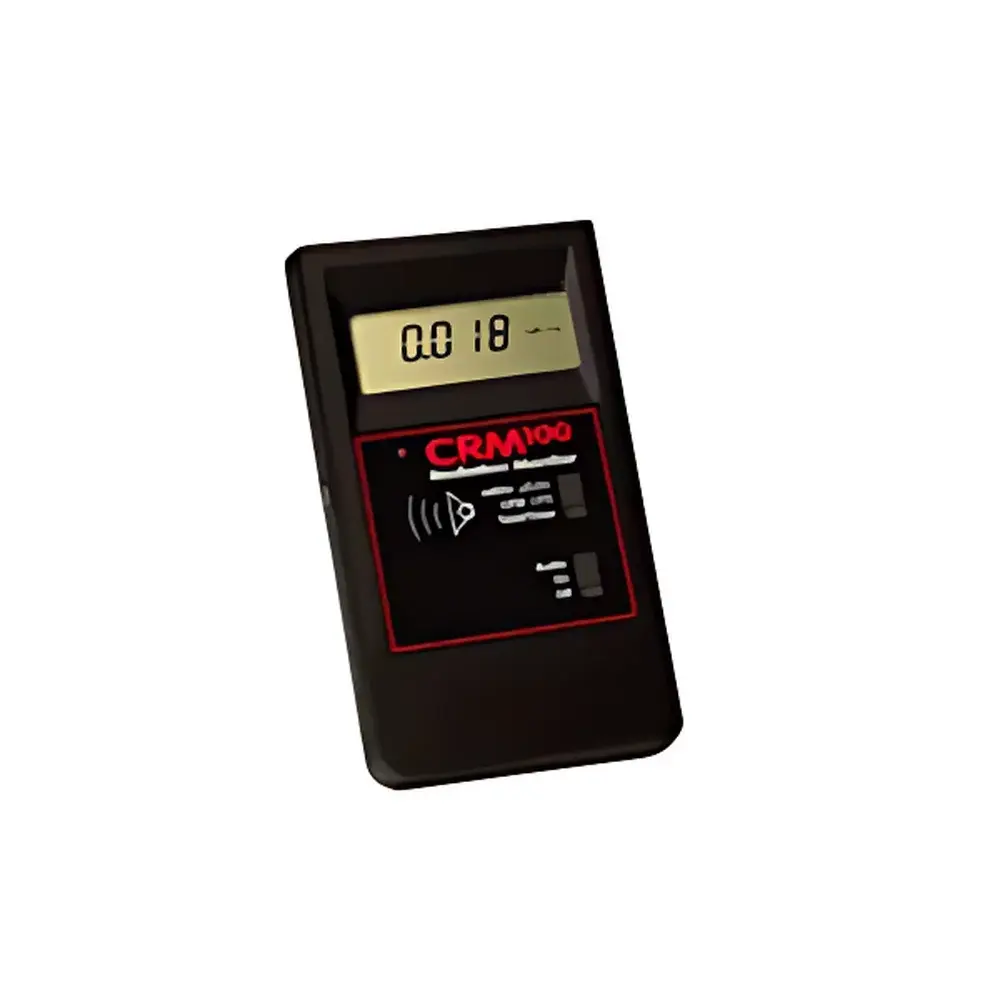
Radiation Detector CRM-100
| Brand | — |
|---|---|
| Origin | USA |
| Manufacturer Type | Authorized Distributor |
| Origin Category | Imported |
| Model | CRM-100 |
| Instrument Type | Portable Dose Rate Meter |
| Measured Radiation Types | Alpha (α), Beta (β), Gamma (γ), and X-ray |
| Detector | Halogen-quenched Geiger-Müller Tube with Mica End-window (1.75″ / 45 mm diameter, density 1.5–2.0 mg/cm²) |
| Wall Material | 0.012″ stainless steel (Grade 446) |
| Energy Range | 20 keV – 3 MeV |
| Dose Rate Range | 0.001–110.0 mR/h or 0.01–1100 µSv/h |
| Count Rate Range | 0–3,500 CPS / 0–350,000 CPM |
| Total Count Capacity | Up to 9,999,000 counts |
| Timer Range | Up to 40 hours |
| Sensitivity | ≥1000 CPM per mR/h (referenced to Cs-137) |
| Accuracy | ±10% typical, ±15% maximum (mR/h and µSv/h modes) |
| Display | 4-digit LCD with mode indicators |
| Audio Feedback | Adjustable click-per-count (muteable) |
| Visual Feedback | LED flash per count |
| Interface | 3.5 mm output jack (CMOS-compatible TTL pulses) |
| Power | One 9 V alkaline battery (typical lifespan: 2160 hours) |
| Dimensions | 150 × 80 × 30 mm |
| Weight | 225 g (including battery) |
| Certifications | CE, RoHS, WEEE, ISO 9001:2001 & ISO 14001 |
Overview
The CRM-100 Radiation Detector is a compact, field-deployable dose rate meter engineered for reliable detection and quantification of ionizing radiation across alpha, beta, gamma, and X-ray spectra. Built around a halogen-quenched Geiger-Müller tube featuring a thin mica end-window (1.75″ diameter, 1.5–2.0 mg/cm² areal density), the instrument achieves broad-spectrum sensitivity while maintaining mechanical robustness and long-term stability. Its energy response spans 20 keV to 3 MeV—covering common environmental and laboratory isotopes including 137Cs, 60Co, and 241Am—making it suitable for routine environmental monitoring, educational demonstrations, and personal safety verification in low-to-moderate radiation fields. Unlike scintillation or semiconductor-based systems, the CRM-100 employs proven GM-tube technology optimized for high reproducibility in portable configurations, with calibrated response traceable to national standards via 137Cs reference sources.
Key Features
- True multi-radiation detection: Simultaneous response to α, β, γ, and X-ray emissions through optimized mica window geometry and stainless-steel side-wall construction
- Dual-unit real-time display: 4-digit LCD showing dose rate in either mR/h (0.001–110.0) or µSv/h (0.01–1100), alongside selectable count-rate modes (CPS: 0–3,500; CPM: 0–350,000)
- Integrated cumulative metrics: Independent total count register (up to 9,999,000) and programmable elapsed timer (0–40 hours), supporting time-integrated exposure assessment
- Configurable audio/visual feedback: Audible click per detected event (user-muteable) and synchronized LED flash—critical for hands-free operation and pedagogical clarity
- Standardized analog pulse output: 3.5 mm CMOS-compatible TTL interface enables direct connection to data loggers, PC-based acquisition systems, or custom DAQ hardware without signal conditioning
- Low-power architecture: Single 9 V alkaline cell delivers >2,100 hours of continuous operation under typical background conditions, minimizing field maintenance requirements
Sample Compatibility & Compliance
The CRM-100 is designed for direct measurement of surface contamination, ambient dose rates, and localized radiation fields without sample preparation. Its mica window permits detection of low-penetrating α and β particles when used at ≤2 cm distance from unshielded sources—a capability validated per ANSI N42.33-2022 for portable radiation survey instruments. While not intended for regulatory compliance dosimetry per IEC 60846 or ANSI N42.20, its calibration against 137Cs ensures metrological consistency for comparative assessments and trend analysis. The device complies with CE Directive 2014/30/EU (EMC), RoHS 2011/65/EU (hazardous substance restrictions), WEEE 2012/19/EU (end-of-life handling), and quality management systems certified to ISO 9001:2001 and ISO 14001:2004. It does not incorporate user-adjustable alarm thresholds or audit-trail functionality required for GLP/GMP environments.
Software & Data Management
The CRM-100 provides raw pulse output via its 3.5 mm jack, enabling integration with third-party software platforms—including LabVIEW, MATLAB, Python-based DAQ libraries (e.g., PySerial), and dedicated radiation logging applications—for timestamped count recording, spectral accumulation, and statistical analysis (e.g., Poisson error estimation, background subtraction). Optional cables and drivers support Windows/macOS/Linux compatibility. No proprietary firmware or embedded OS is present; all configuration remains hardware-based. Data export formats include CSV and plain-text logs, facilitating import into LIMS or Excel-based reporting workflows. Calibration input (2.5 mm jack) allows periodic verification using external reference sources but does not support in-field recalibration.
Applications
- Environmental health & safety (EHS) teams conducting site surveys for legacy contamination or post-incident screening
- University physics and nuclear engineering laboratories performing qualitative radiation demonstrations and shielding experiments
- Museums and cultural institutions assessing radium-dial artifacts or naturally occurring radioactive material (NORM) in geological specimens
- First responder training programs simulating radiological dispersal device (RDD) reconnaissance scenarios
- Radioisotope handling facilities performing routine wipe-test validation and work-area clearance checks
- Geological fieldwork involving uranium-bearing minerals or thorium-rich monazite sands
FAQ
Does the CRM-100 meet FDA 21 CFR Part 11 requirements for electronic records?
No. It lacks digital signature capability, audit trail logging, and user access controls required for regulated clinical or pharmaceutical applications.
Can the CRM-100 detect neutrons?
No. Its Geiger-Müller tube has no neutron-sensitive converter material and exhibits negligible response to fast or thermal neutrons.
Is the mica window replaceable by the user?
No. The end-window is factory-sealed and not field-serviceable; physical damage voids calibration and requires return to authorized service centers.
What is the minimum detectable activity for a 241Am source at 1 cm distance?
Based on typical background-subtracted sensitivity (~1000 CPM/mR/h) and 241Am’s 59.5 keV gamma yield, detection threshold approximates 10–20 kBq under controlled lab conditions—subject to geometry and shielding.
Does the device support external power or USB charging?
No. It operates exclusively on a single 9 V alkaline battery; no DC-in port or rechargeable battery option is available.
Related Products







