
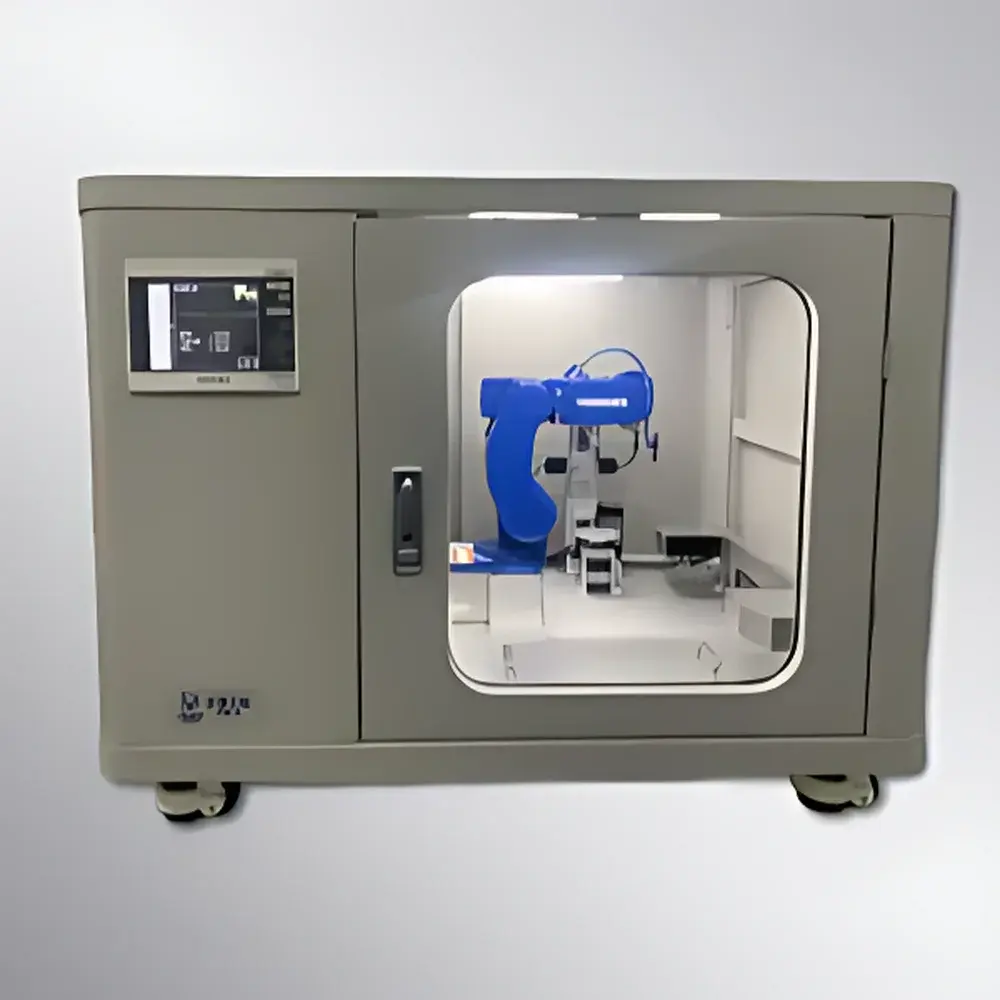
Radioisotope Source Capsule Automatic Inspection System
| Brand | — |
|---|---|
| Origin | Beijing, China |
| Manufacturer Type | Authorized Distributor |
| Product Origin | Domestic (China) |
| Model | Radioisotope Source Capsule Automatic Inspection System |
| Pricing | Available Upon Request |
Overview
The Radioisotope Source Capsule Automatic Inspection System is an integrated metrology platform engineered for high-precision, non-destructive dimensional verification of sealed radioactive source encapsulations—primarily cylindrical metallic capsules used in nuclear medicine, industrial radiography, and research isotope applications. Designed to meet stringent quality assurance requirements in regulated environments, the system implements a hybrid measurement architecture combining optical triangulation and tactile probing principles. This dual-sensor approach ensures traceable, repeatable assessment of critical geometric parameters—including outer diameter, height, axial straightness, and end-face parallelism—without requiring manual repositioning or operator intervention. The system operates under controlled ambient conditions and is compatible with shielded glove-box integration for handling low- to medium-activity sources (e.g., 192Ir, 60Co, 137Cs), aligning with IAEA Safety Standards Series No. SSG-24 and national regulatory guidance for sealed source manufacturing quality control.
Key Features
- Six-axis collaborative robotic arm (payload: 3–5 kg, repeatability ±0.02 mm) for adaptive sample handling across heterogeneous capsule geometries and batch sizes
- Hybrid sensor suite: high-resolution telecentric optical imager (pixel resolution ≤5 µm, field-of-view 25–100 mm) paired with calibrated tactile probe (force-controlled contact, resolution 0.1 µm)
- Automated calibration routine compliant with ISO 10360-2 (CMM performance verification) and traceable to NIM (National Institute of Metrology, China) standards
- Programmable inspection sequences supporting multi-point diameter profiling along axial length and height verification at configurable Z-steps
- Embedded safety interlocks including radiation-aware motion stop logic, emergency egress triggers, and real-time dose rate monitoring interface (compatible with common GM or scintillation detectors)
- Robust mechanical architecture with stainless-steel frame, ESD-safe work surface, and optional lead-lined enclosure for Class II source handling
Sample Compatibility & Compliance
The system accommodates cylindrical source capsules ranging from Ø3 mm × 5 mm to Ø25 mm × 60 mm, including stainless steel (316L), titanium alloy (Grade 2), and zirconium-clad variants. It supports both bare capsules and those mounted on standardized holders per ISO 2919:2012 Annex B. All measurement protocols are documented per ISO/IEC 17025:2017 requirements for testing laboratories, with full audit trail retention for GLP/GMP-aligned facilities. Data integrity complies with ALCOA+ principles (Attributable, Legible, Contemporaneous, Original, Accurate, Complete, Consistent, Enduring, Available), and electronic records satisfy FDA 21 CFR Part 11 criteria when deployed with validated software configuration.
Software & Data Management
Control and analysis are executed via proprietary Windows-based software featuring modular workflow scripting, real-time deviation mapping (color-coded tolerance visualization), and automated report generation in PDF/XLSX formats. Measurement data—including raw sensor outputs, corrected values, uncertainty budgets (per GUM Supplement 1), and image snapshots—is stored in an encrypted SQLite database with role-based access control (RBAC). The software supports export to LIMS via ASTM E1482-compliant XML schema and provides API hooks for integration with MES or ERP systems. Audit logs record all user actions, parameter changes, and calibration events with timestamp, operator ID, and digital signature—enabling full traceability during regulatory inspections.
Applications
- Final dimensional release testing of manufactured radioisotope capsules prior to sterilization and sealing
- In-process verification during encapsulation line operation (e.g., post-welding geometry check)
- Periodic stability monitoring of legacy source inventory (e.g., detecting corrosion-induced dimensional drift)
- Root cause analysis for capsule failure investigations (e.g., buckling, ovality, or weld seam displacement)
- Supporting QA documentation packages for regulatory submissions (e.g., NRC Form 313, CNSC License Application Annexes)
FAQ
Does the system require source-specific fixturing?
No—it uses adaptive robotic path planning and vision-guided alignment to accommodate variable capsule footprints without dedicated tooling.
Can it verify wall thickness or internal voids?
No—this system performs external dimensional metrology only; wall thickness requires complementary techniques such as X-ray CT or ultrasonic testing.
Is remote operation supported for hot cell environments?
Yes—fully compatible with master-slave manipulator interfaces and can be operated via fiber-optic isolated Ethernet link with latency <50 ms.
What calibration certificates are provided?
NIST-traceable calibration reports for optical sensor and tactile probe, plus robot positional accuracy verification per ISO 9283.
How is radiation damage mitigated in optical components?
All optics use radiation-hardened fused silica lenses and anti-radiation coating; sensor electronics are housed outside primary shielding zones with fiber-coupled illumination.
Related Products





