
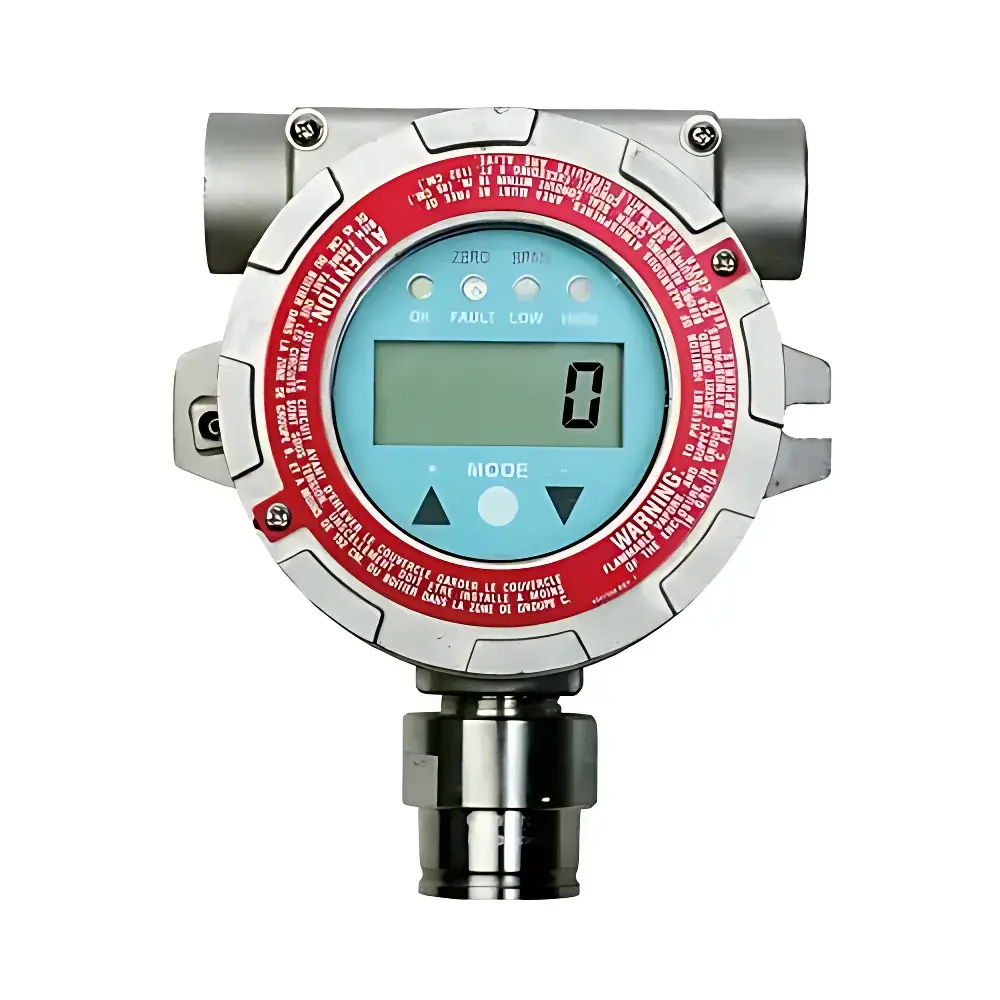
RAE Systems FGM-1200S Intrinsically Safe Infrared Combustible Gas Detector
| Brand | RAE Systems |
|---|---|
| Origin | USA |
| Model | FGM-1200S |
| Detection Principle | Non-Dispersive Infrared (NDIR) |
| Sensor Type | Smart Digital NDIR |
| Installation | Fixed Wall/Mast Mount |
| Enclosure Material | Stainless Steel |
| Protection Rating | IP65 |
| Explosion Protection | ATEX II 2G EEx d II CT6, UL/CSA Certified |
| Operating Temperature | CH₄: −40 °C to +70 °C |
| CO₂ | −20 °C to +60 °C |
| Humidity Range | 0–95% RH (non-condensing) |
| Pressure Range | 90–110 kPa |
| Power Supply | DC 9–36 V, 60 mA (170 mA @ 24 VDC) |
| Output Signals | 4–20 mA (adjustable, 600 Ω load), RS485 Modbus RTU, Two Programmable Dry Contact Relays (30 VDC, 2 A) |
| Response Time (T90) | ≤30 s |
| Accuracy | ±2% FS |
| Sampling Method | Diffusion |
| Display | Backlit LCD with Four-Color Status LEDs |
| Dimensions (H×W×D) | 168 × 150 × 109 mm |
| Weight | 3.5 kg |
Overview
The RAE Systems FGM-1200S is a fixed-mount, explosion-proof infrared combustible gas detector engineered for continuous, reliable monitoring of hydrocarbon gases—including methane (CH₄), propane, butane, and other C₁–C₄ alkanes—in hazardous industrial environments. Utilizing non-dispersive infrared (NDIR) spectroscopy, the FGM-1200S measures gas concentration by detecting characteristic absorption bands in the mid-infrared range (typically 3.3–3.5 µm), enabling selective, interference-resistant detection without chemical consumption or sensor poisoning. Unlike catalytic bead (pellistor) sensors, the NDIR platform remains fully functional in oxygen-deficient atmospheres (<10% O₂), eliminating false negatives during inerting, purging, or confined-space entry operations. The device complies with international intrinsic safety and flameproof design standards, including ATEX II 2G EEx d II CT6, UL 913 Class I, Division 1, Groups B–D, and CSA C22.2 No. 152, making it suitable for Zone 1 and Class I, Div. 1 classified areas across upstream oil & gas, petrochemical refineries, LNG terminals, biogas plants, and wastewater treatment facilities.
Key Features
- Smart digital NDIR sensor with embedded temperature and humidity compensation algorithms—ensures stable performance under extreme ambient conditions (−40 °C to +70 °C, 0–95% RH non-condensing).
- Stainless steel (316L) housing rated IP65 for corrosion resistance in high-humidity, saline, or chemically aggressive process environments.
- Triple-output architecture: industry-standard 4–20 mA analog output (field-adjustable zero/span), RS485 Modbus RTU for integration into DCS/SCADA systems, and two user-programmable relay outputs (30 VDC, 2 A) for local alarm staging or shutdown interlocks.
- Intuitive local interface: large-character backlit LCD display with four-color status indicators (green/amber/red/blue) for real-time gas level, fault, calibration, and communication status—operable via magnetic wand to eliminate need for enclosure opening in hazardous zones.
- Self-diagnostics and sensor health monitoring—supports predictive maintenance scheduling and reduces unplanned downtime in critical safety loops.
- Configurable alarm thresholds and hysteresis settings per IEC 61511 SIL 2 readiness guidelines, with optional event logging for audit trails.
Sample Compatibility & Compliance
The FGM-1200S is validated for detection of saturated hydrocarbons (e.g., CH₄, C₃H₈, C₄H₁₀), unsaturated hydrocarbons (e.g., C₂H₄), and select halogenated compounds (e.g., CHCl₃, CCl₄) that exhibit strong C–H or C–Cl stretching vibrations within its optical bandpass. It exhibits minimal cross-sensitivity to CO₂, CO, H₂O vapor, and common background gases—eliminating false alarms caused by combustion byproducts or ambient humidity fluctuations. The instrument meets requirements for use in accordance with ISO 10156 (gas group classification), EN 60079-29-1 (performance criteria for gas detectors), and NFPA 72 Chapter 17 (initiating device circuit integrity). Its certification portfolio supports compliance with OSHA 1910.120 (HAZWOPER), EPA 40 CFR Part 60 Subpart Ja (leak detection), and EU Directive 2014/34/EU (ATEX) for equipment placed on the market in explosive atmospheres.
Software & Data Management
Configuration, calibration, and diagnostic functions are managed via RAE Systems’ proprietary ProRAE Studio II software (Windows-based), which supports firmware updates, data export in CSV/Excel format, and generation of calibration certificates compliant with ISO/IEC 17025 traceability requirements. When integrated into a broader RAE Guardian or third-party safety system (e.g., Honeywell Experion, Emerson DeltaV), the FGM-1200S enables full audit trail logging—including timestamped calibration events, alarm activations, relay state changes, and sensor drift history—satisfying FDA 21 CFR Part 11 electronic record/electronic signature (ER/ES) expectations where applicable. All configuration parameters are stored in non-volatile memory and survive power loss without reset.
Applications
- Continuous monitoring of flare stack inlet gas composition and pilot flame integrity in refinery flare gas recovery units.
- Leak detection at compressor stations, pipeline valve vaults, and LNG storage tank bund walls.
- Confined space entry pre-check and ventilation verification in sewer networks, digesters, and underground utility tunnels.
- Process safety interlock for solvent recovery systems handling acetone, ethanol, or toluene vapors in pharmaceutical manufacturing cleanrooms.
- Environmental compliance monitoring at landfill gas extraction wells and biogas upgrading skids.
- Fire suppression system pre-discharge verification in electrical switchgear rooms and battery energy storage enclosures.
FAQ
Does the FGM-1200S require oxygen to operate?
No—the NDIR measurement principle is independent of ambient oxygen concentration, enabling accurate detection in inerted, nitrogen-purged, or hypoxic environments.
Can the device detect hydrogen sulfide (H₂S) or carbon monoxide (CO)?
No—H₂S and CO lack strong, distinct absorption features in the operational IR band of this detector; dedicated electrochemical or MOS sensors are required for those gases.
Is field calibration possible without removing the unit from service?
Yes—zero and span calibration can be performed in situ using certified calibration gas and magnetic wand interface, minimizing process interruption.
What is the expected service life of the NDIR sensor?
Under normal operating conditions, the sensor demonstrates >10-year functional stability with no consumables or electrolyte replacement required.
How does the device handle condensation or heavy particulate exposure?
The IP65-rated stainless steel housing and internal hydrophobic filter prevent moisture ingress and particulate fouling; optional heated optics module is available for high-condensation applications.





