
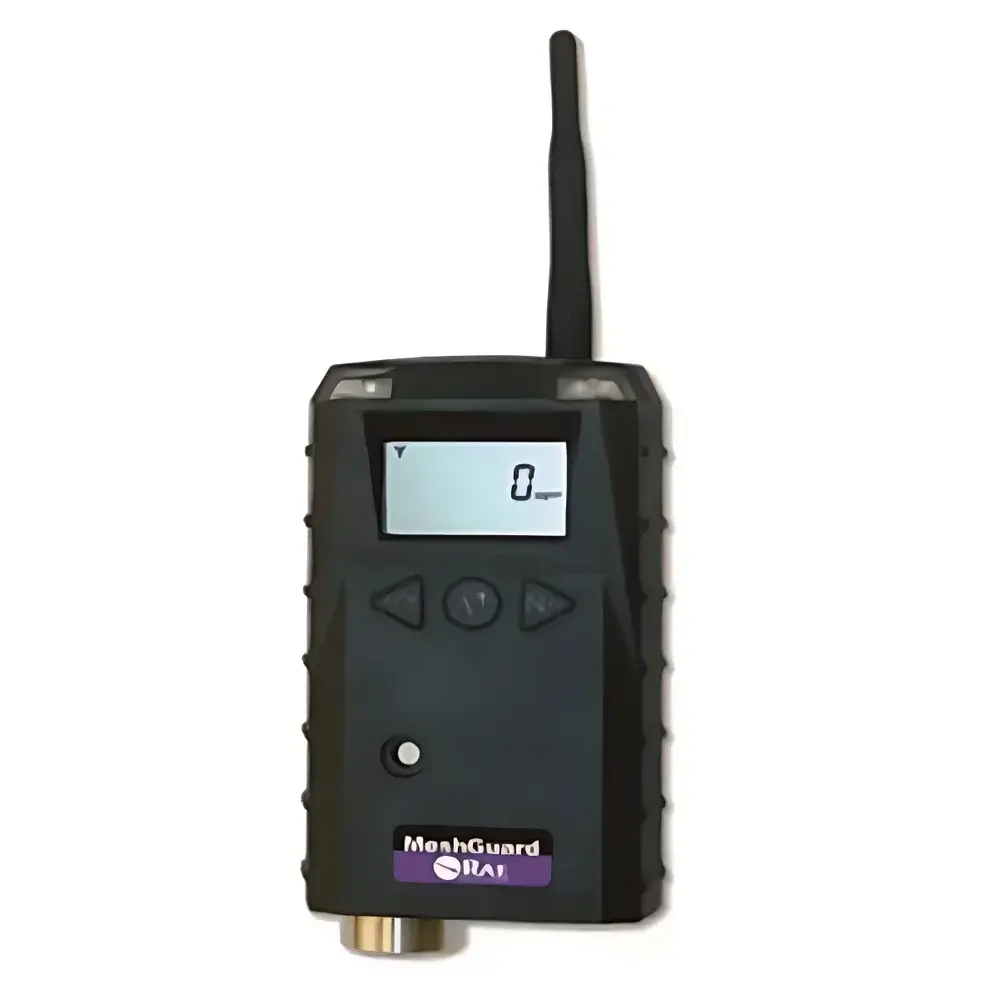
RAE Systems MeshGuard Wireless Gas Detector
| Brand | RAE Systems Inc. |
|---|---|
| Origin | USA |
| Manufacturer Type | Authorized Distributor |
| Product Origin | Imported |
| Model | MeshGuard Wireless Gas Detector |
| Pricing | Available Upon Request |
Overview
The RAE Systems MeshGuard Wireless Gas Detector is a robust, dual-mode (portable and fixed-installation) instrument engineered for real-time detection and monitoring of hazardous gases in dynamic industrial environments. Utilizing electrochemical, catalytic bead, or infrared sensing technologies—depending on configured sensor modules—the MeshGuard operates on a self-organizing mesh network architecture compliant with IEEE 802.15.4 and Zigbee PRO protocols. This enables autonomous node discovery, adaptive routing, and redundant data paths without reliance on centralized infrastructure. Designed for rapid deployment in non-permanent or hard-to-wire locations, the device delivers continuous gas concentration readings (ppm or %LEL), event-triggered alarms, and time-stamped telemetry to a central FMC2000 Wireless Controller or PC-based RAEView software platform. Its operational principle centers on selective gas–sensor interaction, transduction into calibrated analog/digital signals, and wireless transmission via encrypted 2.4 GHz RF communication with AES-128 encryption—ensuring data integrity and regulatory alignment with IEC 61508 SIL 2 functional safety requirements.
Key Features
- True dual-mode operation: functions as both a personal portable monitor and a fixed-point area detector with optional mounting bracket and magnetic base
- Self-healing mesh networking: automatic topology reconfiguration upon node addition, failure, or signal obstruction—no manual reconfiguration required
- Integrated dual-stage alarm system: programmable visual (high-intensity LED strobe) and audible (≥95 dB at 30 cm) alerts with configurable thresholds per gas channel
- Extended battery life: rechargeable lithium-ion battery supporting up to 12 months of typical fixed deployment or 24+ hours of continuous portable use (varies by sensor type and sampling frequency)
- Tool-free magnetic mounting: enables secure, vibration-resistant installation on ferrous surfaces without drilling, wiring, or structural modification
- IP66-rated enclosure: dust-tight and protected against powerful water jets—suitable for outdoor, refinery, and offshore applications
- On-device diagnostics: real-time sensor health monitoring, battery voltage reporting, RF link quality assessment, and fault logging with event timestamps
Sample Compatibility & Compliance
The MeshGuard supports interchangeable sensor cartridges for common toxic and combustible gases—including H2S, CO, O2, SO2, Cl2, NH3, CH4, and C3H8—with cross-sensitivity profiles documented per ISO 16000-23 and IEC 60079-29-1. Each sensor module undergoes factory calibration traceable to NIST standards and supports field bump testing per OSHA 1910.120 and EPA Method 204. The system complies with ATEX II 2G Ex ib IIC T4 Gb, IECEx Ex ib IIC T4 Gb, UL 913 Class I, Division 1, Groups B, C, D, and meets EMC Directive 2014/30/EU and RoHS 2011/65/EU. Data logging and alarm records satisfy audit requirements under OSHA 1910.1200 (HazCom) and support GLP/GMP-aligned documentation practices when integrated with RAEView’s 21 CFR Part 11-compliant user access controls and electronic signature capability.
Software & Data Management
MeshGuard nodes communicate natively with the FMC2000 Wireless Controller (up to 250 nodes per gateway) or via USB/RS-485 to RAEView v5.x software on Windows-based workstations. RAEView provides centralized configuration management, real-time GIS-mapped visualization of gas levels and alarm states, historical trend analysis (min/max/avg over user-defined intervals), automated report generation (PDF/CSV), and customizable email/SMS alerting via SMTP or cellular modem integration. All configuration changes, calibration events, and alarm activations are logged with immutable timestamps and operator IDs—enabling full traceability for internal audits or regulatory inspections. Firmware updates are delivered over-the-air (OTA) with rollback capability and SHA-256 signature verification.
Applications
- Temporary worksites: turnaround maintenance, pipeline pigging operations, and contractor-led refinery shutdowns where wired infrastructure is unavailable or cost-prohibitive
- Remote upstream operations: wellhead monitoring, flare stack perimeter surveillance, and storage tank farm leak detection in oil & gas exploration zones
- Confined space entry support: pre-entry atmospheric verification and continuous monitoring during excavation, vessel cleaning, or ductwork inspection
- Municipal infrastructure: wastewater treatment plant headworks, lift station sump monitoring, and landfill gas migration tracking
- Chemical distribution hubs: loading rack vapor monitoring, drum storage area surveillance, and warehouse aisle air quality mapping
FAQ
What gas types can the MeshGuard detect?
The MeshGuard supports plug-and-play sensor modules for up to four gases simultaneously—including oxygen deficiency/enrichment, combustibles (LEL), hydrogen sulfide, carbon monoxide, sulfur dioxide, chlorine, ammonia, and hydrocarbons—subject to regional certification and sensor availability.
Does MeshGuard require a dedicated base station?
No. It operates within a peer-to-peer mesh network; however, an FMC2000 controller or compatible gateway is required for data aggregation, remote visualization, and alarm notification.
Can MeshGuard data be integrated into existing SCADA or DCS systems?
Yes—via Modbus TCP or OPC UA interfaces through the FMC2000 gateway, enabling seamless interoperability with Emerson DeltaV, Honeywell Experion, Siemens PCS7, and other industry-standard control platforms.
Is calibration traceable to national standards?
All factory calibrations are NIST-traceable, and each unit ships with a Certificate of Conformance detailing sensor lot numbers, calibration dates, zero/span values, and uncertainty budgets per ISO/IEC 17025 guidelines.
How is cybersecurity addressed in the wireless protocol?
The mesh network employs AES-128 encryption for payload confidentiality, HMAC-SHA256 for message integrity, and unique per-node keys provisioned during manufacturing—meeting IEC 62443-3-3 SL2 requirements for industrial IoT devices.
Related Products







