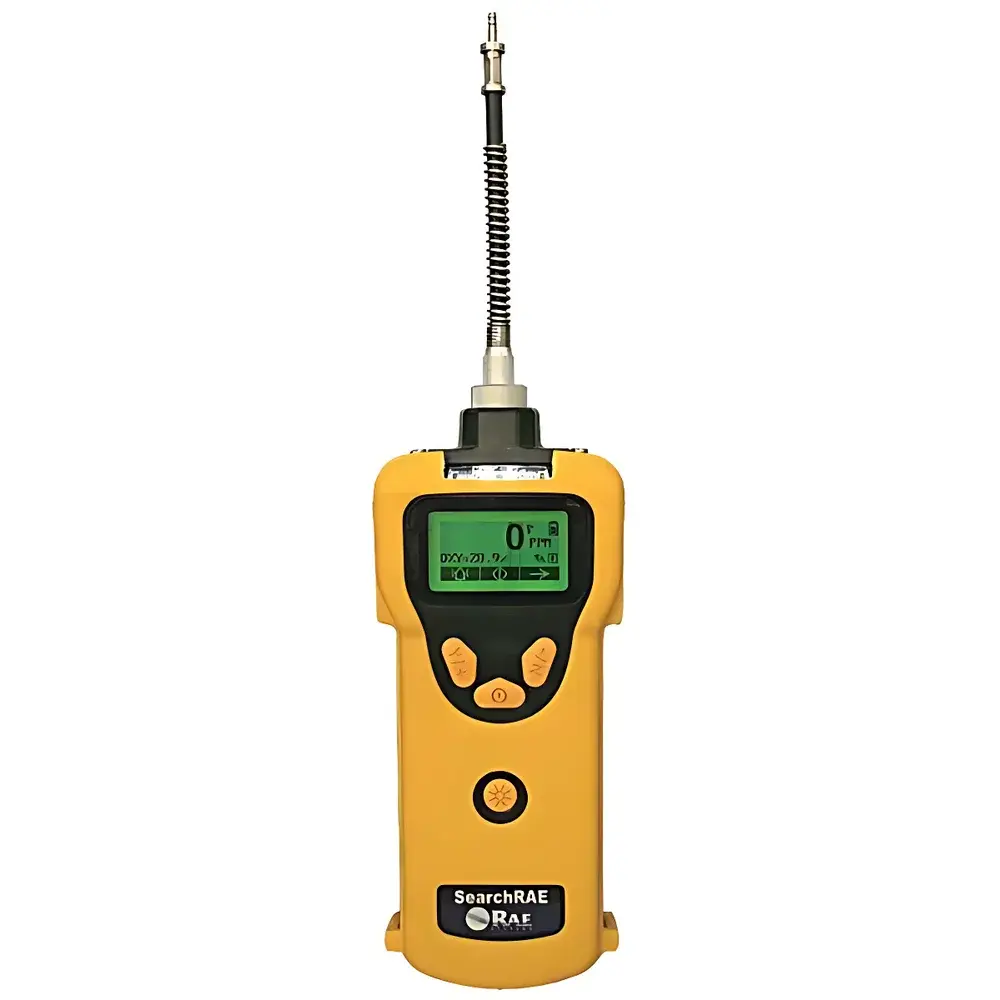
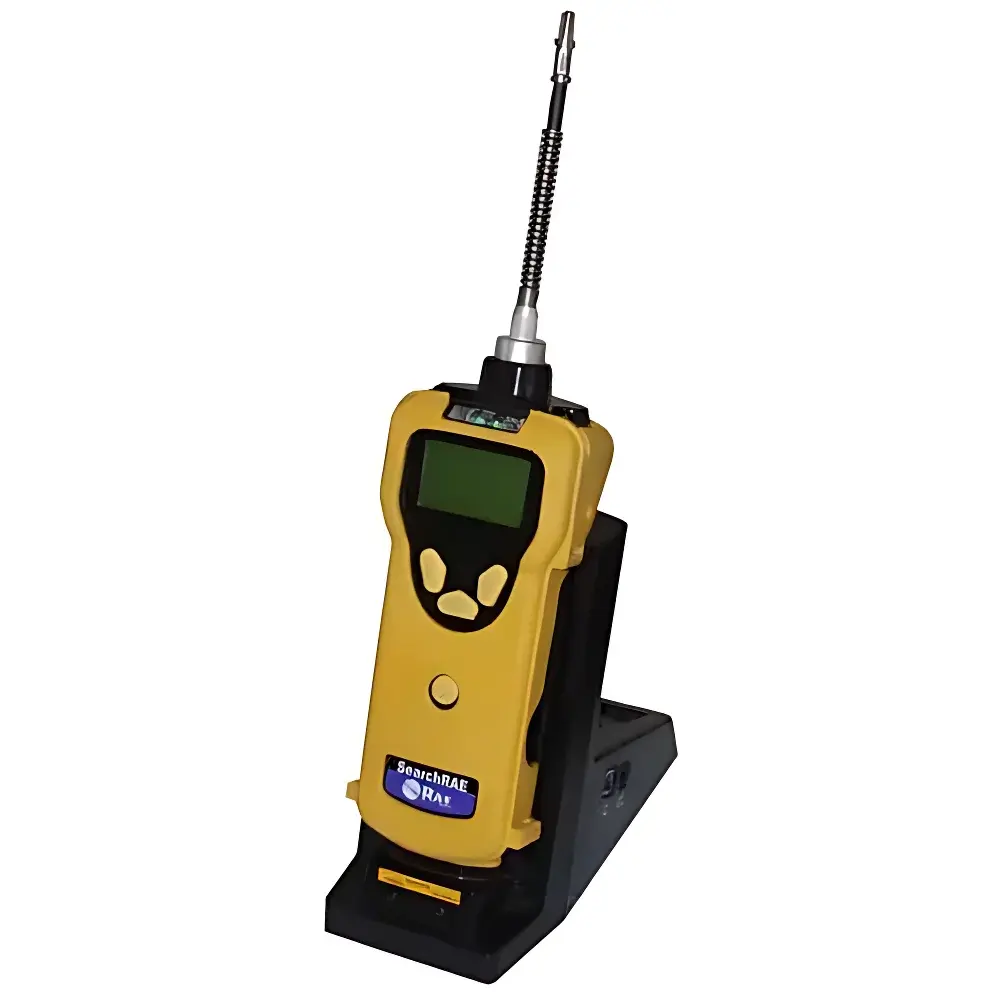
RAE Systems SearchRAE PGM-1600 Combustible & Toxic Gas Detector
| Brand | RAE Systems |
|---|---|
| Origin | USA |
| Model | PGM-1600 |
| Dimensions | 21 × 8.5 × 6.5 cm |
| Weight | 700 g (with Li-ion battery) |
| Sampling Method | Pump-assisted |
| Enclosure Material | Engineering plastic with rubber overmold |
| Ingress Protection | IP65 |
| EMC Compliance | EMC Directive 89/336/EEC |
| Operating Temperature | −20 °C to +50 °C |
| Humidity Range | 0–95% RH (non-condensing) |
| Hazardous Area Certification | Ex ia(d) IIC T4 |
| Display | Graphic LCD with auto-backlight |
| Languages | Chinese, English + icons |
| Alarm | 95 dB @ 30 cm audible alarm, dual-color LED flash |
| Alarm Types | High/Low gas concentration, low battery, sensor fault, pump blockage |
| Data Storage | SD card (Excel-compatible format) |
| Sampling Interval | 1–3600 s adjustable |
| Pump Flow Rate | 450–550 cc/min |
| Battery | 3.7 V rechargeable Li-ion |
| Runtime | Up to 16 h (typical field use) |
| Charge Time | 8 h |
| Calibration | Zero and span calibration |
| Sensor Options | LEL or LEL/VOL catalytic bead sensor |
| Sensor Specifications | O₂ (0–30% vol, 0.1% res., T90 ≤15 s) |
| LEL/VOL (dual-range | 0–100% LEL / 0–100% vol, 1% res., T90 ≤15 s) |
Overview
The RAE Systems SearchRAE PGM-1600 is a compact, intrinsically safe, pump-assisted portable gas detector engineered for simultaneous monitoring of combustible gases (via catalytic bead or dual-range LEL/VOL sensing), oxygen deficiency/enrichment, and toxic gases including carbon monoxide and hydrogen sulfide. Designed in accordance with IEC 60079-0 and IEC 60079-11 for use in Zone 0/1 hazardous locations, the PGM-1600 employs proven electrochemical (EC), catalytic bead (CB), and metal oxide semiconductor (MOS) sensor technologies to deliver reliable, real-time detection across diverse industrial environments. Its architecture integrates a high-efficiency micro-diaphragm sampling pump, robust IP65-rated housing, and dual-mode display interface—enabling operation under extreme ambient conditions (−20 °C to +50 °C, up to 95% RH non-condensing). The instrument is explicitly intended for personnel safety applications in confined space entry, hydrocarbon processing, pipeline integrity verification, and upstream/downstream petrochemical operations where multi-gas threat assessment is mission-critical.
Key Features
- Intrinsically safe design certified to Ex ia(d) IIC T4, permitting deployment in explosive atmospheres containing Group IIC gases (e.g., hydrogen, acetylene, ethylene)
- Pump-assisted sampling with regulated flow (450–550 cc/min) and automatic pump status feedback—critical for remote or diffusion-limited sampling points
- Graphical LCD with auto-backlight and integrated white LED illumination for low-light or underground workspaces
- Modular sensor architecture enabling tool-free replacement of EC, CB, and MOS sensors—minimizing downtime during maintenance cycles
- Dual-language interface (English and Chinese) with intuitive icon-based navigation and context-sensitive prompts
- SD card data logging compliant with ISO 17025 traceability requirements; stores timestamped readings, peak values, alarm events, and system diagnostics in native Excel (.csv) format
- Configurable alarm thresholds per channel (high/low limits), with independent latching and non-latching modes for regulatory reporting alignment
- Extended runtime support via swappable 3.7 V Li-ion battery (16 h typical) or field-replaceable 4×AA alkaline configuration—eliminating dependency on charging infrastructure
Sample Compatibility & Compliance
The PGM-1600 supports direct sampling of ambient air and process-adjacent gas streams without pre-conditioning. Its LEL sensor detects hydrocarbons (methane, propane, butane) and solvent vapors; EC O₂ sensor verifies atmospheric oxygen levels per OSHA 1910.146 and NFPA 350 confined space entry protocols; CO and H₂S sensors meet ASTM D6204 and EN 45544-2 response time and sensitivity criteria. The MOS sensor extends detection capability to low-concentration methane in ventilation-controlled zones. All sensor calibrations adhere to ISO 14644-1 cleanroom validation principles for zero-drift stability. Device-level compliance includes ATEX 2014/34/EU, IECEx, UL 913 8th Ed., and CSA C22.2 No. 152. Regulatory documentation—including factory calibration certificates, sensor lot traceability, and explosion-proof test reports—is provided with each unit for audit readiness under OSHA, EPA, and EU Seveso III frameworks.
Software & Data Management
Data retrieval occurs via three interoperable pathways: SD card extraction (plug-and-play Excel import), USB communication through the optional docking station (supporting firmware updates and parameter configuration), and RS232 serial link via travel charger (for legacy system integration). Logged datasets include full metadata: GPS coordinates (when paired with external module), operator ID, calibration history, pump runtime, and battery discharge profile. Exported files conform to GLP-compliant naming conventions and support automated ingestion into LIMS platforms (e.g., LabWare, Thermo Fisher SampleManager) via configurable CSV mapping. Audit trail functionality records all user-initiated actions—including alarm acknowledgments, calibration events, and sensor swaps—with immutable timestamps aligned to NIST-traceable real-time clock.
Applications
- Natural gas distribution: leak surveying along transmission mains, metering stations, and regulator vaults
- Refinery turnaround safety: pre-entry verification in fractionation towers, flare headers, and sour water strippers
- Offshore platform monitoring: continuous watch for H₂S breakthrough in drilling mud systems and cargo tank atmospheres
- Chemical manufacturing: real-time tracking of CO accumulation in reformer furnaces and ammonia synthesis loops
- Municipal utility inspections: sewer line ingress assessment for CH₄ and H₂S per EPA Method 21 and ASTM D7252
- Emergency response: rapid hazard mapping during transportation incidents involving flammable liquid tankers or compressed gas cylinders
FAQ
What certifications validate the PGM-1600 for use in Class I, Division 1 areas?
The device carries Ex ia(d) IIC T4 certification per IEC 60079-0/11, ATEX 2014/34/EU, and UL 913 8th Edition—covering Group IIC gases at ambient temperatures up to +50 °C.
Can the LEL/VOL sensor distinguish between %LEL and %vol readings simultaneously?
Yes—the dual-range catalytic bead sensor outputs concurrent values: one scaled to lower explosive limit (%LEL) and another linearized to volumetric concentration (%vol), selectable via menu-driven units toggle.
Is SD card logging compliant with FDA 21 CFR Part 11 requirements?
While the PGM-1600 itself does not implement electronic signatures or role-based access control, its CSV export structure, immutable timestamps, and full event logging enable integration into validated Part 11–compliant review workflows when deployed within a qualified LIMS environment.
How frequently must span calibration be performed for H₂S detection in sour service environments?
Per OSHA 1910.120 and API RP 14C, daily bump testing is required prior to each shift; full span calibration is recommended every 30 days or after exposure to >50 ppm H₂S—verified using NIST-traceable calibration gas.
Does the pump maintain consistent flow rate across varying battery states?
Yes—the microprocessor-regulated pump driver compensates for voltage drop across the Li-ion discharge curve, maintaining 450–550 cc/min within ±5% tolerance throughout operational life.