
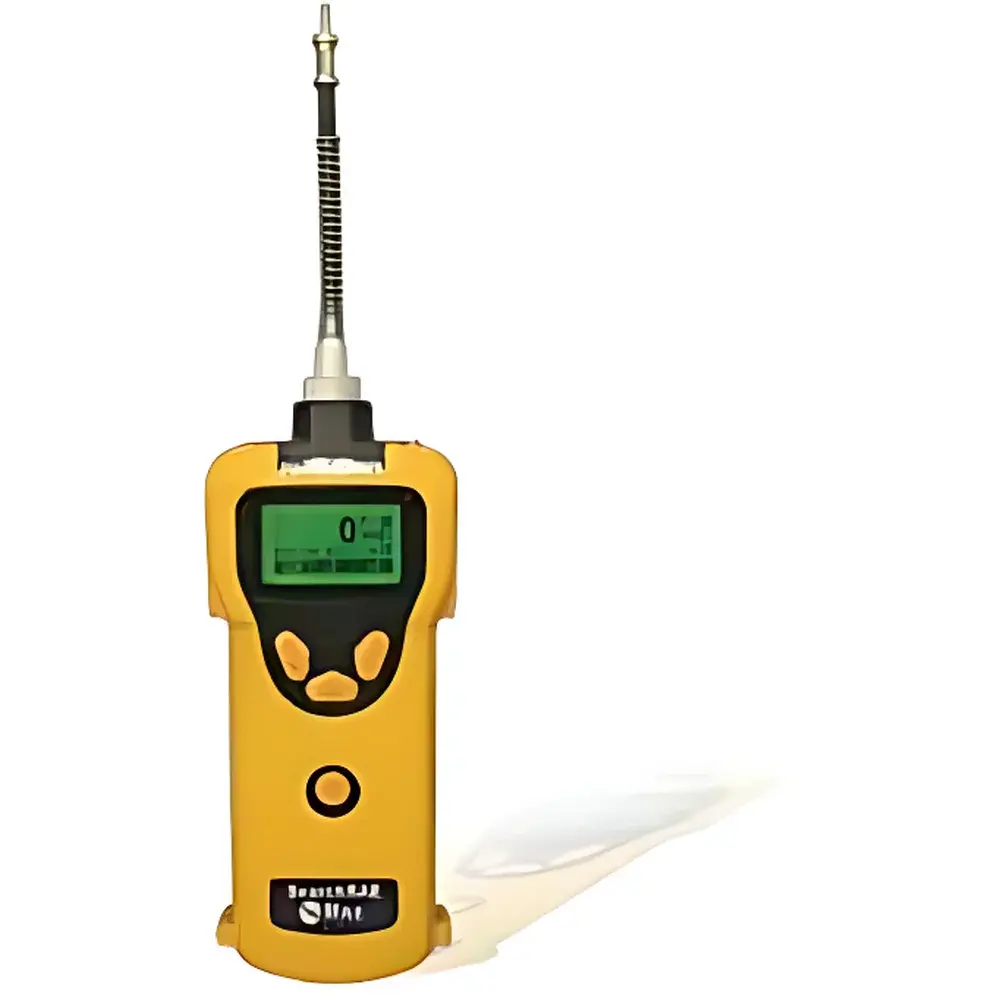
RAE Systems SearchRAE PGM-1600 Multigas Detector
| Brand | RAE Systems Inc. |
|---|---|
| Origin | USA |
| Model | PGM-1600 |
| Instrument Principle | Electrochemical Sensor (O₂, CO, H₂S), Catalytic Bead (LEL), Metal Oxide Semiconductor (MOS) |
| Type | Portable Multicomponent Gas Analyzer |
| Response Time | ≤15 s (T90) |
| Repeatability | ±2% of reading (O₂, LEL, CO, H₂S) |
| Sampling Pump | Integrated diaphragm pump, 30 m extendable sampling line |
| Power Supply | Rechargeable 3.7 V Li-ion battery or 4× AA alkaline batteries |
| Data Storage | Removable SD card, CSV/Excel-compatible export format |
| Display | Backlit graphical LCD with multilingual UI (including Chinese) |
| Sensor Slots | 3 configurable bays supporting interchangeable electrochemical, catalytic bead, TC, and MOS sensors |
Overview
The RAE Systems SearchRAE PGM-1600 is a rugged, field-deployable multicomponent gas detector engineered for simultaneous real-time monitoring of combustible gases (LEL), oxygen deficiency/enrichment (O₂), toxic gases (CO, H₂S), and volatile organic compounds (VOCs) via MOS sensing. Its operational architecture integrates three independent sensor bays—each accepting industry-standard electrochemical, catalytic bead (pellistor), thermal conductivity (TC), or metal oxide semiconductor (MOS) modules—enabling configuration flexibility across diverse hazard profiles. The instrument employs fundamental detection principles aligned with recognized industrial safety standards: catalytic combustion for hydrocarbon LEL measurement per ASTM E681 and IEC 60079-15; electrochemical transduction for O₂, CO, and H₂S in accordance with ISO 16000-23 and OSHA 29 CFR 1910.120; and MOS-based broad-spectrum VOC screening compliant with EPA Method TO-15 derivations. Designed for use in confined space entry, refinery turnaround zones, pipeline integrity verification, and upstream oilfield operations, the PGM-1600 delivers trace-level sensitivity while maintaining structural robustness against mechanical shock, humidity (up to 95% RH non-condensing), and temperature extremes (–20 °C to +50 °C).
Key Features
- Triple-sensor bay architecture enabling concurrent detection of up to three gas species—including LEL (catalytic bead), O₂/CO/H₂S (electrochemical), and VOCs (MOS)—with automatic cross-interference compensation.
- Integrated high-efficiency diaphragm sampling pump rated for continuous operation with 30-meter sampling tubing, maintaining full metrological validity across extended draw distances per EN 45544-2 requirements.
- Auto-ranging detection capability spanning ppm (for toxicants), %LEL (for flammables), and %vol (for oxygen and high-concentration hydrocarbons) without manual range switching.
- Backlit graphical LCD with intuitive icon-driven menu navigation supporting English, Spanish, French, German, and Simplified Chinese—optimized for gloved-hand operation and low-light environments.
- Onboard RAE Gas Library containing over 200 pre-calibrated response factors, enabling rapid sensor selection and minimizing calibration drift during multi-gas surveys.
- SD card logging (FAT32 formatted) storing time-stamped concentration data, alarm events, pump status, and battery voltage in comma-separated values (CSV) format compatible with Microsoft Excel and LIMS integration.
Sample Compatibility & Compliance
The PGM-1600 is validated for direct ambient air sampling and diffusion-based measurement, as well as active pumped sampling from ducts, manholes, storage tanks, and vapor recovery units. It meets ATEX II 2G Ex ib IIB T4 Gb and IECEx Ex ib IIB T4 Gb certification for use in Zone 1 hazardous areas. Device firmware and data handling protocols support audit-ready documentation per OSHA 1910.146 (Confined Space Entry), NFPA 70E (Electrical Safety), and ANSI Z88.2-2015 (Respiratory Protection). All sensor calibrations are traceable to NIST-certified reference standards, and factory calibration certificates include uncertainty budgets per ISO/IEC 17025.
Software & Data Management
Data retrieval occurs via standard SD card removal or optional USB interface using RAE’s ProRAE Studio II desktop software (Windows only). This application enables spectral trend analysis, alarm threshold customization, sensor life-cycle tracking, and automated report generation compliant with FDA 21 CFR Part 11 electronic record requirements—including user authentication, audit trail logging, and electronic signature support. Raw CSV files retain UTC timestamps synchronized to internal RTC, facilitating correlation with GIS-tagged inspection logs and third-party SCADA systems.
Applications
- Petrochemical plant perimeter monitoring and leak detection during maintenance turnarounds
- Confined space atmospheric testing prior to worker entry (O₂, LEL, H₂S, CO)
- Landfill gas migration studies (CH₄, CO, H₂S, VOC screening)
- Chemical warehouse ventilation validation and spill response triage
- Utility tunnel and sewer system safety assessment
- Emergency response vehicle-mounted deployment with remote telemetry options
FAQ
What sensor configurations are supported in the PGM-1600’s three bays?
The device accepts any combination of electrochemical (O₂, CO, H₂S, SO₂, Cl₂, NH₃), catalytic bead (LEL for methane, propane, hydrogen), thermal conductivity (CO₂, CH₄ in inert backgrounds), or MOS (broad VOC detection). No hardware modification is required.
Is the built-in sampling pump intrinsically safe?
Yes—the pump motor and drive circuitry are certified under the same ATEX/IECEx Ex ib IIB T4 Gb rating as the main unit, permitting use in explosive atmospheres without external barriers.
Can the SD card data be imported into enterprise EHS platforms?
Absolutely. CSV exports contain ISO 8601 timestamps, gas IDs, concentration units, alarm flags, and sensor serial numbers—enabling seamless ingestion into SAP EHS, Intelex, or Sphera Gensuite via standard API or batch upload.
How often does the instrument require bump testing and calibration?
Bump testing is recommended before each day’s use per OSHA 1910.120; full calibration is required every 180 days or after exposure to sensor poisons (e.g., silicones, sulfides), verified using certified span gases traceable to NIST SRMs.







