
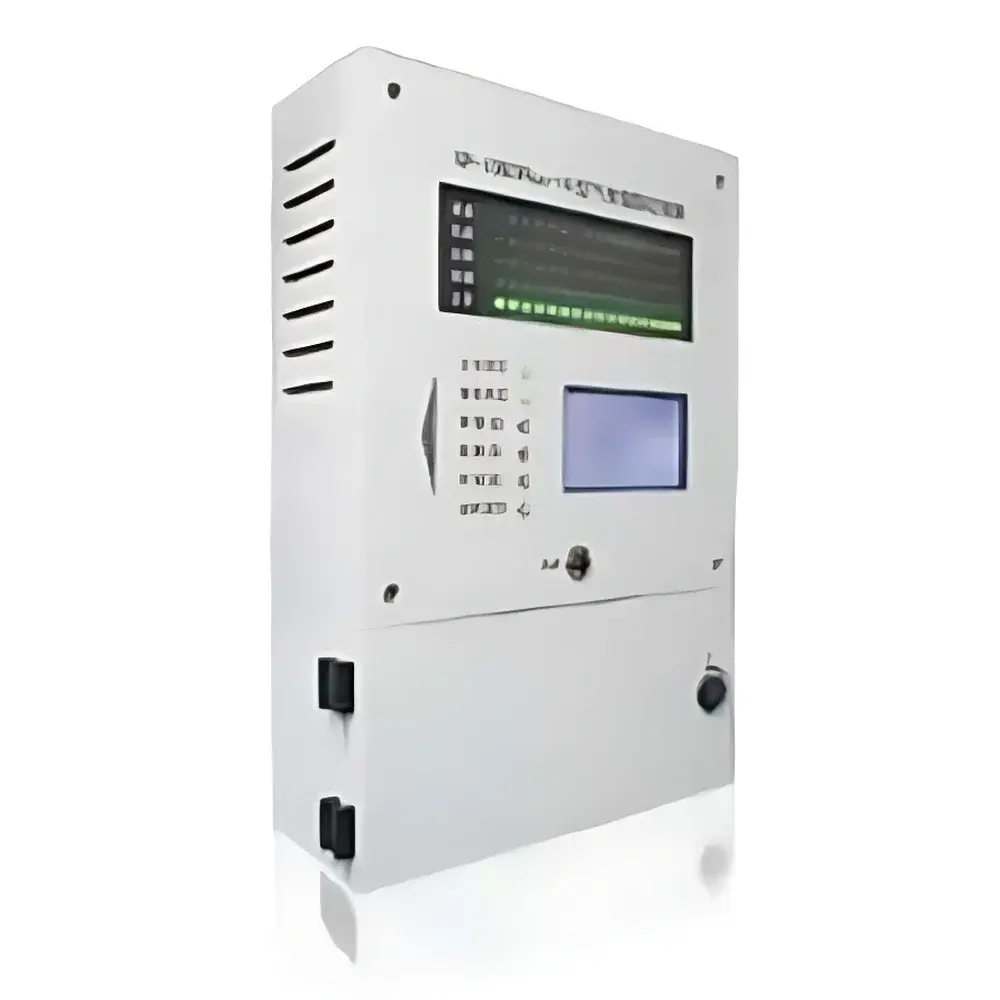
RAE Systems SP-1003 Plus-16 Wall-Mounted Combustible Gas Alarm Controller
| Brand | RAE Systems Inc. |
|---|---|
| Origin | USA |
| Model | SP-1003 Plus-16 |
| Certifications | Compliant with GB 16808–2008 |
| Power Backup | ≥2 h (main power failure) |
| Alarm Sound Pressure Levels | 65 dB / 95 dB / 115 dB (user-selectable) |
| Analog Output | 4–20 mA (synchronized) |
| Digital Communication | RS485 Modbus RTU & RS232 |
| Relay Outputs | 8 programmable + 3 common (Level 1 alarm, Level 2 alarm, fault) with adjustable delay (0–60 s) |
| Event Log Capacity | ≥1,000 entries |
| Display | Main – large dot-matrix LCD (Chinese menu, real-time gas concentration, zone ID, system time) |
| Self-Test & Lock Display Functions | Yes |
| Standby Power Low-Voltage Alert | >1 h warning duration |
Overview
The RAE Systems SP-1003 Plus-16 is a wall-mounted combustible gas alarm controller engineered for continuous monitoring and centralized alarm management in industrial and municipal hazardous environments. Designed to interface with standard 4–20 mA analog output gas detectors—including catalytic bead (pellistor), infrared (IR), and semiconductor sensors—the SP-1003 Plus-16 functions as a central control unit that acquires, processes, validates, and acts upon real-time gas concentration data. Its ARM-based CPU ensures deterministic response timing, high computational accuracy, and robust immunity to electromagnetic interference—critical attributes for safety-critical applications governed by functional safety expectations. The controller operates under a fail-safe architecture: all alarm outputs default to energized (or de-energized, per configuration) upon loss of power or internal fault, supporting SIL 2-aligned system integrity when integrated into larger safety instrumented systems (SIS). It is not a standalone detection device but a certified signal aggregation and decision node compliant with China’s national standard GB 16808–2008 for combustible gas alarm controllers.
Key Features
- ARM Cortex-based embedded processor delivering high-speed signal processing, low-latency alarm triggering (<100 ms typical), and long-term stability across ambient temperatures from −20 °C to +60 °C
- Dual-display architecture: primary dot-matrix LCD with Chinese-language menu navigation, displaying real-time concentration (ppm or %LEL), detector address, alarm status, system clock, and event history; auxiliary high-intensity LED array for immediate visual identification of alarm level and fault conditions
- Multi-protocol digital communication: RS485 Modbus RTU (slave mode) for integration with SCADA, DCS, or BMS platforms; RS232 port for local configuration, firmware updates, and diagnostic logging via terminal software
- Flexible I/O configuration: eight user-programmable relay outputs (NO/NC configurable) plus three dedicated common relays—assigned to first-level alarm, second-level alarm, and system fault—with individually adjustable time delays (0–60 seconds) to prevent nuisance tripping during transient events
- Integrated backup power management: rechargeable sealed lead-acid battery sustains full operational functionality—including display, alarm signaling, and relay actuation—for ≥2 hours during AC mains failure; low-battery warning remains active for >60 minutes prior to capacity exhaustion
- Comprehensive event logging: non-volatile memory stores ≥1,000 timestamped records (alarm activation/deactivation, sensor fault, power interruption, relay operation, self-test results), accessible via LCD menu or exported via RS232
Sample Compatibility & Compliance
The SP-1003 Plus-16 accepts input signals exclusively from certified 4–20 mA analog transmitters compliant with HART physical layer specifications (though HART communication is not supported). It is compatible with detectors calibrated for methane, propane, hydrogen, gasoline vapor, and other hydrocarbon or hydrogen-based combustibles—provided their output conforms to standard current loop linearity and zero/span tolerances (±0.5% FS typical). While the controller itself does not carry ATEX, IECEx, or UL/cUL hazardous location certifications, it is intended for installation in non-classified (unclassified or Class I, Division 2 non-incendive) areas—such as control rooms, analyzer shelters, or equipment enclosures—where it interfaces with intrinsically safe or explosion-proof field devices. Its compliance with GB 16808–2008 confirms adherence to electromagnetic compatibility (EMC), insulation resistance, surge immunity (IEC 61000-4-5 Level 3), and alarm response time requirements specific to Chinese industrial safety regulations.
Software & Data Management
Configuration and diagnostics are performed locally using the built-in LCD interface with hierarchical Chinese menus—no external PC required for routine operation. All settings—including alarm thresholds (independent upper/lower limits per channel), relay logic, sound pressure level selection, display timeout, and clock calibration—are retained in EEPROM and survive power cycles. The controller supports audit-ready operational integrity through its lock-display function (prevents unauthorized parameter changes during maintenance) and automated self-test sequence (verifies CPU, memory, relay drivers, and audio-visual indicators at power-up and on demand). Event logs include ISO 8601 timestamps and support chronological filtering. For enterprise-level traceability, third-party SCADA systems can poll Modbus registers to extract live status and historical alarms—enabling alignment with GLP/GMP documentation practices where alarm acknowledgment and response verification are mandated.
Applications
The SP-1003 Plus-16 serves as a core component in distributed gas detection networks across regulated and high-consequence industries. Typical deployments include refinery perimeter monitoring zones, LNG terminal compressor buildings, municipal water treatment digester enclosures, underground parking ventilation control panels, grain elevator headhouse control cabinets, and university chemistry lab exhaust plenum supervision systems. Its relay outputs directly drive solenoid valves, exhaust fans, emergency shutdown circuits, and strobe/horn assemblies—enabling automatic mitigation responses per predefined safety protocols. In fire protection engineering, it integrates with NFPA 72-compliant notification appliances; in environmental compliance contexts, its data stream feeds into EPA-submission-ready emission monitoring systems (EMS) when paired with certified methane analyzers.
FAQ
Does the SP-1003 Plus-16 support HART communication?
No. It accepts only standard 4–20 mA analog signals and does not decode or interact with HART digital superimposed signals.
Can it be used in Zone 1 hazardous areas?
No. This controller is rated for non-hazardous locations only. Field detectors must bear appropriate explosion protection certification (e.g., Ex d, Ex ia, Ex nA) for classified area use.
Is firmware upgrade possible in the field?
Yes—via RS232 connection using RAE Systems’ official configuration utility and signed firmware binaries.
What is the maximum number of connected detectors?
The SP-1003 Plus-16 supports up to 16 independent 4–20 mA inputs, each assignable to discrete alarm zones and relay actions.
Does it meet FDA 21 CFR Part 11 requirements?
No. It lacks electronic signature capability, audit trail encryption, and role-based access control required for Part 11 compliance; however, its deterministic logging supports manual review in GxP environments.







