
Rain Test Chamber for IPX1–IPX3 Ingress Protection Testing
| Brand | OEM / Custom Brand |
|---|---|
| Origin | Imported |
| Supplier Type | Authorized Distributor |
| Price | USD 3,600 (FOB Reference) |
| Compliance | GB/T 2423.38–1995 (Ra2 & Rb2.2), GB 4208–2017 (IPX1–IPX3), IEC 60529 |
| Rainfall Rate | 200–300 mm/h (Ra2) |
| Drip Nozzle Diameter | Ø0.4 mm, Spacing: 20–25 mm |
| Handheld Spray Nozzle | 78° spray angle, 30° tilt from horizontal, Pressure: 80–100 kPa, Flow Rate: 10.0 ± 0.5 L/min |
| Test Duration | 0–999.9 min |
| Chamber Temperature Range | 25 ± 5 °C (ambient), Water Temp ≤ 20 °C |
| Chamber Construction | 304 Stainless Steel + Copper Components |
| Viewing Window | Tempered glass with sealed frame |
| Drainage System | Sloped floor with perimeter gutter and lift cart integration |
Overview
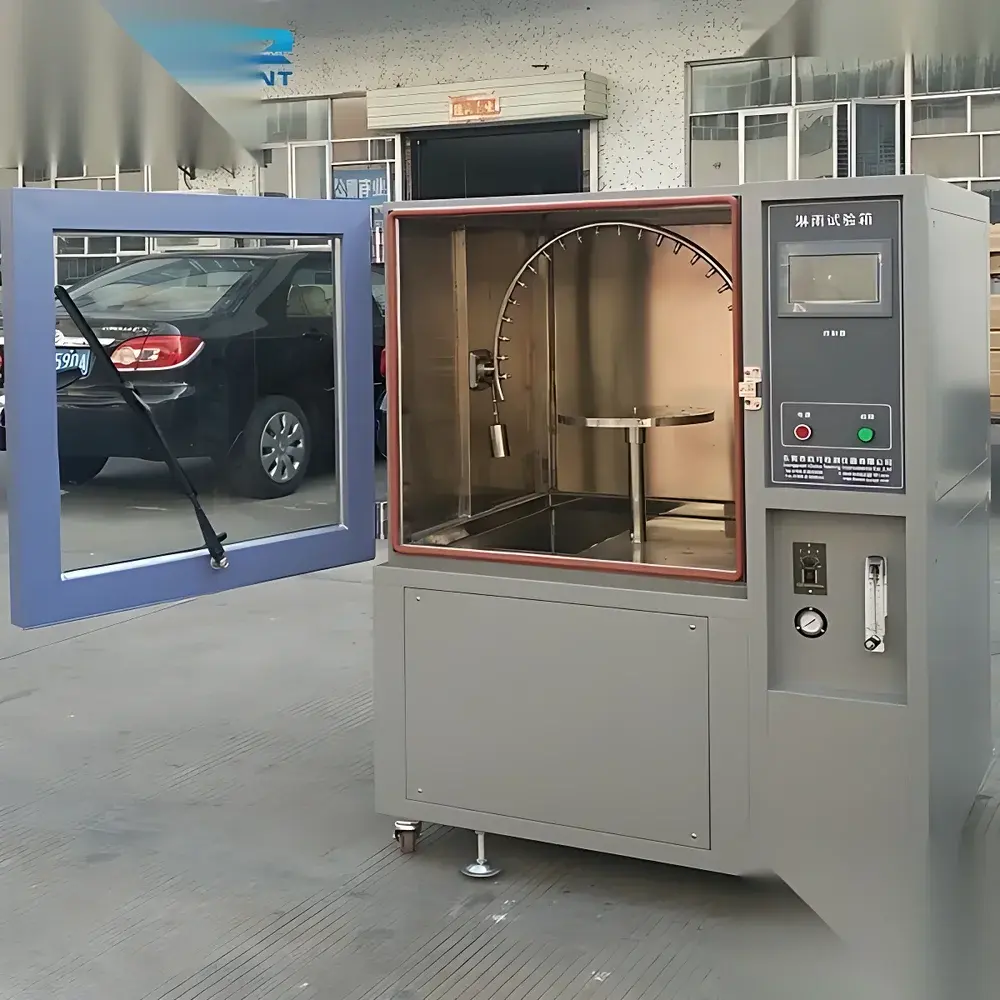
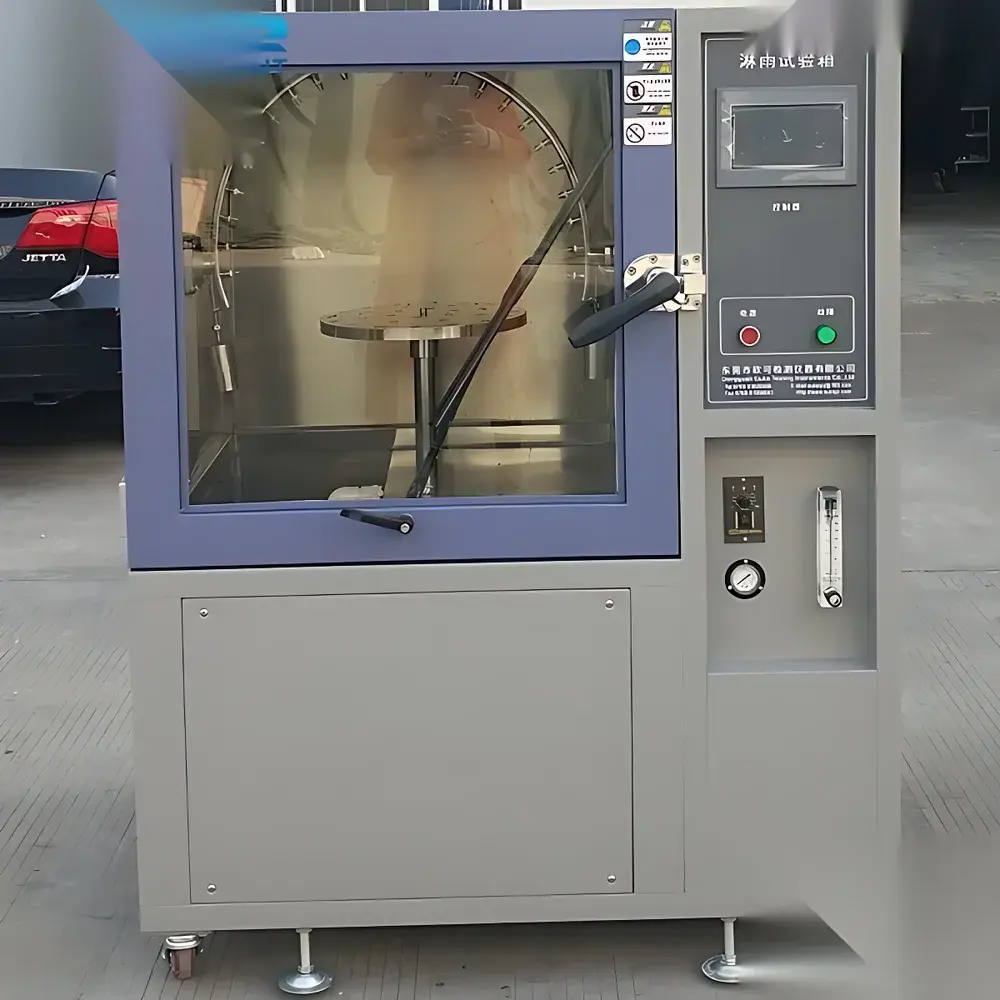
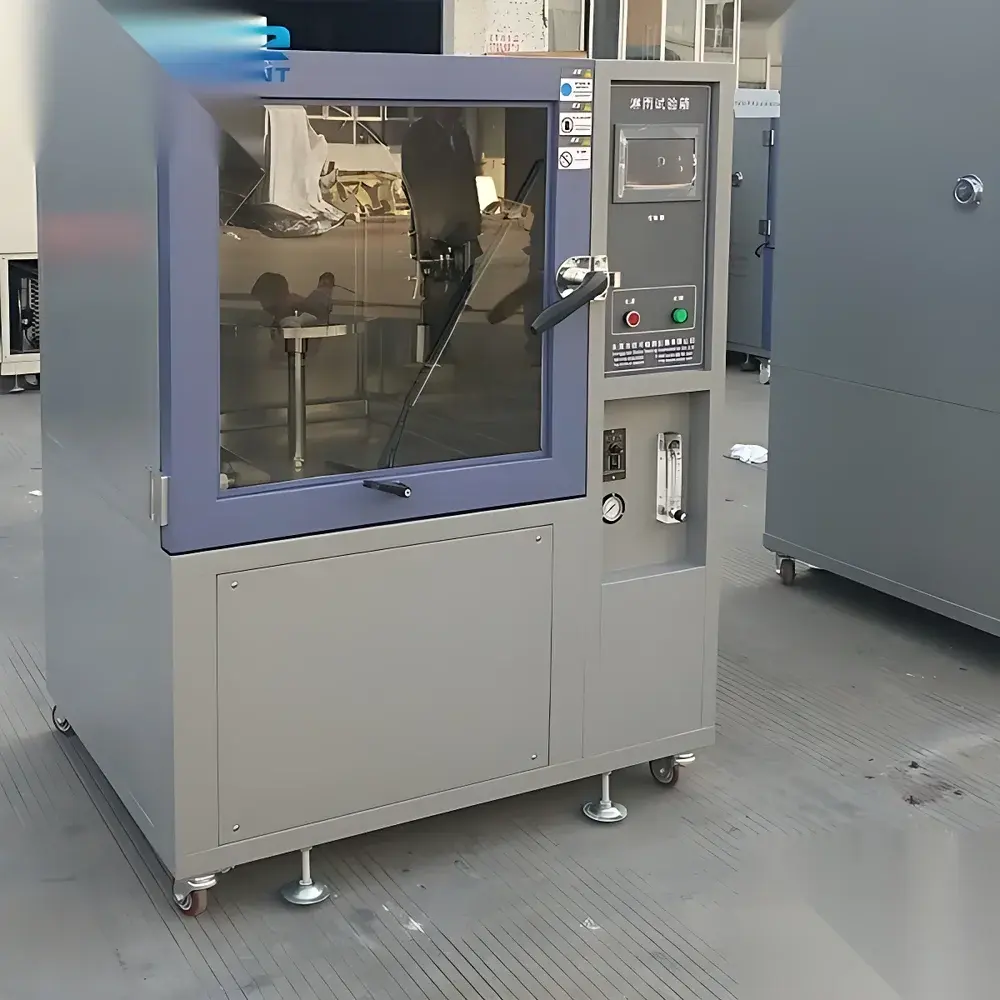
The Rain Test Chamber is a precision-engineered environmental test system designed to evaluate the ingress protection (IP) rating of electrical and electronic enclosures against vertical dripping (IPX1), tilted dripping (IPX2), and directed water spray (IPX3) in accordance with GB/T 2423.38–1995 (equivalent to IEC 60068-2-18 Ed. 4.0), GB 4208–2017, and related national standards. It implements two standardized test methods: Ra2 (drip box method) and Rb2.2 (hand-held oscillating spray method), enabling repeatable, auditable validation of enclosure integrity under controlled rainfall simulation. Unlike generic water exposure cabinets, this chamber integrates calibrated hydraulic delivery, geometrically defined nozzle arrays, and thermally stable ambient conditioning—ensuring measurement traceability and compliance readiness for QC labs, certification bodies, and R&D facilities operating under GLP or ISO/IEC 17025 frameworks.
Key Features
- Modular dual-mode testing: Independent Ra2 drip box (200–300 mm/h uniform flux) and Rb2.2 handheld spray assembly (four fixed-position nozzles, each compliant with GB 4208–2017 Fig. 5 and GB/T 2423.38 Annex B)
- Precision hydraulic control: Stainless steel centrifugal pump with integrated pressure regulator, digital flow meter (±0.2 L/min resolution), and 0–300 kPa analog pressure gauge for real-time verification of spray force
- Geometrically validated drip array: Rectangular reservoir with 0.4 mm stainless steel nozzles spaced at 20–25 mm intervals; bottom area ≥2× specimen footprint; adjustable height (0.2–2.0 m) to meet standard-defined drop distance tolerances
- Thermally stabilized test environment: Ambient temperature maintained at 25 ± 5 °C via passive thermal mass design; separate cold-water supply line ensures inlet water temperature remains ≤20 °C, eliminating thermal drift during extended cycles
- Operator-safe chamber architecture: Fully sealed 304 stainless steel enclosure with tempered observation window, integrated floor drainage trough, and motorized lift cart for secure specimen loading without manual lifting or repositioning
- Compliance-grade instrumentation: Digital timer (0–999.9 min, 0.1 min resolution), microprocessor-based temperature monitor (0–100 °C), phase-loss protected main power switch, and electromagnetic pump interlock circuitry
Sample Compatibility & Compliance
This chamber accommodates specimens up to 1,200 mm × 1,200 mm × 1,500 mm (W×D×H) on its adjustable tilt base, which supports orientation angles from 0° to 45° relative to vertical—critical for IPX2 testing per GB/T 2423.38 Clause 4.3. Specimens are mounted on a perforated support platform to prevent water accumulation beneath the unit under test. All wetted components—including nozzles, reservoirs, piping, and pump housings—are constructed from corrosion-resistant 304 stainless steel and electrolytic copper, ensuring long-term stability in chloride-free deionized or filtered municipal water (recommended filtration: ≤5 µm). The system meets mechanical and procedural requirements for third-party certification audits per CNAS-CL01, ISO/IEC 17025, and manufacturer internal QA protocols aligned with IATF 16949 and IPC-A-610.
Software & Data Management
While this model operates via hardwired industrial controls (no embedded OS), it supports full traceability through external data logging. Analog outputs from the pressure gauge, flow meter, and temperature sensor are compatible with standard 4–20 mA DAQ systems (e.g., National Instruments CompactDAQ or Keysight 34972A). Test duration, start/stop timestamps, and operator ID can be recorded manually in lab notebooks or imported into LIMS platforms via CSV export. For regulated environments requiring electronic records, optional RS-485 interface modules enable integration with validated SCADA systems compliant with FDA 21 CFR Part 11 (audit trail, electronic signatures, and data integrity controls). Calibration certificates for all field instruments (pressure, flow, time, temperature) are provided with initial commissioning and recommended annually per ISO/IEC 17025 Clause 6.5.
Applications
The Rain Test Chamber serves as a primary validation tool across multiple sectors: automotive ECU housings (SAE J1211 pre-compliance), outdoor LED lighting fixtures (IEC 60598-1), industrial control panels (UL 50E), consumer electronics (IEC 60529 IPX1–IPX3), and railway signaling equipment (EN 61373). It is routinely deployed in incoming inspection labs to verify supplier-submitted IP claims, in reliability engineering groups conducting HALT/HASS pre-screening, and by notified bodies performing type testing for CCC, CE, and PSE marks. Its Ra2/Rb2.2 dual-method capability eliminates the need for separate drip and spray test stations—reducing footprint, cross-contamination risk, and procedural variability between test modes.
FAQ
What IP ratings can this chamber validate?
It fully supports IPX1 (vertical drip), IPX2 (tilted drip at 15° increments up to 45°), and IPX3 (oscillating spray or steady spray at 60° from vertical) per GB 4208–2017 and IEC 60529.
Is distilled or deionized water required?
Filtered tap water (≤5 µm particulate) is sufficient; however, deionized water is recommended for extended nozzle service life and to prevent scaling in high-cycle production environments.
Can the chamber be integrated into an automated test sequence?
Yes—via optional analog signal outputs (4–20 mA) and RS-485 Modbus RTU, enabling synchronization with environmental stress screening systems or MES-controlled test workflows.
What maintenance is required for long-term accuracy?
Quarterly nozzle inspection and cleaning, annual calibration of pressure/flow/temperature sensors, and biannual verification of drip uniformity using ASTM D7269–18 collection grid methodology.
Does the system include documentation for regulatory submissions?
Standard delivery includes test method alignment report (GB/T 2423.38–1995 vs. IEC 60068-2-18), material compliance certificate (RoHS/REACH), and factory calibration records for all critical instruments.



