
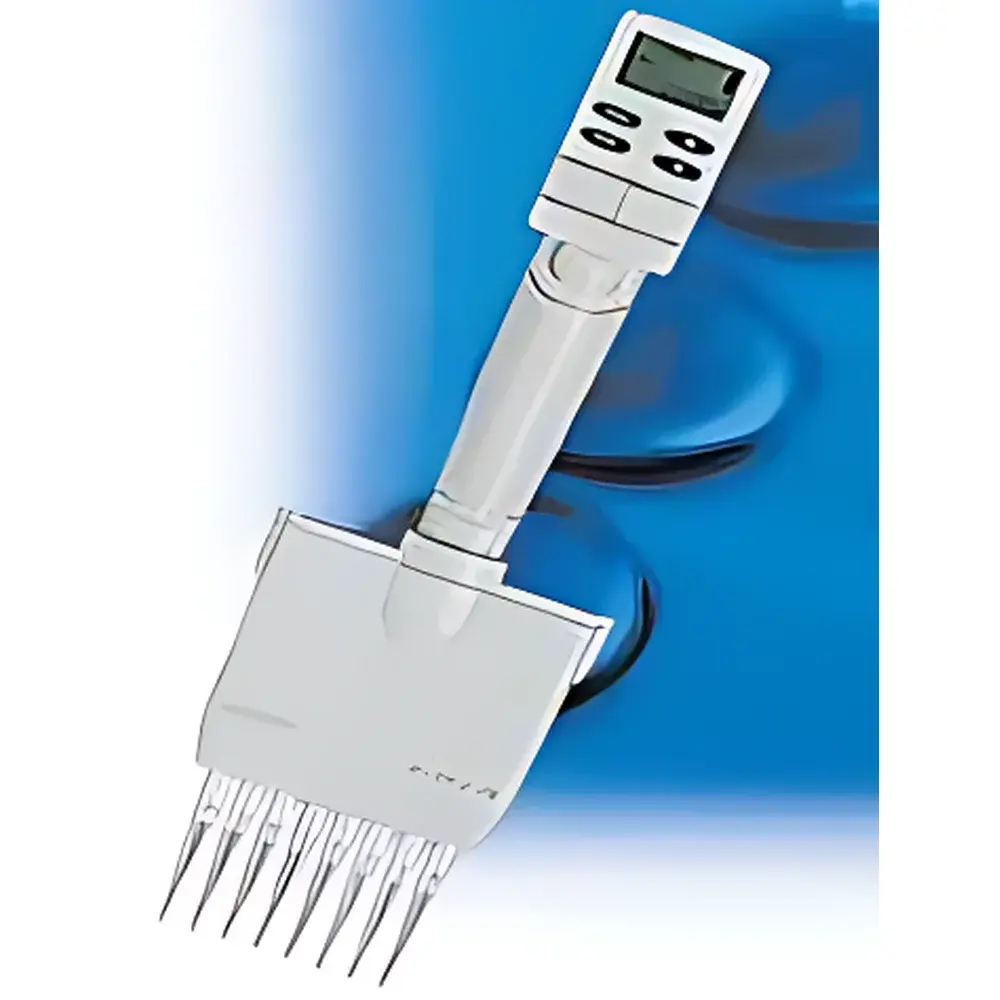
Rainin EDP3 Electric Multi-Channel and Single-Channel Pipette
| Brand | Rainin |
|---|---|
| Origin | USA |
| Model | E3/SE3 |
| Volume Range Options | 1–10 µL to 100–1200 µL (8-, 12-, 16-, and 24-channel configurations) |
| Drive Mechanism | Microprocessor-Controlled Stepper Motor |
| Tip Ejection System | LTS (Low-Torque Tip System) |
| Power Source | Rechargeable Lithium-Ion Battery |
| Compliance | ISO 8655-2, ISO 8655-5, GLP/GMP-ready data integrity support |
Overview
The Rainin EDP3 Electric Pipette series—engineered by Rainin, a Mettler Toledo company—is a high-precision liquid handling platform designed for demanding life science, clinical diagnostics, and pharmaceutical R&D laboratories. Built upon a closed-loop microprocessor-controlled stepper motor architecture, the EDP3 eliminates operator-induced variability inherent in manual pipetting, delivering repeatable volumetric accuracy across all channel configurations (single, 8-, 12-, 16-, and 24-channel). Its core measurement principle relies on precise displacement control of the piston within an air-cushion system, calibrated per ISO 8655-2 for gravimetric verification and traceable to NIST standards. The EDP3 is not merely a motorized upgrade—it represents a systemic integration of mechanical precision, ergonomic intelligence, and regulatory-aware software design, enabling consistent performance under routine high-throughput workflows and critical assay validation protocols.
Key Features
- LTS (Low-Torque Tip System): Ensures uniform tip attachment force across all channels—eliminating channel-to-channel variation in seal integrity and aspiration consistency without manual tightening.
- Multi-Mode Programmable Operation: Supports standard pipetting, reverse pipetting, continuous dispensing, mixing, serial dilution, and titration—all programmable via intuitive rotary dial and LCD interface with real-time volume confirmation.
- Ergonomic Design Architecture: Weight-distributed chassis, low actuation force (<0.8 N for tip ejection), and angled tip alignment reduce wrist flexion and repetitive strain risk during extended use.
- Long-Life Rechargeable Battery: Integrated lithium-ion battery supports >10,000 pipetting cycles per charge (typical usage), with hot-swap capability via E3-RCS rapid charging station or wall-mounted E3-WPS power supply.
- Modular Channel Configurations: Available in 8-, 12-, 16- (2×8), and 24-channel (2×12) formats, with volume ranges spanning 1–10 µL up to 100–1200 µL—each calibrated and certified per ISO 8655-5 for multi-channel accuracy and linearity.
- Tool-Free Maintenance: Front-accessible piston assembly and autoclavable lower parts (excluding electronics) enable rapid decontamination and serviceability without specialized tools.
Sample Compatibility & Compliance
The EDP3 is validated for use with standard conical polypropylene tips compliant with ISO 8655-3, including Rainin LTS and LiteTouch tips. It maintains accuracy across aqueous solutions, buffers, serum, glycerol-containing reagents (up to 40% v/v), and low-surface-tension solvents when configured with appropriate tip types and calibration offsets. All models meet ISO 8655-2 (volumetric accuracy), ISO 8655-5 (multi-channel performance), and EN ISO/IEC 17025 requirements for accredited calibration laboratories. Data output supports ALCOA+ principles—audit trails, electronic signatures, and user-level access controls are available when integrated with Rainin’s Liquidator Software Suite, aligning with FDA 21 CFR Part 11 and EU Annex 11 expectations for regulated environments.
Software & Data Management
When paired with Rainin Liquidator Software (v3.2+), the EDP3 enables full method lifecycle management: protocol creation, version-controlled storage, instrument firmware updates, and export of CSV/Excel-compatible audit logs with timestamps, user IDs, and parameter metadata. The software enforces role-based permissions and generates IQ/OQ documentation templates compliant with GxP validation frameworks. Raw pipetting event data—including volume setpoint, actual dispensed volume (via internal sensor feedback), tip type, and error flags—is retained locally on-device memory (non-volatile flash) and synchronized upon USB or Bluetooth connection. No cloud dependency is required for basic operation or compliance reporting.
Applications
- High-throughput ELISA, qPCR, and NGS library preparation requiring sub-microliter precision across 96- or 384-well plates.
- Cell culture media dispensing and stem cell passaging where inter-channel consistency directly impacts assay reproducibility.
- Reference standard dilution series in analytical chemistry labs adhering to USP and ICH Q2(R2) guidelines.
- QC release testing of biologics under cGMP conditions, where traceable volume delivery and electronic record retention are mandatory.
- Academic teaching labs requiring robust, serviceable instrumentation with pedagogical programming interfaces for technique validation.
FAQ
Is the EDP3 compatible with non-Rainin tips?
Yes—standard ISO-compliant conical tips may be used; however, optimal LTS performance, channel synchronization, and warranty coverage require Rainin LTS or LiteTouch tips.
How is calibration verified and documented?
Each unit ships with a Certificate of Conformance referencing ISO 8655-2 gravimetric test data at three volume points (10%, 50%, and 100% of range); field recalibration is supported using Rainin’s CalCheck Kit and Liquidator Software.
Can the EDP3 be used in biosafety cabinets or cold rooms?
Yes—the operating temperature range is 15–30°C and relative humidity 30–70% non-condensing; optional low-temp battery variants are available for controlled-environment applications.
Does the EDP3 support electronic signature capture for 21 CFR Part 11 compliance?
Electronic signatures are enabled through Liquidator Software v3.2+, which implements identity authentication, audit trail encryption, and immutable record archiving per Part 11 Subpart B requirements.
What is the recommended maintenance interval?
Routine cleaning and visual inspection are advised after each shift; full preventive maintenance—including piston lubrication and torque verification—is recommended every 12 months or after 50,000 cycles, whichever occurs first.
Related Products



