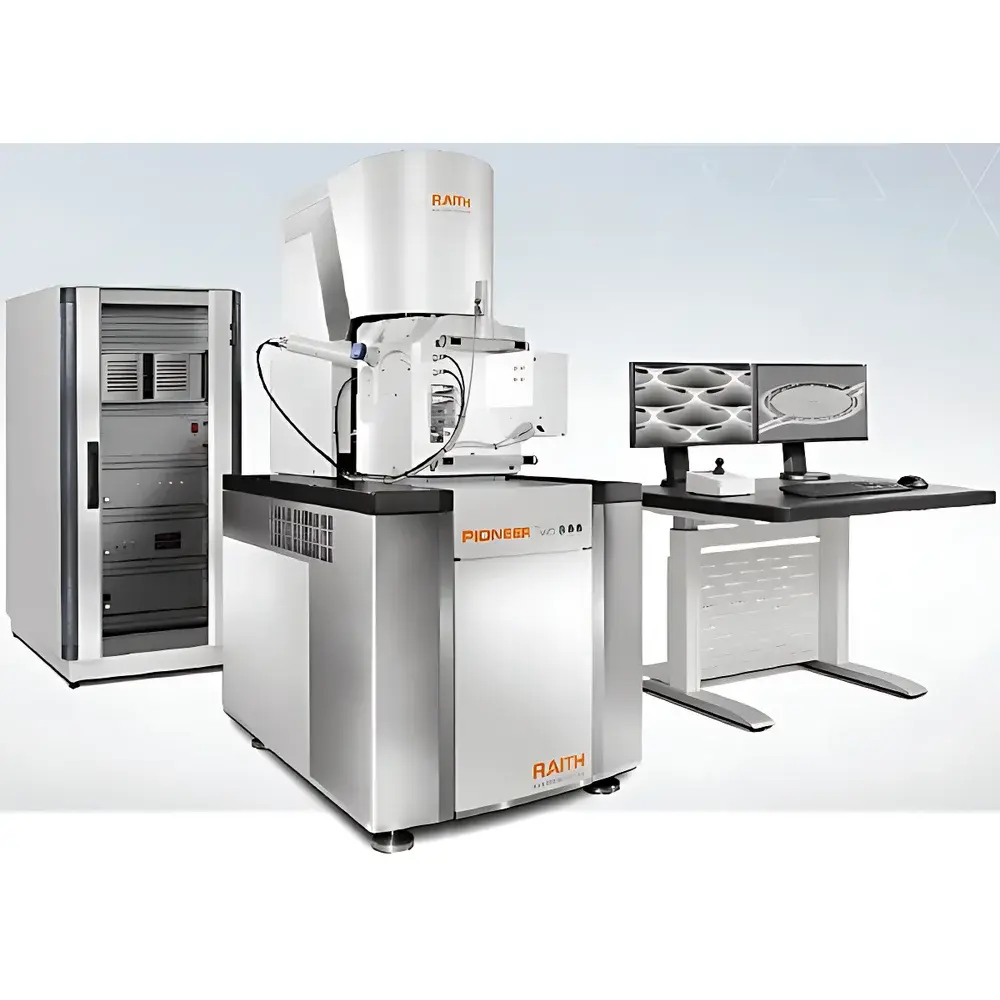
Raith Pioneer Two Electron Beam Lithography System
| Brand | Raith |
|---|---|
| Origin | Germany |
| Model | Pioneer Two |
| Electron Source | Thermal Field Emission Gun |
| Accelerating Voltage Range | 20 V – 30 kV |
| Minimum Guaranteed Resolution (Line Width) | ≤8 nm |
| Stage Travel (X/Y/Z) | 50 mm × 50 mm × 25 mm |
| XY Positioning Accuracy | ±2 nm |
| Overlay/Pattern Stitching Accuracy | ≤50 nm |
| Imaging Magnification Range | 20× – 1,000,000× |
| Optional Add-ons | Backscattered Electron Detector (BSED), Energy-Dispersive X-ray Spectrometer (EDS), Tilt-Rotation Stage Module |
Overview
The Raith Pioneer Two Electron Beam Lithography System is a high-precision, research-grade direct-write nanofabrication platform engineered for academic laboratories, national institutes, and advanced semiconductor R&D facilities. Based on scanning electron microscopy (SEM) architecture and thermal field emission (TFE) electron optics, the system delivers sub-10 nm pattern resolution through precisely controlled electron beam scanning synchronized with a laser-interferometric motion stage. Unlike conventional photolithography tools requiring masks, the Pioneer Two enables maskless, flexible, and rapid prototyping of nanostructures—including plasmonic devices, quantum dot arrays, metamaterials, and MEMS/NEMS components—on substrates up to 2 inches in diameter. Its integrated dual-functionality as both a lithography tool and a high-resolution imaging instrument eliminates the need for separate SEM characterization, streamlining nanoscale process development workflows.
Key Features
- Thermal field emission electron source ensuring stable beam current, low energy spread (<0.3 eV), and extended source lifetime—critical for high-reproducibility exposure across multi-hour writing sessions.
- Laser interferometer-controlled precision stage with 50 mm × 50 mm × 25 mm travel range and true bidirectional positioning accuracy of ±2 nm—enabling reliable large-area stitching and overlay alignment for multi-layer device fabrication.
- Sub-8 nm minimum line width performance validated under standard process conditions (e.g., PMMA resist, 30 kV acceleration, optimized dwell time and dose calibration), meeting requirements for advanced nanophotonics and quantum device patterning.
- Real-time SEM-mode imaging with magnification from 20× to 1,000,000×, supporting in situ alignment, critical dimension verification, and post-exposure inspection without sample transfer.
- Modular hardware architecture compliant with vacuum interlock standards (10⁻⁷ mbar base pressure), allowing seamless integration of optional analytical modules including backscattered electron detection (BSED), energy-dispersive X-ray spectroscopy (EDS), and motorized tilt-rotation stages (±70° tilt, 360° rotation).
Sample Compatibility & Compliance
The Pioneer Two accommodates wafers and substrates up to 50 mm (2-inch) diameter with standard holders; custom chucks support non-planar or fragile samples (e.g., TEM grids, suspended membranes). Compatible resist systems include PMMA, ZEP, HSQ, and conductive polymers—each supported by built-in dose calibration routines and proximity effect correction algorithms. The system meets CE marking requirements and adheres to IEC 61000-6-2/6-4 electromagnetic compatibility standards. For regulated environments, optional audit-trail logging, user access control, and electronic signature modules are available to support GLP, ISO/IEC 17025, and FDA 21 CFR Part 11 compliance during qualification and validation processes.
Software & Data Management
Operation is managed via Raith’s proprietary Nanosuite software—a Windows-based platform supporting vector-based pattern design, hierarchical layout import (GDSII/OASIS), real-time beam blanking, and dynamic focus/stigmation correction. Nanosuite includes automated stage calibration, dose matrix optimization, and scriptable Python API for custom automation (e.g., batch exposure sequencing, metrology-driven feedback loops). All exposure logs, parameter sets, and image metadata are stored in timestamped, immutable project files with SHA-256 checksum integrity verification. Data export supports TIFF, PNG, CSV, and HDF5 formats for downstream analysis in MATLAB, Python (NumPy/SciPy), or commercial metrology suites.
Applications
- Nanophotonic circuit fabrication: grating couplers, photonic crystals, and plasmonic waveguides requiring <10 nm edge roughness control.
- Quantum device prototyping: gate-defined quantum dots, superconducting nanowires, and topological insulator heterostructures demanding sub-10 nm feature fidelity.
- MEMS/NEMS maskless patterning: high-aspect-ratio structures in Si, SiN, and metal films using lift-off or etch-transfer processes.
- Electron beam-induced deposition (EBID) and etching: localized material growth or removal via precursor gas injection (optional add-on).
- Reference sample fabrication: NIST-traceable linewidth standards, CD-SEM calibration targets, and metrology artifacts for SEM/AFM cross-calibration.
FAQ
What substrate sizes does the Pioneer Two support?
Standard operation supports substrates up to 50 mm (2-inch) diameter; smaller chips (e.g., 10 × 10 mm dies) are accommodated using dedicated clamping fixtures.
Is the system compatible with conductive and insulating substrates?
Yes—integrated beam-induced charge compensation (via flood gun or low-energy electron flooding) mitigates charging effects on SiO₂, glass, and polymer substrates.
Can the Pioneer Two perform multi-layer alignment and overlay?
Yes—laser-interferometric stage repeatability and fiducial-based alignment routines enable overlay accuracy ≤50 nm across multiple exposure layers.
Does Nanosuite support automated dose calibration for new resists?
Yes—integrated contrast curve measurement tools allow empirical determination of optimal exposure dose and development time for novel resist formulations.
What vacuum and facility requirements apply?
The system operates at ≤1 × 10⁻⁷ mbar; it requires standard lab electrical supply (230 V, 50 Hz), cooling water (≤25 °C, 2 L/min), and vibration-isolated optical table mounting (recommended).