
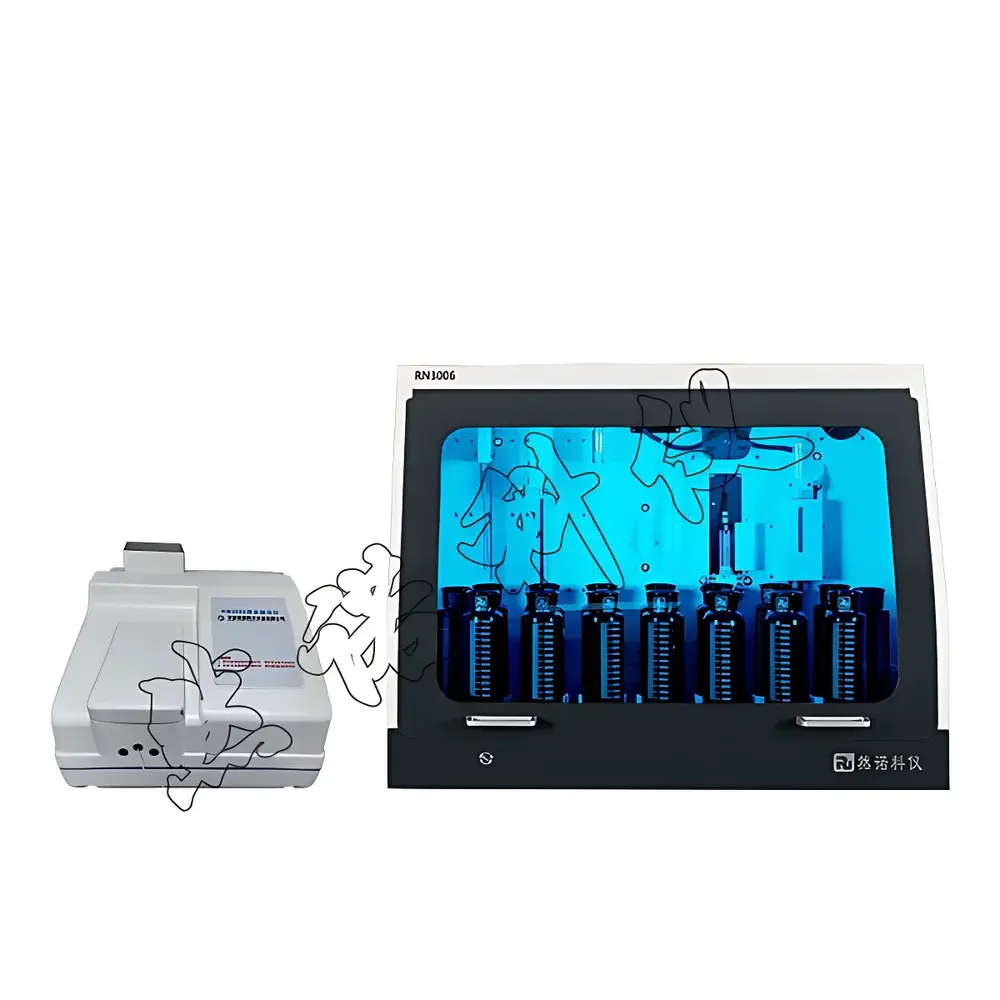
Rannuo RN3006 Fully Automated Fluorescence Oil-in-Water Analyzer
| Brand | Rannuo |
|---|---|
| Origin | Zhejiang, China |
| Manufacturer Type | Authorized Distributor |
| Instrument Type | Laboratory-Based |
| Model | RN3006 |
| Measurement Principle | Fluorescence Spectrophotometry |
| Measurement Range | 0–10 mg/L |
| Detection Limit | 0.001 mg/L |
| Resolution | 0.0001 mg/L |
| Analysis Time per Sample | 5–8 minutes |
| Compliance Standard | GB 17378.4–2007 (Marine Monitoring Specifications – Part 4: Seawater Analysis) |
Overview
The Rannuo RN3006 Fully Automated Fluorescence Oil-in-Water Analyzer is a laboratory-grade instrument engineered for precise, high-throughput quantification of petroleum hydrocarbons—specifically aromatic compounds—in aqueous matrices. It operates on the principle of fluorescence spectrophotometry, leveraging the native fluorescence of polycyclic aromatic hydrocarbons (PAHs) following solvent extraction. Per GB 17378.4–2007, seawater or freshwater samples are extracted with petroleum ether; the resulting organic phase is measured at an excitation wavelength of 310 nm and emission wavelength of 360 nm. The instrument’s optical path is calibrated to ensure linear response across the 0–10 mg/L range, with trace-level sensitivity enabled by low-noise photomultiplier detection and optimized optical filtering. Designed for regulatory-compliant environmental laboratories, the RN3006 delivers reproducible results suitable for marine monitoring programs, wastewater discharge verification, and source water quality assessment.
Key Features
- Fully automated sample processing: integrated liquid handling performs sample volume measurement, reagent dispensing (petroleum ether), phase separation via centrifugal partitioning, and fluorescence measurement—without manual intervention.
- Modular carousel autosampler with drag-chain drive mechanism: supports unattended batch analysis of up to 60 samples; enables true multi-sequence operation with real-time sample list editing during run execution.
- High-precision, corrosion-resistant syringe pump: programmable volumetric delivery of petroleum ether (range: 5–25 mL, ±0.5% accuracy), ensuring method flexibility and reagent economy.
- Integrated liquid level sensing: automatically detects and records actual sample volume prior to extraction, eliminating volumetric error from meniscus misreading or container irregularity.
- Onboard standard curve generation: automatic serial dilution and calibration curve fitting using up to six reference standards; supports both linear and quadratic regression models.
- Self-cleaning fluidic pathway: built-in reverse-flush protocol between samples minimizes carryover; validated cross-contamination <0.05% (tested with 10 mg/L naphthalene standard).
Sample Compatibility & Compliance
The RN3006 is validated for use with seawater, brackish water, surface freshwater, and treated effluents. It accommodates sample containers of 25–500 mL volume (standardized glass or HDPE bottles). All wetted components—including tubing, valves, and cuvette holder—are chemically resistant to petroleum ether, acetone, and chlorinated solvents. The system complies with GB 17378.4–2007 and aligns with internationally recognized methodologies including ASTM D5889–18 (Standard Test Method for Determination of Petroleum Hydrocarbons in Water by Fluorescence) and ISO 9377-2:2000 (Water Quality — Determination of Hydrocarbon Oil Index — Part 2: Fluorometric Method). Data integrity meets GLP requirements: audit trail logging, user access control, and electronic signature support are embedded in firmware.
Software & Data Management
The RN3006 is operated via Rannuo Analytical Suite v3.2—a Windows-based application supporting method setup, sequence definition, real-time monitoring, and report generation. Raw fluorescence intensity values, corrected background signals, and concentration outputs are stored in encrypted SQLite databases with timestamped metadata (operator ID, instrument ID, environmental conditions). Export options include CSV, PDF analytical reports, and XML for LIMS integration. Software enforces 21 CFR Part 11 compliance through role-based permissions, electronic signatures for critical actions (e.g., calibration validation), and immutable audit logs covering all data modifications and instrument events.
Applications
- Regulatory marine monitoring programs requiring adherence to national oceanographic standards.
- Environmental impact assessments near offshore drilling platforms or port facilities.
- Wastewater treatment plant effluent testing for hydrocarbon discharge compliance.
- Drinking water source surveillance in estuarine or industrial-adjacent watersheds.
- Research applications involving PAH fate and transport modeling in aquatic systems.
- Method validation and inter-laboratory comparison studies under ISO/IEC 17025 frameworks.
FAQ
What sample volume is required for analysis?
Typical analysis uses 100–250 mL of water sample; the system automatically measures actual volume via capacitive level sensing and adjusts reagent dosage accordingly.
Can the instrument handle turbid or suspended-solid-rich samples?
Yes—integrated phase separation includes centrifugal partitioning and optional filtration module (accessory); particulate interference is minimized prior to fluorescence measurement.
Is method validation documentation available?
Yes—Rannuo provides IQ/OQ documentation templates, performance qualification protocols, and GB 17378.4–2007 verification reports upon request.
How is calibration maintained over time?
The system supports daily performance checks using certified reference standards; drift correction algorithms apply baseline normalization based on blank signal stability.
What maintenance intervals are recommended?
Syringe pump calibration every 6 months; optical path cleaning quarterly; full fluidic system inspection annually—schedule tracked within software maintenance log.
Related Products







