
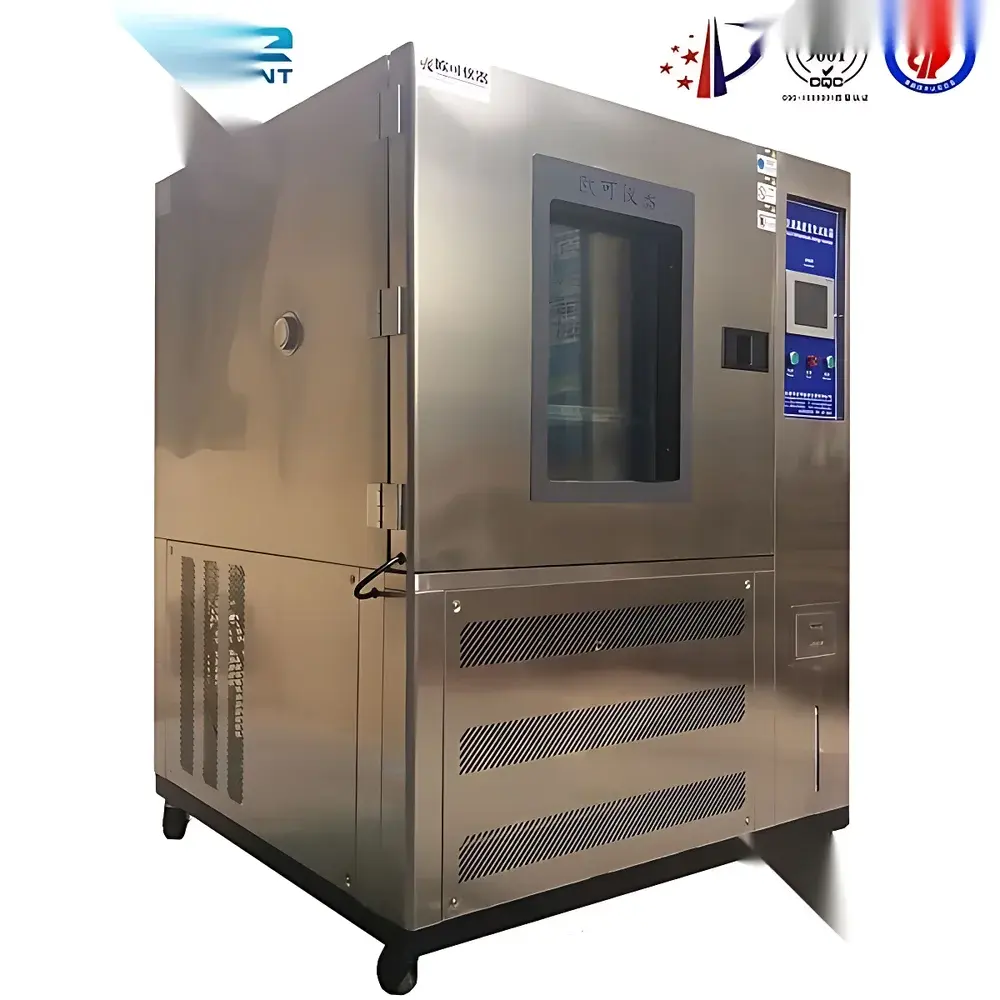
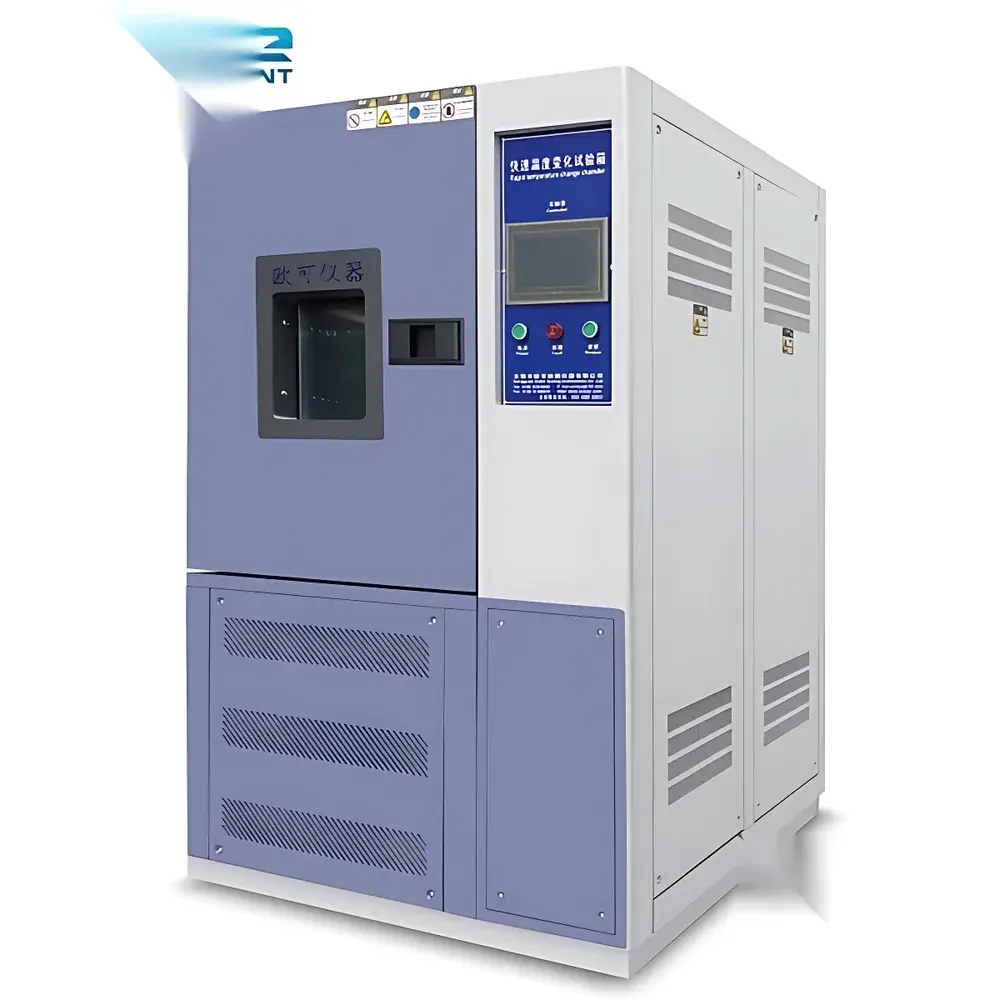
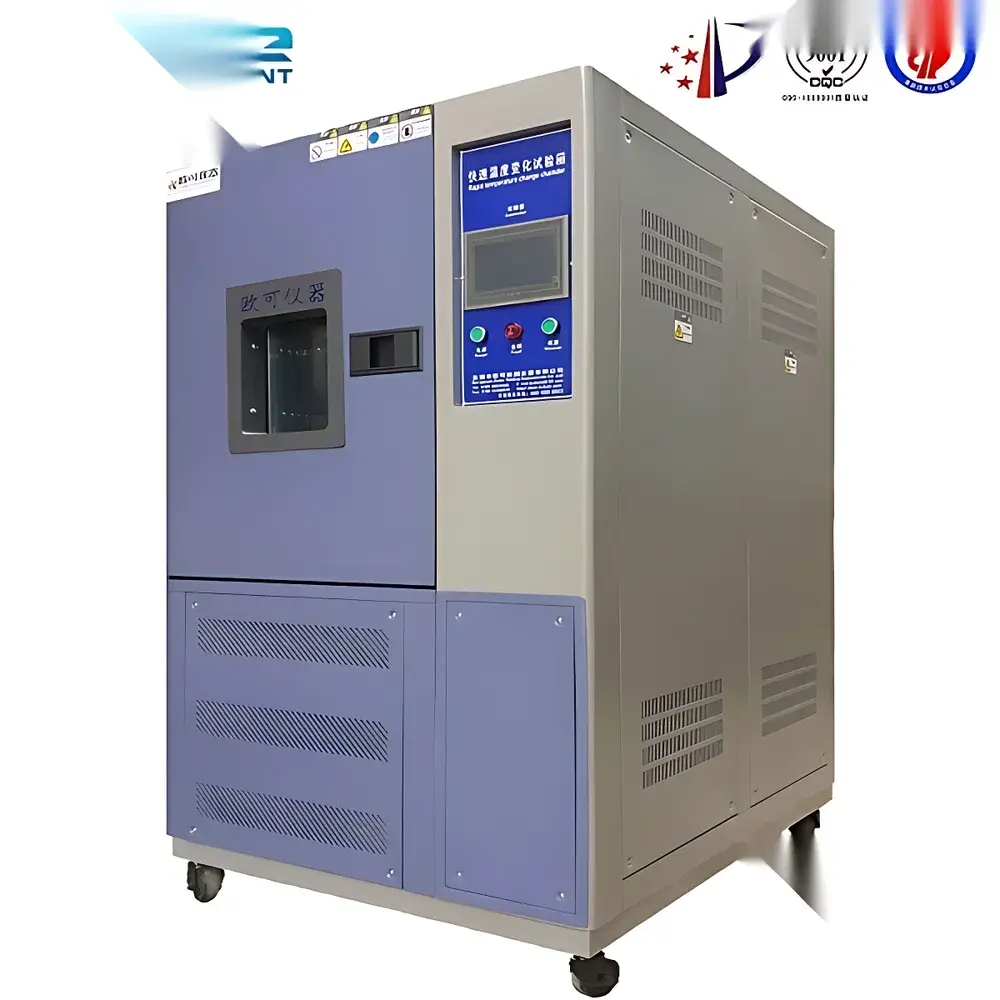
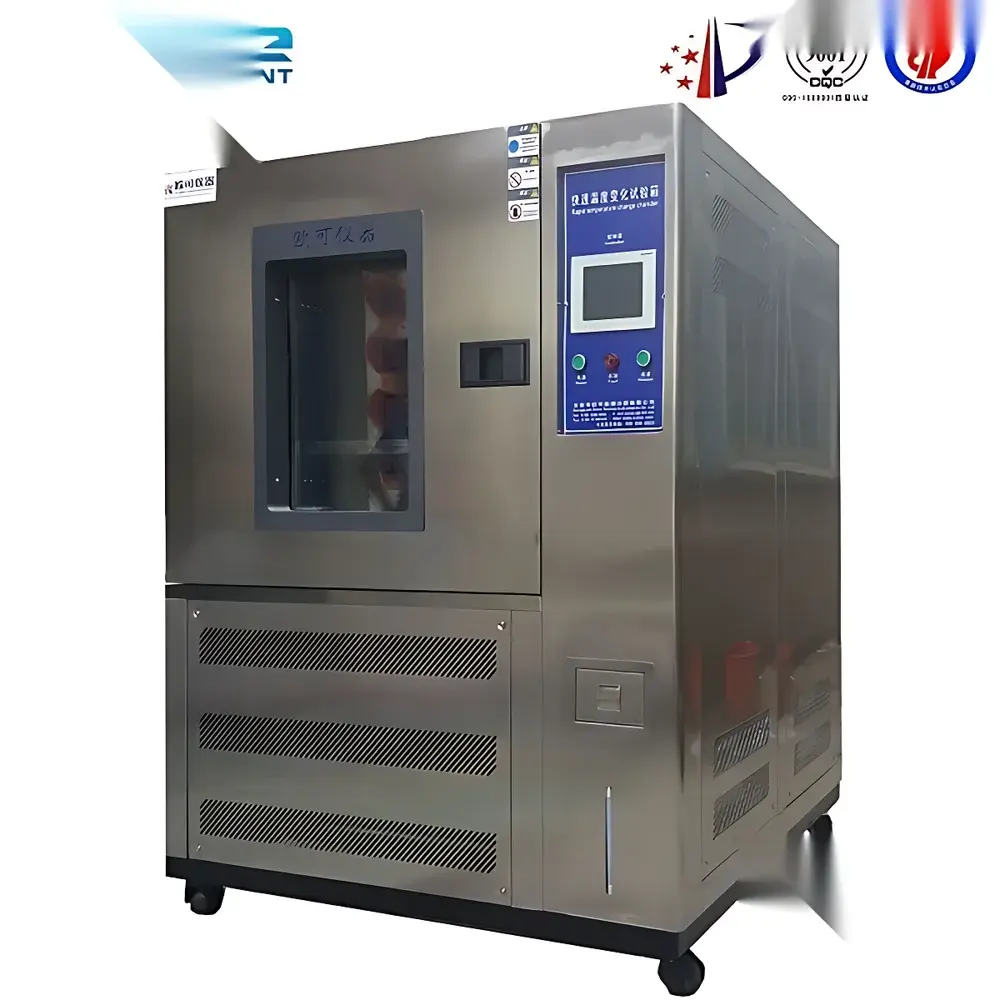
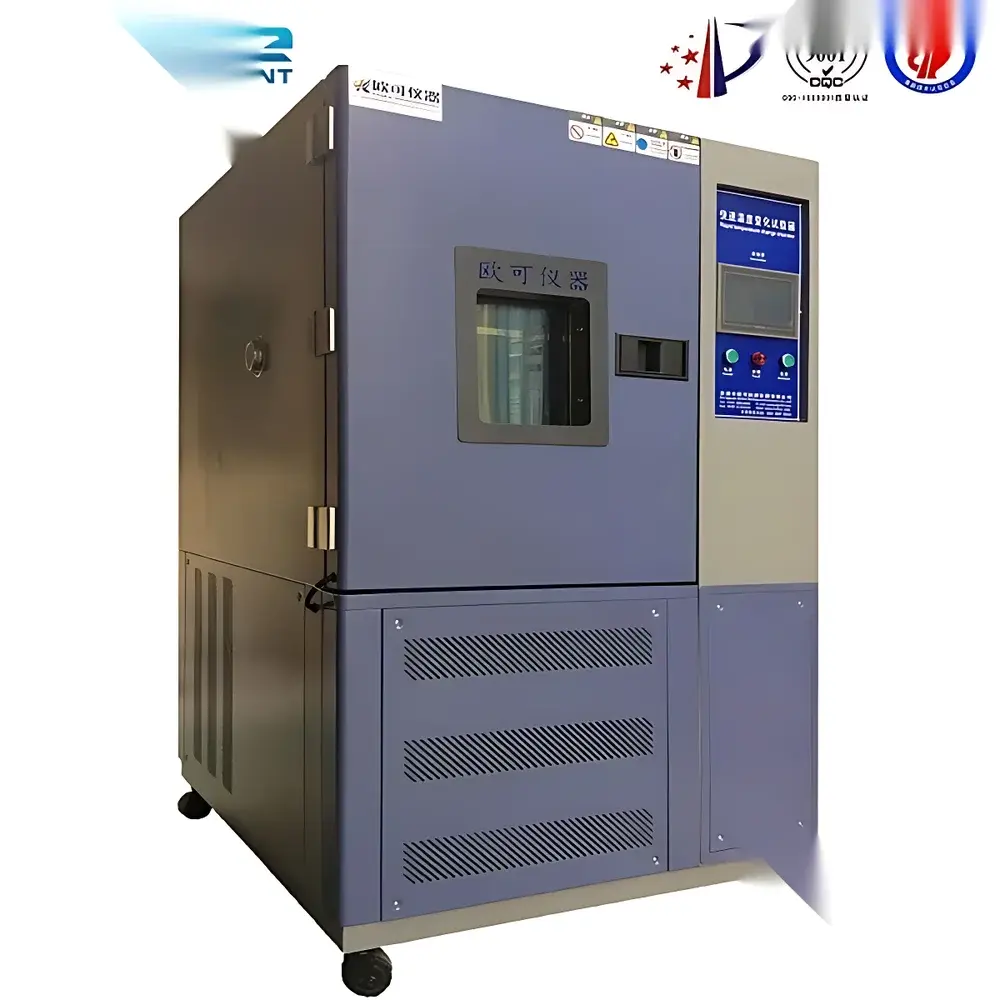
Rapid Temperature Change Environmental Test Chamber
| Brand | Other Brands |
|---|---|
| Origin | Imported |
| Manufacturer Type | General Distributor |
| Price | USD 14,000 (approx.) |
| Internal Dimensions (W×H×D) | 50×75×60 cm to 100×100×100 cm |
| Temperature Range | −70 °C to +150 °C |
| Humidity Range | 20–98% RH (optional: 5–98% RH) |
| Rapid Thermal Transition Range | −45 °C to +85 °C or −20 °C to +85 °C |
| Ramp Rates | 5–25 °C/min (customizable) |
| Temperature Uniformity | ±2 °C |
| Temperature Stability | ±0.5 °C |
| Humidity Uniformity | ±3.0% RH (at ≥75% RH) |
| Humidity Stability | ±2.5% RH |
| Refrigerant | R507 / R23 (zero ozone depletion potential, HFC-based) |
| Control System | 7-inch color LCD touchscreen controller with bilingual (English/Chinese) interface |
| Safety Protections | Overcurrent, leakage current, compressor overload, grounding fault, overtemperature, and acoustic alarm |
| Compliance Standards | GB/T 2423.1, GB/T 2423.2, GB/T 2423.22, GJB 150.3, GJB 150.4, GB 10589, GB 11158, GB 10592 |
Overview
The Rapid Temperature Change Environmental Test Chamber is an engineered solution for accelerated thermal stress evaluation of electronic components, automotive modules, aerospace subsystems, and industrial materials under dynamically varying temperature conditions. Based on dual-stage cascade refrigeration architecture and precision PID-controlled forced-air convection, the chamber delivers tightly regulated, repeatable thermal transients across a broad operational envelope—from −70 °C to +150 °C—with ramp rates configurable up to 25 °C/min. Its design adheres to fundamental thermodynamic principles governing heat transfer in enclosed test volumes, ensuring minimal thermal lag and high spatial uniformity through optimized airflow distribution and insulated stainless-steel (SUS#304) internal construction. Unlike static thermal chambers, this system supports programmable cycling between extreme temperature setpoints—including dwell periods, transition profiles, and user-defined dwell-transition-dwell sequences—enabling simulation of real-world environmental exposure scenarios such as aircraft ascent/descent cycles, automotive under-hood thermal shock, or PCB solder joint fatigue testing.
Key Features
- High-fidelity dual-stage cascade refrigeration system utilizing environmentally compliant HFC refrigerants (R507/R23), certified zero ODP and low GWP
- 7-inch full-color touchscreen controller with intuitive GUI, supporting English/Chinese language switching and real-time visualization of temperature/humidity curves
- 96 preloaded test profiles compliant with IEC, MIL-STD, and national standards (e.g., GB/T 2423 series, GJB 150)
- Programmable cycle parameters: up to 999 cycles, transition time up to 999 h 59 min, automatic start/stop scheduling
- 50 mm diameter access port on left chamber wall for external signal/power feedthrough during live testing
- PLC-integrated safety interlock architecture with redundant monitoring of compressor status, refrigerant pressure, chamber temperature, and electrical integrity
- Advanced air circulation design minimizing thermal stratification; validated uniformity of ±2 °C (temperature) and ±3.0% RH (≥75% RH)
Sample Compatibility & Compliance
The chamber accommodates samples ranging from small PCB assemblies to medium-sized enclosures (max. internal volume: 1,000 L). Its interior chamber—fabricated from electropolished SUS#304 stainless steel—resists corrosion and facilitates cleaning under GLP-compliant laboratory environments. The system meets mechanical and thermal performance requirements outlined in GB/T 10589 (low-temperature chamber specifications), GB/T 11158 (high-temperature chamber specifications), and GB/T 10592 (combined temperature/humidity chamber criteria). It supports validation protocols aligned with ISO/IEC 17025 calibration traceability and is compatible with audit-ready documentation packages required for FDA 21 CFR Part 11–governed quality systems when integrated with compliant data logging software.
Software & Data Management
The embedded controller logs timestamped temperature and humidity data at user-selectable intervals (1–60 sec), storing up to 100 test records internally. Optional Ethernet or RS485 interfaces enable remote monitoring and integration with centralized LIMS or MES platforms. Export functionality supports CSV format for post-test statistical analysis (e.g., Cpk, delta-T profiling, failure correlation). Audit trails—including operator ID, parameter changes, alarm events, and system resets—are retained with tamper-resistant timestamps, satisfying GLP/GMP documentation requirements. Firmware updates are performed via USB without requiring factory service intervention.
Applications
- Thermal cycling qualification of semiconductor packages per JEDEC JESD22-A104
- Environmental stress screening (ESS) of avionics hardware under MIL-STD-810H Method 503.5
- Reliability assessment of battery cells and BMS modules under rapid charge/discharge thermal loads
- Validation of seal integrity and material dimensional stability in medical device housings
- Accelerated aging studies for polymer composites used in automotive exterior trim
- Pre-compliance testing against IEC 60068-2-14 (change of temperature) and IEC 60068-2-1 (cold) / -2 (dry heat)
FAQ
What is the maximum achievable ramp rate, and is it maintained across the full temperature range?
The system achieves up to 25 °C/min between −45 °C and +85 °C. Ramp linearity and repeatability are verified per GB/T 2423.22 Annex A; rates may vary slightly near absolute extremes (e.g., −70 °C or +150 °C) due to thermodynamic constraints.
Can the chamber operate in humidity-only mode without temperature variation?
Yes—constant humidity control (20–98% RH) is supported independently of temperature setpoint, with stability maintained at ±2.5% RH under steady-state conditions.
Is third-party calibration certification available?
Factory calibration is traceable to NIM (National Institute of Metrology, China) standards. Optional UKAS-accredited calibration certificates are available upon request for international compliance needs.
What power supply configuration is required for installation?
Three-phase AC 380 V ±5%, 50 Hz ±0.5 Hz, five-wire system (L1/L2/L3/N/PE); dedicated circuit breaker rated ≥63 A recommended for KS-TH-1000 model.
How is data integrity ensured during extended unattended operation?
Non-volatile memory retains all runtime logs and alarm history even during power interruption. Controller firmware includes CRC-verified data storage and automatic recovery on reboot.



