
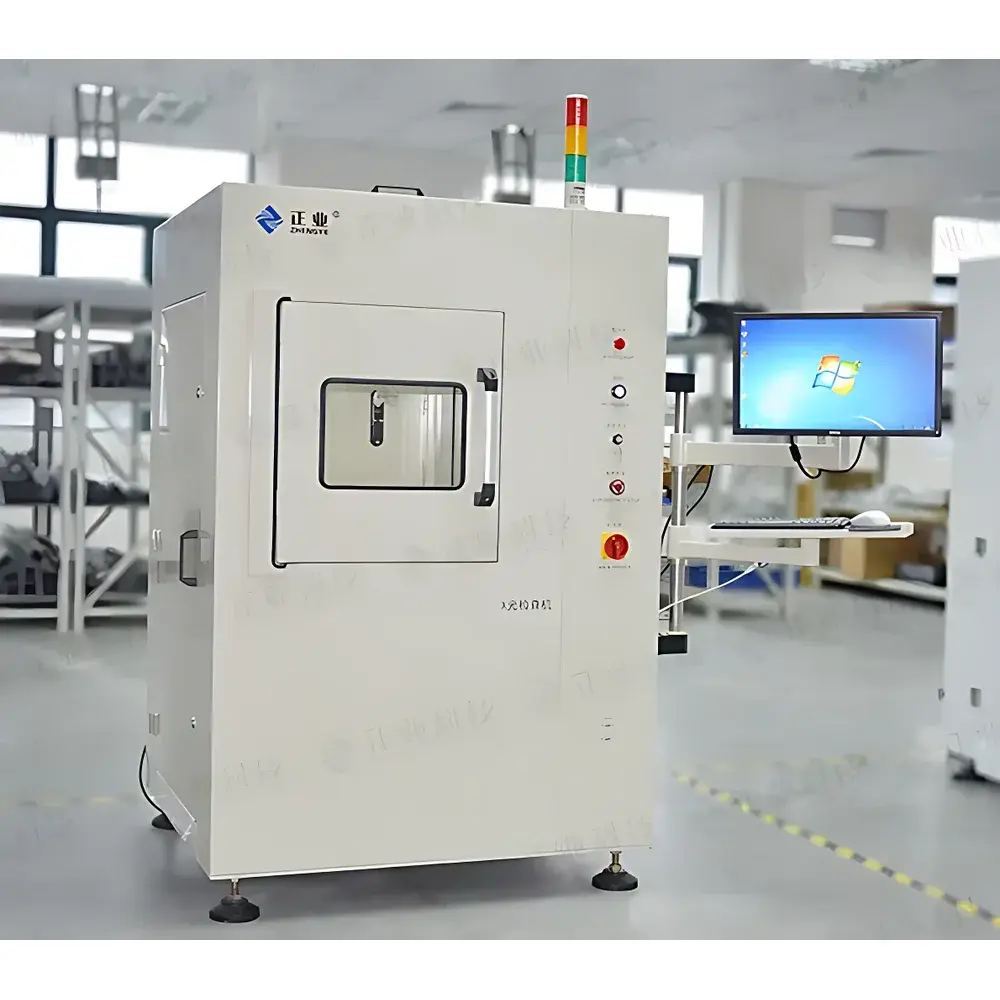
X-ray Non-destructive Testing System for Lithium-ion Battery Cells
| Brand | Aisida |
|---|---|
| Origin | Guangdong, China |
| Manufacturer Type | Authorized Distributor |
| Country of Origin | China |
| Model | CellScan-XR Series |
| Pricing | Available Upon Request |
Overview
The Aisida CellScan-XR Series is an industrial X-ray non-destructive testing (NDT) system engineered for high-precision internal inspection of lithium-ion battery cells during R&D, incoming quality control (IQC), and in-process manufacturing verification. Based on real-time transmission radiography, the system utilizes a micro-focus X-ray source coupled with a high-resolution image intensifier to generate high-contrast, low-noise 2D projection images of cell internals—including electrode stacking alignment, separator integrity, weld joint morphology, foil wrinkling, foreign particle presence, and anode/cathode coating uniformity. Unlike destructive cross-sectioning or time-consuming CT reconstruction, this system delivers rapid, repeatable, and fully traceable 2D inspection without compromising cell functionality—making it integral to battery safety validation, root cause analysis (RCA), and process capability studies in accordance with ISO 26262 functional safety guidelines and UL 1642/IEC 62133 compliance workflows.
Key Features
- 2.5D Metrology Engine: Supports calibrated geometric measurements including linear distance, circle diameter, concentricity of multi-layer electrode stacks, and radial offset between tab weld center and current collector centroid—enabling quantitative assessment of assembly tolerances per IPC-A-610 or GB/T 31485 standards.
- CNC Path Programming: Full motion path recording and playback across X, Y, and Z axes; enables reproducible positioning for small-batch or lot-based inspection sequences with sub-5µm repeatability, critical for trending dimensional drift over production runs.
- Smart Navigation Interface: Large-field-of-view live preview window with click-to-move targeting; eliminates manual stage adjustment delays and reduces operator-induced positioning error by >70% compared to conventional manual navigation.
- Real-Time Image Processing: On-the-fly contrast enhancement, noise suppression, edge sharpening, and dynamic range optimization; supports DICOM, TIFF, PNG, and BMP export with embedded metadata (exposure kV/mA, focal spot size, magnification factor).
- Stable Mechanical Architecture: Fixed sample platform with motorized X-ray tube and image intensifier mounted on precision-ground ball-screw stages driven by stepper motors and timing belt synchronization—ensuring vibration-free imaging at magnifications up to 15× with <0.1% geometric distortion.
Sample Compatibility & Compliance
The CellScan-XR accommodates cylindrical (18650, 21700, 32140), prismatic (up to 200 × 150 × 20 mm), and pouch-type cells (up to 250 × 150 mm active area) with adjustable collimation and automatic exposure optimization. All hardware and software modules comply with IEC 61000-6-3 (EMC), IEC 61000-6-4 (industrial immunity), and GB/T 18801–2015 (X-ray equipment safety). Optional audit trail logging and user role management align with FDA 21 CFR Part 11 requirements for electronic records in regulated battery qualification environments.
Software & Data Management
The proprietary Aisida VisionInsight™ software provides intuitive workflow-driven inspection sequencing, automated pass/fail decision logic based on configurable tolerance bands, and synchronized image annotation with measurement overlays. Raw and processed images are stored with timestamped metadata in a local SQLite database; export options include CSV reports with statistical summaries (mean, std dev, Cp/Cpk), PDF inspection certificates, and integration-ready RESTful API endpoints for MES/SPC system connectivity (e.g., Siemens Opcenter, Rockwell FactoryTalk).
Applications
- Electrode stack misalignment detection in stacked or wound cell formats
- Weld seam integrity verification for tab-to-foil connections (ultrasonic vs. laser weld differentiation)
- Separator shrinkage or pore collapse analysis under thermal stress preconditioning
- Foreign material identification (metallic debris, fiber contaminants) down to 25µm detectability at 10× magnification
- Coating thickness uniformity mapping via grayscale density correlation (calibrated against reference standards)
- Root cause analysis of field return failures using archived inspection baselines
FAQ
Does the system support automated defect classification using AI algorithms?
Yes—optional Aisida DeepInspect™ module integrates convolutional neural networks trained on annotated battery defect libraries (delamination, dendrite shadows, void clusters) for unsupervised anomaly scoring and class-specific confidence reporting.
Can the system be integrated into an existing automated production line?
Yes—equipped with Ethernet/IP and Modbus TCP interfaces, programmable I/O triggers, and PLC-compatible start/stop signaling for inline deployment with conveyor synchronization.
What radiation safety certifications does the system carry?
It meets GBZ 117–2020 (China) and IEC 62463–2010 Class II B cabinet requirements; full shielding includes lead-lined enclosure, interlocked door switches, and real-time dose monitoring with audible alarm thresholds.
Is remote diagnostics and software update support available?
Yes—secure remote access via TLS-encrypted VNC session; firmware and algorithm updates delivered through Aisida’s certified OTA portal with version-controlled changelogs and rollback capability.





