
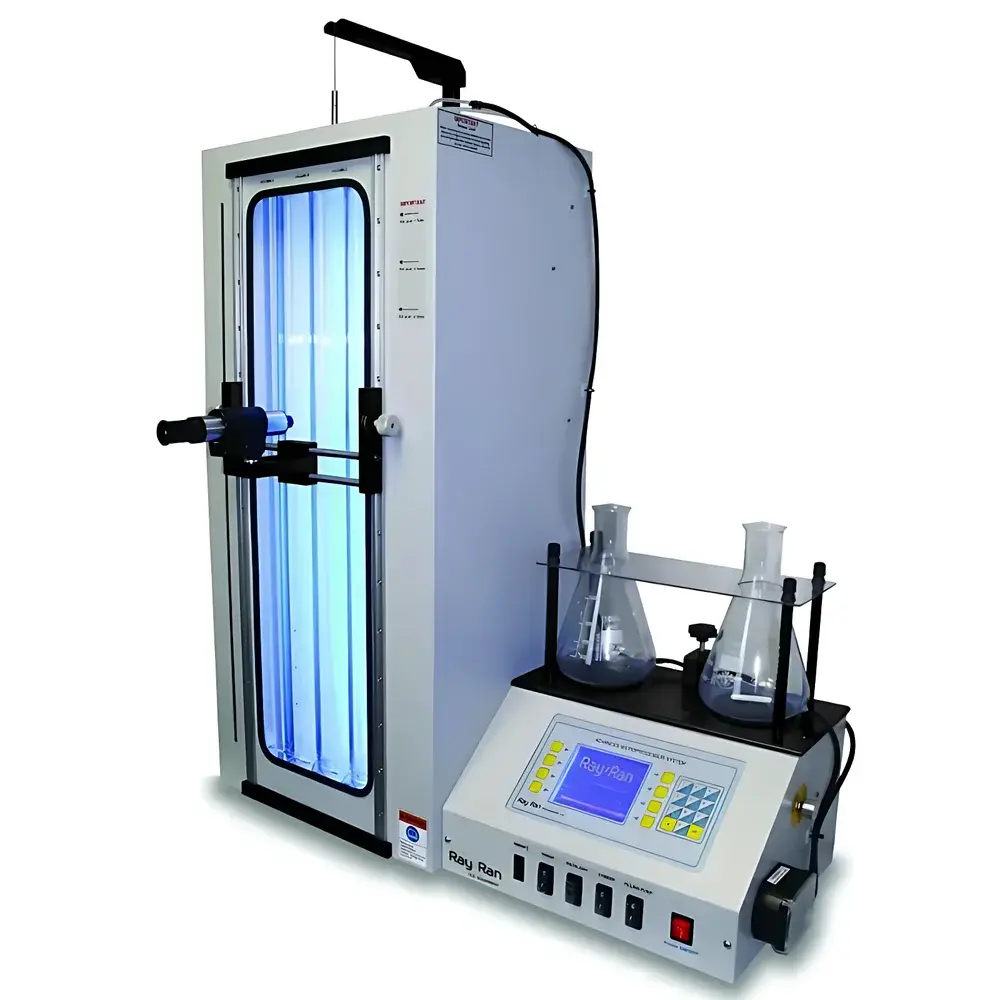
Ray-Ran DGA Density Gradient Apparatus
| Brand | Ray-Ran |
|---|---|
| Origin | Netherlands |
| Model | DGA |
| Net Weight (3-column) | 70 kg |
| Net Weight (6-column) | 80 kg |
| Dimensions (3-column) | 850 × 400 × 1110 mm (W×D×H) |
| Dimensions (6-column) | 1200 × 400 × 1110 mm (W×D×H) |
| Power Supply | 110–240 VAC, 50–60 Hz |
| Display | 160 × 128 pixel alphanumeric graphical LCD with backlight |
| Temperature Control Accuracy | ±0.1 °C |
| Optical Magnification | 7× |
| Cooling | Integrated mini-USB compatible cooling coil |
| Pumping System | Variable-speed peristaltic pump |
| Calibration | Automated density calibration with traceable certificate |
| Compliance | CE-marked, conforms to EN 61000-6-3 and EN 61000-6-2 |
Overview
The Ray-Ran DGA Density Gradient Apparatus is a precision-engineered instrument designed for the quantitative determination of material density distribution in solid or semi-solid samples—particularly polymers, plastics, composites, and geological particulates—using the principle of equilibrium sedimentation in a stable, vertically oriented density gradient column. The system establishes a reproducible, linear or near-linear density gradient within calibrated glass columns via controlled dual-pump infusion of immiscible, miscible, or partially miscible liquid phases (e.g., cesium chloride/water, sodium iodide/ethanol, or bromoform/xylene mixtures). Samples are introduced into the column and allowed to equilibrate under controlled thermal conditions; their final buoyant position corresponds directly to their intrinsic density, enabling high-resolution density profiling with traceable metrological integrity.
Key Features
- Modular column configuration: supports both 3-column and 6-column operational modes, enabling parallel sample analysis or multi-density reference calibration runs without hardware reconfiguration.
- Dual-conical filling bottles and automated magnetic stirring ensure homogeneous gradient formation and eliminate interfacial turbulence during column filling.
- Integrated variable-speed peristaltic pumping system enables precise, pulse-free fluid delivery across a wide viscosity range (up to 500 mPa·s), critical for stable gradient establishment in high-density media.
- 7× optical microscope with adjustable focus and LED illumination facilitates real-time visual confirmation of particle banding, stratification, and interface clarity—essential for method validation and outlier detection.
- Digital temperature control (±0.1 °C) maintained via Peltier-based cooling/heating module and integrated mini-USB-compatible cooling coil, ensuring thermal stability over extended equilibration periods (typically 12–72 h).
- Automated scanning mechanism with stainless-steel scanning basket provides repeatable vertical traversal of the column at user-defined intervals (0.1–5 mm steps), coupled with optical density sensing or manual visual registration.
- Graphical LCD interface (160 × 128 pixels) with alphanumeric keypad enables local setup, parameter logging, and real-time status monitoring—including pump speed, temperature setpoint, elapsed time, and column identification.
Sample Compatibility & Compliance
The DGA accommodates a broad spectrum of sample types including thermoplastic granules, injection-molded test specimens, rubber compounds, mineral powders, recycled plastic flakes, and fiber-reinforced composites. Sample dimensions are constrained only by column inner diameter (standard: 25 mm ID) and maximum length (≤100 mm). The apparatus complies with relevant sections of ISO 1183-1 (Plastics — Methods for determining density — Part 1: Immersion method, liquid pyknometer method and titration method) and ASTM D1505 (Standard Test Method for Density of Plastics by the Density-Gradient Technique). Its CE marking confirms conformity with EU Electromagnetic Compatibility (EMC) Directive 2014/30/EU and Low Voltage Directive 2014/35/EU. Traceable calibration certificates—traceable to NPL (UK) or PTB (Germany) standards—are supplied with each unit, supporting GLP and ISO/IEC 17025 laboratory accreditation requirements.
Software & Data Management
The included Windows-compatible technical software enables full instrument control, automated data capture, and post-acquisition density calculation. It supports direct import of scanned band positions (manual or image-assisted), automatic interpolation against pre-loaded gradient calibration curves, and generation of density histograms, cumulative distribution functions (CDF), and statistical summaries (mean, median, standard deviation, skewness). All raw and processed datasets are stored with full audit trail metadata—including operator ID, timestamp, instrument serial number, calibration certificate ID, and environmental logs (temperature, duration). Software functionality aligns with FDA 21 CFR Part 11 requirements for electronic records and signatures when deployed with appropriate IT governance controls (e.g., role-based access, electronic signature enforcement, and audit log retention).
Applications
- Density distribution analysis of polyethylene (HDPE/LDPE) and polypropylene grades for quality control and resin characterization.
- Identification and quantification of polymer blends and phase-separated morphologies in multi-material systems.
- Assessment of filler dispersion homogeneity and density segregation in compounded thermoplastics.
- Sorting and verification of mixed plastic waste streams in recycling facilities (e.g., PET vs. PVC vs. PS differentiation).
- Geological sample analysis: mineral density separation and heavy mineral concentrate profiling.
- Validation of additive manufacturing part density uniformity and porosity estimation in sintered polymer components.
FAQ
What density range can the DGA accommodate?
The measurable density range depends on the selected gradient medium pair and column length; typical operational ranges span 0.85 g/cm³ to 2.20 g/cm³, extendable to 3.0 g/cm³ using high-density halogenated solvents under controlled fume hood conditions.
Is gradient preparation fully automated?
The DGA automates pump-driven gradient formation and magnetic stirring, but selection, preparation, and degassing of gradient liquids remain manual user responsibilities per ISO 1183-1 Annex B guidelines.
Can the system be integrated into a LIMS environment?
Yes—raw ASCII output files (.csv, .txt) and structured XML export options support seamless ingestion into laboratory information management systems (LIMS) via standard file watchers or API-based middleware.
What maintenance is required for long-term accuracy?
Annual recalibration of temperature sensors and pump flow rates is recommended; optical components require periodic cleaning with lens-grade solvent; gradient columns must be inspected for etching or residue buildup after each solvent type change.
Does the DGA support GMP-compliant operation?
When used with validated software configurations, documented SOPs, and trained personnel, the DGA meets foundational GMP expectations for density testing as outlined in ICH Q5C and USP , particularly when paired with its traceable calibration documentation and audit-trail-enabled software.



