
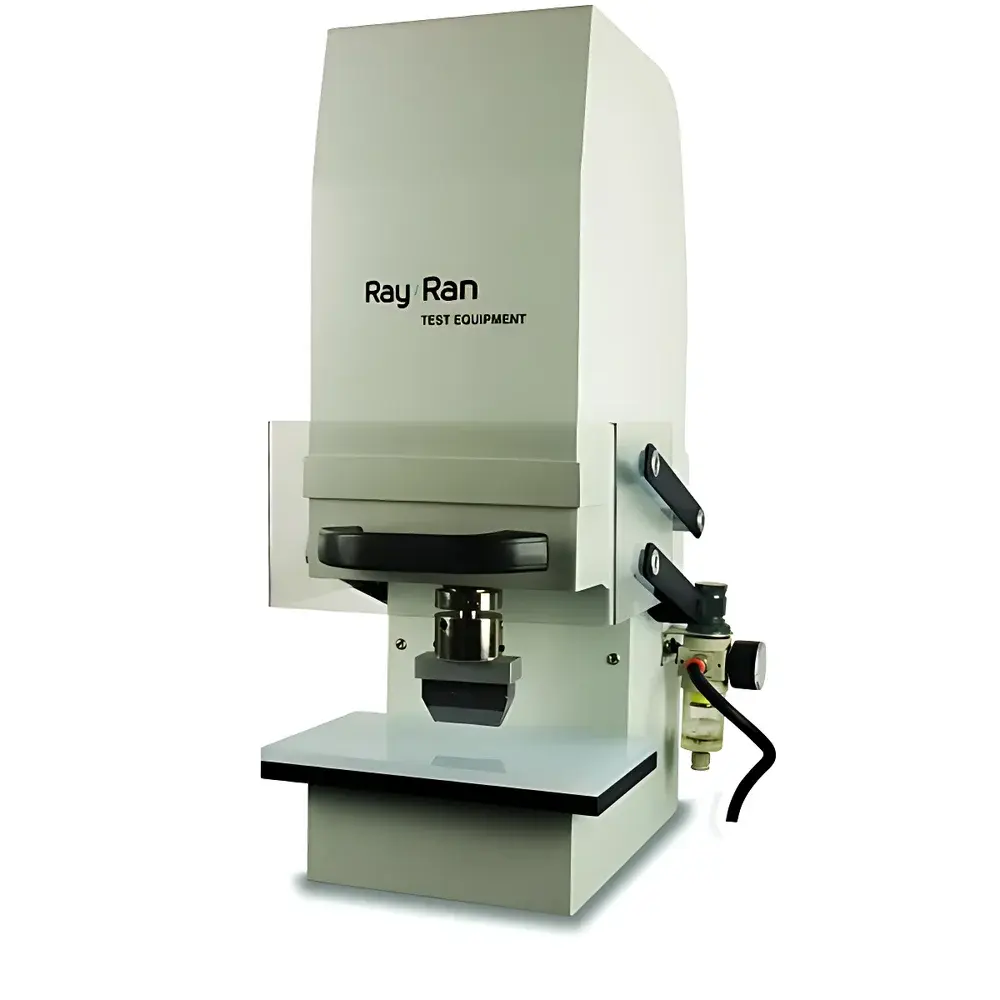
Ray-Ran PCP Pneumatic Specimen Punch Press
| Brand | Ray-Ran |
|---|---|
| Origin | United Kingdom |
| Model | PCP |
| Weight | 72 kg |
| Dimensions (W×D×H) | 300 × 300 × 630 mm |
| Operating Air Pressure | 10 bar (145 psi) |
| Maximum Punch Force | 50 kN |
| Compatible Die Shank Diameter | 25 mm (standard), custom shanks available |
| Cutting Plate Material | Polypropylene |
| Safety Guard | Polycarbonate interlocked shield |
| Base Footprint | 500 × 300 mm |
Overview
The Ray-Ran PCP Pneumatic Specimen Punch Press is an engineered solution for high-precision, repeatable specimen preparation in physical property testing laboratories. Designed and manufactured in the United Kingdom, this compact, floor-standing pneumatic press operates on a controlled compressed air supply to deliver consistent, high-force punching action without mechanical linkage or hydraulic fluid dependency. Its core principle relies on direct pneumatic actuation of a vertically aligned punch ram, translating regulated air pressure into linear force applied through standardized cutting dies. This ensures minimal operator variability and eliminates manual effort—critical for compliance with standardized test methods requiring uniform specimen geometry (e.g., ISO 527-2, ASTM D638, ISO 179-1, and EN ISO 1133). The PCP series is purpose-built for laboratories conducting tensile, impact, flexural, and melt flow index testing where dimensional accuracy, edge quality, and repeatability of specimens directly influence measurement validity.
Key Features
- Robust, self-contained architecture: All-steel frame with vibration-damped base; no anchoring required—designed for stable operation on standard laboratory benches or workshop floors.
- Pneumatic force delivery: Delivers up to 50 kN nominal punch force at 10 bar supply pressure, enabling clean, burr-free cuts through thermoplastics (e.g., PP, PE), elastomers, composites, textiles, paperboard, and rigid foams up to 8 mm thickness.
- Interlocked safety system: Polycarbonate transparent guard must be fully lowered and engaged before actuation—compliant with EN ISO 13857 and EN 60204-1 requirements for safeguarding against point-of-operation hazards.
- Modular die interface: Standard 25 mm diameter die shank mounting; optional custom shank diameters (e.g., 12 mm, 32 mm) available to accommodate ISO, ASTM, or customer-specific die geometries (dumbbell, circular, rectangular, dog-bone).
- Dedicated cutting platform: 500 × 300 mm polypropylene support plate with calibrated surface flatness (<0.1 mm deviation), optimized for thermal stability and resistance to die wear during repeated use.
- Tool alignment verification system: Integrated depth-stop mechanism ensures precise die-to-plate contact at full stroke—preventing over-penetration, die chipping, or premature blade dulling.
Sample Compatibility & Compliance
The PCP press accommodates a broad range of sheet, film, and laminate materials used in polymer, packaging, automotive, and textile quality control. Verified compatibility includes polyethylene (LDPE/HDPE), polypropylene, PVC, PET, ABS, polycarbonate sheets, nonwovens, geotextiles, corrugated board, and laminated foils. Material suitability depends not only on tensile strength but also on compressive modulus and lateral deformation resistance under localized loading—a factor accounted for in ISO 20457:2018 guidance for specimen preparation equipment validation. The unit conforms to CE marking requirements under the Machinery Directive 2006/42/EC and meets essential health and safety requirements for laboratory-scale industrial equipment. It supports GLP-compliant workflows when integrated with documented calibration procedures and maintenance logs.
Software & Data Management
While the PCP is a manually initiated, non-programmable mechanical device, its operational consistency enables seamless integration into digital QA/QC systems. Users may log punch cycles, die usage history, and material batch identifiers via LIMS-compatible spreadsheets or electronic lab notebooks (ELNs). Optional pressure transducer kits (sold separately) allow real-time monitoring and recording of actual line pressure during actuation—supporting audit readiness for ISO/IEC 17025 accredited laboratories. No embedded firmware or proprietary software is required; all maintenance, calibration, and safety checks follow manufacturer-supplied checklists aligned with ISO 9001 clause 7.1.5.
Applications
- Preparation of standardized tensile bars per ASTM D638 Type I–V and ISO 527-2 Type 1A/1B.
- Cutting Charpy/Izod impact specimens per ISO 179-1 and ASTM D256.
- Generating specimens for flexural testing (ISO 178), hardness indentation (ISO 868), and peel adhesion (ASTM D903).
- Production of MFI test pellets (ISO 1133-1) and compression-molded plaques for subsequent testing.
- Routine QC sampling in extrusion, injection molding, and converting operations—reducing reliance on hand-cutting or CNC machining for small-batch validation.
FAQ
What compressed air specifications are required for reliable operation?
A clean, dry, oil-free air supply at 10 bar (±0.2 bar) with minimum flow rate of 120 L/min is recommended. An inline filter-regulator-lubricator (FRL) unit is advised to maintain consistent pressure and protect internal seals.
Can the PCP be used with non-standard die geometries?
Yes—custom die holders and adapter plates are available upon request for specialized shapes including multi-cavity, stepped, or asymmetric profiles, subject to structural feasibility assessment.
Is periodic calibration required?
The press itself does not require metrological calibration; however, annual verification of air pressure regulator accuracy and functional safety testing of the interlocked guard are recommended per ISO/IEC 17025 Clause 6.4.3.
What maintenance intervals apply to pneumatic components?
Seals and O-rings should be inspected every 6 months or after 5,000 cycles; replacement kits and torque specifications are provided in the technical manual.
Does Ray-Ran provide traceable certification for the PCP?
Each unit ships with a Factory Certificate of Conformance (CoC) detailing serial number, build date, and conformity to EN 60204-1 and Machinery Directive 2006/42/EC; UKAS-accredited calibration certificates for optional pressure sensors are available on request.



