
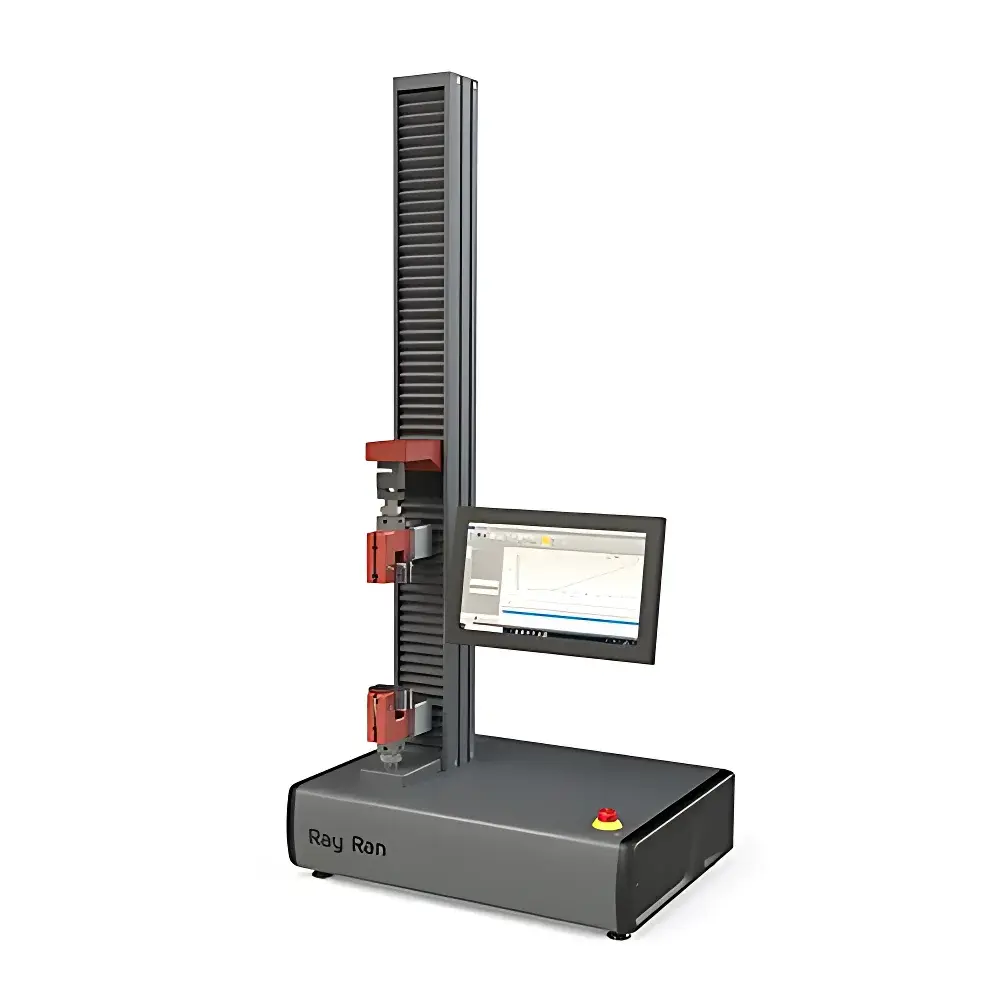
Ray-Ran X250 Single-Column Desktop Universal Testing Machine
| Brand | Ray-Ran |
|---|---|
| Origin | United Kingdom |
| Model | X250-1 / X250-2.5 / X250-3 |
| Load Capacity | 1 kN / 2.5 kN / 3 kN |
| Load Accuracy | ±0.5% of reading, down to 0.1% of sensor full scale |
| Effective Test Stroke | 630 mm / 990 mm / 990 mm |
| Vertical Clearance | 800 mm / 1160 mm / 1160 mm |
| Position Resolution | 1 µm |
| Throat Depth | 108 mm |
| Speed Range | 0.00001–2500 mm/min |
| Speed Accuracy | ±0.1% at steady state |
| Maximum Force at Full Speed | 1 kN / 2.5 kN / 3 kN |
| Data Acquisition Rate | 500 Hz (optional 1000 Hz) |
| Connectivity | Ethernet (USB via adapter optional) |
| Frame Stiffness | 8 kN/mm |
| Weight | 58 kg / 65 kg / 65 kg |
| Operating Temperature | −10 °C to +40 °C |
| Humidity | 10–90% RH (non-condensing) |
| Power Supply | 230 V, 1-phase, 50/60 Hz (115 V option available) |
| Power Consumption | 0.3 kW |
Overview
The Ray-Ran X250 Single-Column Desktop Universal Testing Machine is an engineered solution for precision mechanical property evaluation of materials across R&D, quality control, and regulatory compliance laboratories. Designed and manufactured in the United Kingdom, the X250 employs a high-stiffness single-column architecture combined with digital AC servo control and brushless motor drive to deliver repeatable, traceable force-displacement measurements under tensile, compressive, flexural, shear, peel, and puncture loading conditions. Its measurement principle is based on closed-loop load and position control using calibrated strain-gauge-based load cells and high-resolution encoder feedback, compliant with ISO 7500-1 (Class 0.5), ASTM E4, and ISO 5893 standards for static testing machines. The system supports both manual and automated test sequences, enabling consistent execution of standardized protocols—including ISO 527, ASTM D638, ISO 178, and EN 13120—without operator intervention.
Key Features
- High-accuracy load cells with ±0.5% accuracy over the full range, validated down to 0.1% of capacity—ensuring reliable low-force measurements critical for thin films, elastomers, and biomedical specimens.
- Auto-sensing capability for load cells and extensometers: calibration parameters are stored onboard, eliminating manual configuration errors and supporting rapid sensor interchange.
- 800% overload tolerance on load cells—designed to withstand accidental overloads without recalibration or hardware damage.
- Precision preloaded, self-cleaning recirculating ball screw assembly with lifetime sealed lubrication, delivering quiet, backlash-free motion and long-term positional stability.
- Cross-roller linear guidance system ensures axial alignment within ±2 µm over full stroke, minimizing bending moments and improving data fidelity during off-center loading.
- 23-bit position resolution (1 µm) and ultra-low speed capability (0.00001 mm/min) enable creep, stress-relaxation, and slow-strain-rate testing per ISO 899-1 and ASTM D2990.
- Integrated safety architecture includes hardware-limited overtravel protection, dynamic overload cutoff, impact detection, and retractable bellows shielding for the ball screw against particulate ingress.
- Compact desktop footprint (W × D × H: ~500 × 550 × 1100 mm for X250-1) optimizes bench space while maintaining structural rigidity (8 kN/mm frame stiffness).
Sample Compatibility & Compliance
The X250 accommodates a broad spectrum of specimen geometries and material classes—from rigid thermoplastics and composites to soft hydrogels, foams, adhesives, textiles, and pharmaceutical dosage forms. Standard T-slot columns and crosshead mounting interfaces support modular fixtures including pneumatic wedge grips, compression platens, bend fixtures, peel testers, and custom tooling. Optional contact and non-contact extensometry—including video-based DIC systems and laser extensometers—enables strain measurement per ISO 9513 (Class 1 or better). All configurations comply with GLP and GMP documentation requirements when paired with Ray-Ran’s compliant software suite, which maintains full audit trails, electronic signatures, and 21 CFR Part 11–ready user access controls.
Software & Data Management
Control and analysis are executed via Ray-Ran’s Windows-based UniTest software—a validated platform supporting method-driven test definition, real-time visualization, and post-test reporting aligned with ISO 10360 and ASTM E29. The system acquires data synchronously across up to four analog channels (e.g., load, displacement, extensometer, environmental sensor) at rates up to 1000 Hz. Six configurable I/O ports allow integration with external devices such as digital calipers, balance inputs, or environmental chambers. Raw data is saved in ASCII CSV and proprietary .UTX formats, with built-in tools for statistical analysis (mean, SD, CV%), pass/fail thresholding, and export to LIMS or ERP systems. Calibration verification routines run in situ without external equipment, generating timestamped reports traceable to NIST-traceable standards.
Applications
- Tensile testing of polymer films, fibers, and medical device components per ISO 527-2 and ASTM D882.
- Compression testing of foams, gels, tablets, and packaging materials per ISO 844 and USP <1217>.
- Flexural strength and modulus determination for composites and laminates per ISO 178 and ASTM D790.
- Peel and tack testing of pressure-sensitive adhesives per PSTC-101 and AFERA 4012.
- Product-specific functional testing—including snap-fit evaluation, hinge durability, and actuation force profiling.
- Creep and relaxation characterization under controlled load or displacement profiles for viscoelastic materials.
FAQ
What load capacities are available for the X250 series?
The X250 is offered in three standard configurations: X250-1 (1 kN), X250-2.5 (2.5 kN), and X250-3 (3 kN), each optimized for specific application ranges and specimen stiffness requirements.
Is the system compatible with third-party extensometers?
Yes—the X250 supports analog and digital input from certified contact and non-contact extensometers, including LVDT, clip-on, laser, and video-based systems, with automatic scaling and unit conversion.
Can the machine be integrated into a laboratory network for centralized data management?
Absolutely. Native Ethernet connectivity enables secure remote monitoring, scheduled calibration alerts, and direct upload to shared network drives or cloud-based QA repositories.
Does the system meet international metrological standards for verification?
Yes—it conforms to ISO 7500-1 (Class 0.5), ISO 5893, and ASTM E4 for static testing machines, and supports periodic verification using accredited reference standards.
What power supply options are available for global deployment?
Standard 230 V, 1-phase, 50/60 Hz operation is provided; a factory-configured 115 V variant is available upon request for North American and Japanese installations.



