
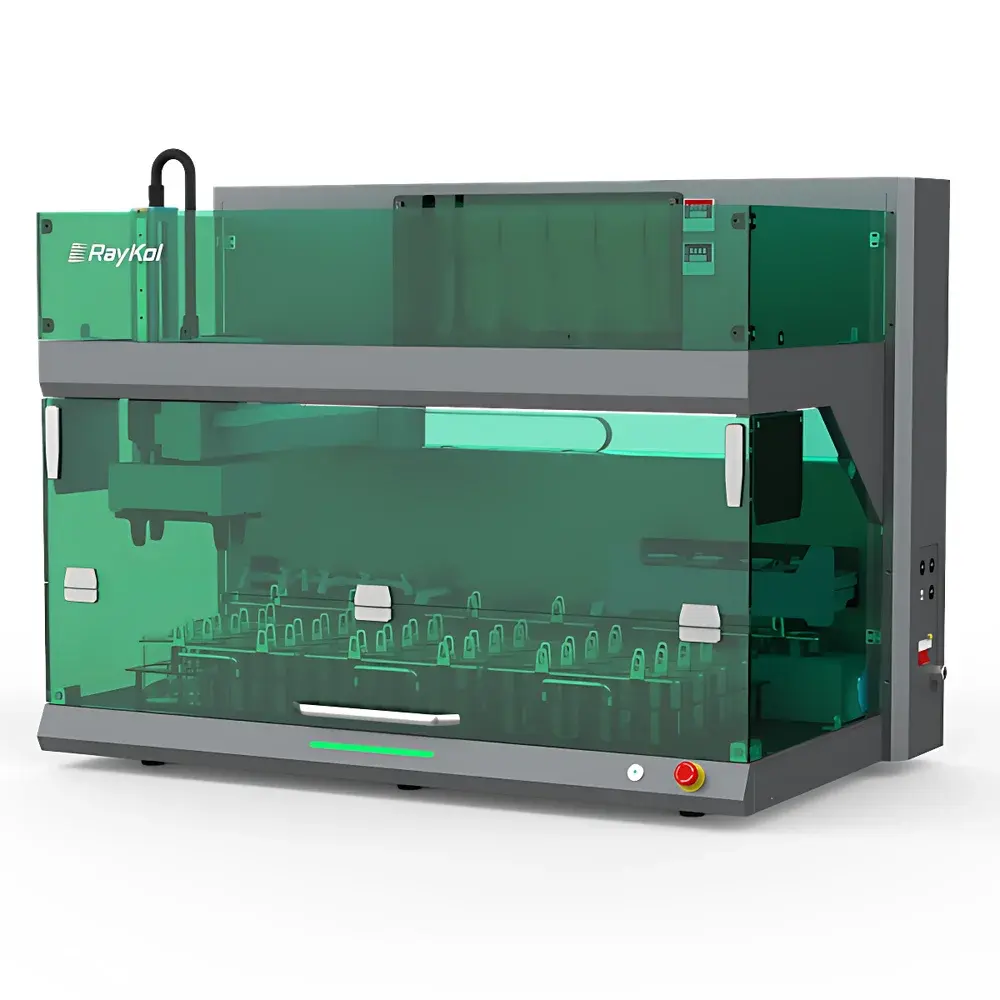
Raykol AT200 Fully Automated Soil Organic Matter Analyzer
| Brand | Raykol |
|---|---|
| Origin | Fujian, China |
| Manufacturer Type | Original Equipment Manufacturer (OEM) |
| Country of Origin | China |
| Model | AT200 |
| Pricing | Available upon request |
Overview
The Raykol AT200 Fully Automated Soil Organic Matter Analyzer is a dedicated benchtop system engineered for high-throughput, standardized quantification of soil organic matter (SOM) using the classical wet oxidation titration method—specifically aligned with internationally recognized agricultural and forestry standard protocols. Unlike mass spectrometry-based instruments—which are misclassified in the source taxonomy—the AT200 operates on a robust, chemometric endpoint titration principle: potassium dichromate (K₂Cr₂O₇) oxidation under sulfuric acid conditions, followed by ferrous ammonium sulfate (FAS) back-titration with automated colorimetric endpoint detection. This methodology ensures traceable compliance with NY/T 1121.6–2006 (Soil Testing – Part 6: Determination of Soil Organic Matter) and LY/T 1237–1999 (Determination of Organic Matter and C/N Ratio in Forest Soils). The system eliminates manual pipetting, timing, visual endpoint interpretation, and hand-calculated conversions—replacing them with closed-loop fluidic control, real-time photometric monitoring, and embedded stoichiometric algorithms.
Key Features
- Fully automated workflow—from reagent dispensing and digestion to titration and report generation—minimizing operator intervention and inter-observer variability.
- 4-channel parallel titration architecture enabling simultaneous analysis of up to four samples per cycle, significantly increasing throughput without cross-contamination.
- 48-position sample carousel with programmable batch sequencing; supports unattended overnight operation for large-volume routine testing.
- Biomimetic color recognition system utilizing dual-wavelength photometry (e.g., 450 nm and 620 nm) to distinguish subtle hue shifts at the redox endpoint, augmented by multi-criteria decision logic (e.g., slope threshold, inflection point confirmation, and signal stability window).
- Independent syringe pump modules for each reagent line—no shared valves or manifolds—ensuring zero carryover and eliminating cross-sample contamination risks.
- Integrated 4-zone metal-block digestion module with PID-controlled temperature regulation (range: ambient to 200 °C), real-time thermal monitoring, and customizable ramp/hold profiles per batch.
Sample Compatibility & Compliance
The AT200 accepts air-dried, sieved (<2 mm) soil samples weighing 0.5–5.0 g, compatible with mineral, organic, and amended soils across pH 4–9. It fully satisfies method validation requirements under Chinese agricultural standards (NY/T 1121.6–2006) and forestry sector guidelines (LY/T 1237–1999), including precision (RSD ≤3.5% for triplicate analysis), recovery (92–105% for CRM-spiked matrices), and linearity (r² ≥0.999 over 0.1–15% SOM range). All critical process parameters—including digestion temperature, titrant volume, reaction time, and endpoint criteria—are logged with timestamped audit trails, supporting GLP-compliant laboratory documentation and internal quality assurance reviews.
Software & Data Management
The proprietary ATControl software provides a validated, intuitive interface compliant with FDA 21 CFR Part 11 requirements—featuring role-based user access control, electronic signatures, immutable audit logs, and automatic backup to network drives or cloud repositories. Preloaded method templates include NY/T 1121.6–2006 and LY/T 1237–1999 configurations; users may modify digestion duration, FAS concentration, or endpoint sensitivity within defined safety boundaries. Raw absorbance curves, titration volume vs. time plots, and final SOM concentration (g/kg or %) are auto-calculated using certified reference material (CRM)-based calibration curves. Export formats include CSV, PDF reports (with lab header, analyst ID, instrument serial number, and QC flags), and LIMS-compatible XML.
Applications
- Routine soil fertility assessment in agricultural extension laboratories and agronomy research centers.
- Long-term ecological monitoring programs tracking carbon sequestration trends in cropland, pasture, and afforested sites.
- Environmental impact assessments for land-use change, biochar amendment trials, and compost maturity evaluation.
- Quality control of commercial soil amendments, organic fertilizers, and remediated brownfield substrates.
- Method transfer and training platforms in university teaching labs due to its transparency in redox chemistry visualization and reproducible endpoint detection.
FAQ
Does the AT200 comply with ISO or ASTM standards for soil organic carbon determination?
The AT200 implements the dichromate oxidation principle referenced in ISO 14235:1998 (Soil quality — Determination of organic carbon content) and aligns with the core chemical approach of ASTM D4373–21 (Standard Test Method for Total Organic Carbon in Soil), though it is specifically validated against Chinese national agricultural standards.
Can the system handle high-clay or saline soils without modification?
Yes—method presets include optional pre-treatment steps (e.g., carbonate removal with HCl fumigation) and adaptive titration speed modulation to accommodate variable matrix interference; validation data for Vertisols and saline-sodic soils are available upon request.
Is remote monitoring or integration with enterprise LIMS supported?
The AT200 supports OPC UA and HL7 protocol interfaces; secure HTTPS-based remote status viewing and scheduled report push are configurable via the ATControl software’s API layer.
What maintenance intervals are recommended for long-term operational reliability?
Syringe pump calibration and optical path cleaning are advised every 200 runs; digestion block verification (±1 °C accuracy) and photometer baseline validation are performed quarterly per IQ/OQ documentation templates supplied with the system.






