
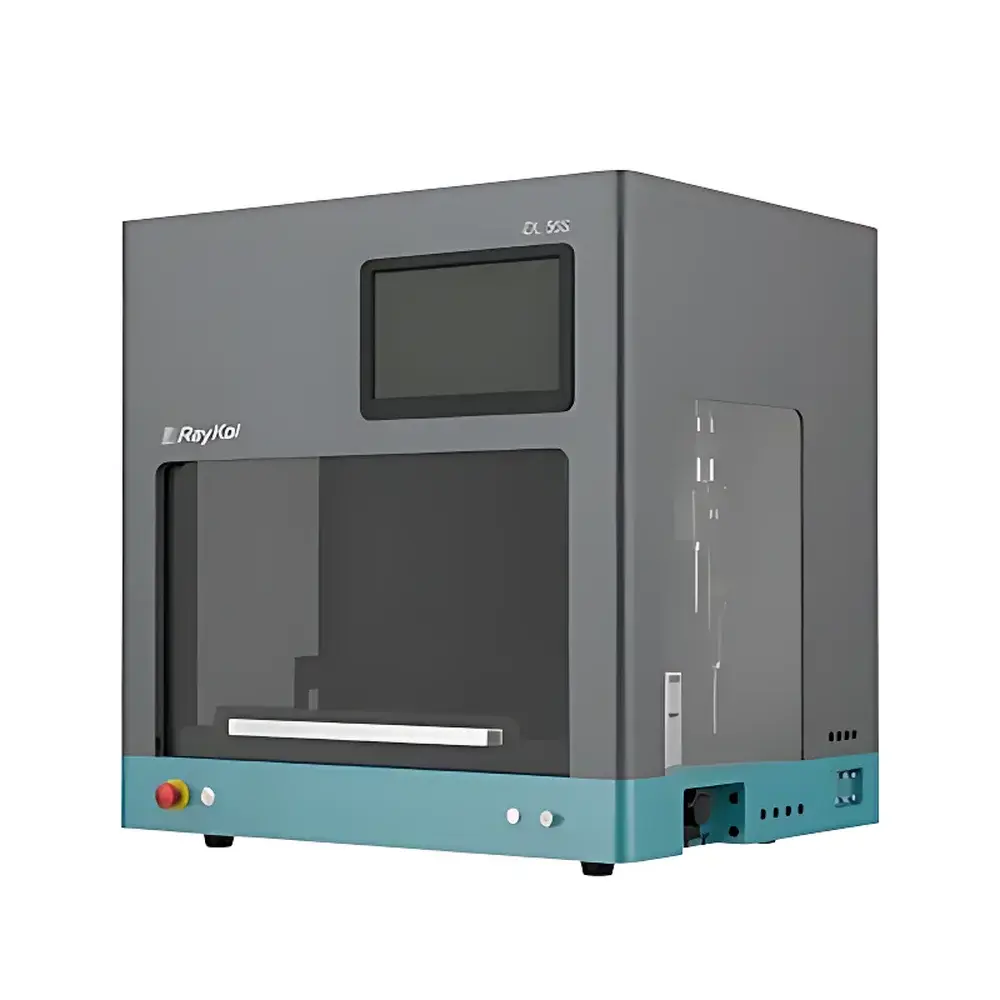
Raykol IDL 50S Intelligent Liquid Dispensing Workstation
| Brand | Raykol |
|---|---|
| Origin | Fujian, China |
| Manufacturer Type | Original Equipment Manufacturer (OEM/ODM) |
| Country of Origin | China |
| Model | IDL 50S |
| Plate Processing Time | 30 sec per position |
| Dispensing Accuracy | < ±1% |
| Dispensing Volume Range | 0–20 mL |
| Sample Throughput | 36 positions |
| Dimensions (W×D×H) | 750 × 600 × 750 mm |
Overview
The Raykol IDL 50S Intelligent Liquid Dispensing Workstation is an automated, dual-channel precision liquid handling platform engineered for high-throughput, reproducible solvent dispensing in analytical sample preparation workflows. Designed around a positive-displacement dual-syringe pump architecture, the system delivers volumetric accuracy and repeatability essential for regulated quantitative analysis—particularly in pesticide residue testing, herbal medicine QC, and food safety laboratories. Unlike manual pipetting or single-channel dispensers, the IDL 50S employs real-time capacitive liquid level sensing combined with dynamic liquid surface tracking to enable reliable aspiration from heterogeneous or low-volume samples (e.g., <5 mL organic extracts), minimizing human error and operator exposure to volatile solvents. Its closed-loop motion control, integrated fume extraction, and transparent safety enclosure support compliant operation in ISO/IEC 17025-accredited labs and GLP environments.
Key Features
- Dual independent syringe pumps (2 × 20 mL capacity) enabling simultaneous dispensing into two vessels—effectively doubling throughput without compromising precision.
- Capacitive probe technology with sub-5 µL liquid detection resolution under standard matrix conditions; supports adaptive surface tracking during aspiration to prevent over-drawing or phase contamination (e.g., avoiding aqueous interphase in biphasic extractions).
- High-speed XYZ robotic arm with repeatable positioning accuracy (<±0.2 mm), completing full 36-position dispensing cycles in ≤20 minutes.
- Modular tube rack compatibility: accepts standard 15 mL and 50 mL conical tubes on interchangeable 36-position carriers—no custom consumables required.
- Integrated safety architecture: polycarbonate viewing shield, active exhaust ventilation rated for Class I organic vapors (e.g., acetonitrile, ethyl acetate), and automatic pause-on-low-solvent or full-waste-bin detection.
- On-board tablet interface with intuitive graphical workflow builder; supports protocol cloning, stepwise validation, and audit-trail-enabled method execution logs.
Sample Compatibility & Compliance
The IDL 50S accommodates a broad range of sample containers—including borosilicate glass vials, polypropylene centrifuge tubes, and deep-well plates—without requiring proprietary tips or adapters. Its chemically resistant fluid path (PTFE-coated stainless steel probes, EPDM seals) ensures compatibility with common extraction solvents (e.g., hexane, dichloromethane, methanol). The system adheres to key regulatory expectations for instrument qualification: it supports IQ/OQ documentation packages, provides timestamped electronic records meeting ALCOA+ principles, and enables configuration locking for 21 CFR Part 11-compliant environments when deployed with validated LIMS integration. Method performance aligns with pharmacopoeial standards including Chinese Pharmacopoeia (ChP) 2020 Vol. IV General Chapter 2341 and national standards GB 23200.111–23200.121 for multiresidue pesticide analysis.
Software & Data Management
Controlled via a dedicated Android-based tablet interface, the IDL 50S software offers drag-and-drop protocol design, real-time status monitoring, and configurable cleaning sequences (volume, frequency, solvent selection). All dispensing events—including aspirate/dispense volumes, timestamps, error flags, and maintenance alerts—are stored locally with optional encrypted export to CSV or direct API transfer to laboratory information management systems (LIMS). Software logs include user authentication, parameter change history, and electronic signatures for critical steps—facilitating internal audits and external inspections under GLP or GMP frameworks. Automatic cross-contamination mitigation is enforced through programmable needle wash cycles (up to 5 rinse steps per dispense) and residual carryover validation reports (measured ≤10⁻⁵ using dye-based recovery assays).
Applications
The IDL 50S is optimized for quantitative solvent partitioning steps in multi-residue analytical workflows. Primary use cases include: standardized dilution of QuEChERS extracts prior to LC-MS/MS or GC-MS analysis; precise addition of internal standards or reconstitution solvents in pharmaceutical stability studies; and high-volume fractionation of botanical extracts in traditional Chinese medicine (TCM) quality control. It is routinely deployed in accredited food testing labs performing residue screening per GB 23200 series standards, environmental labs conducting soil/water extract processing, and contract research organizations supporting regulatory submissions to NMPA, CNAS, or EU Reference Laboratories.
FAQ
What is the minimum detectable liquid volume using capacitive sensing?
Under typical matrix conditions (e.g., acetonitrile/water mixtures), the system achieves stable liquid-level detection at ≥5 µL; optimal performance (≤2 µL resolution) requires homogeneous, non-viscous media with consistent dielectric properties.
Does the IDL 50S support serial dilution protocols?
Yes—the software includes built-in serial dilution templates with customizable dilution factors, intermediate mixing steps, and plate mapping logic for 96-well or 384-well formats.
Can the system be integrated with third-party LIMS or ELN platforms?
It provides RESTful API access and configurable CSV export; validated integrations are available for Thermo Fisher SampleManager, LabVantage, and Benchling via Raykol’s Professional Services team.
Is routine calibration required, and how is it performed?
Gravimetric verification per ISO 8655-5 is recommended quarterly; the system includes guided calibration routines with traceable weight input and auto-generated compliance reports.
What maintenance intervals are specified for syringe pumps and fluidic components?
Syringe seals require replacement every 12 months or after 50,000 cycles; needle wash manifolds and waste tubing should be inspected biweekly and replaced quarterly under continuous operation.



