
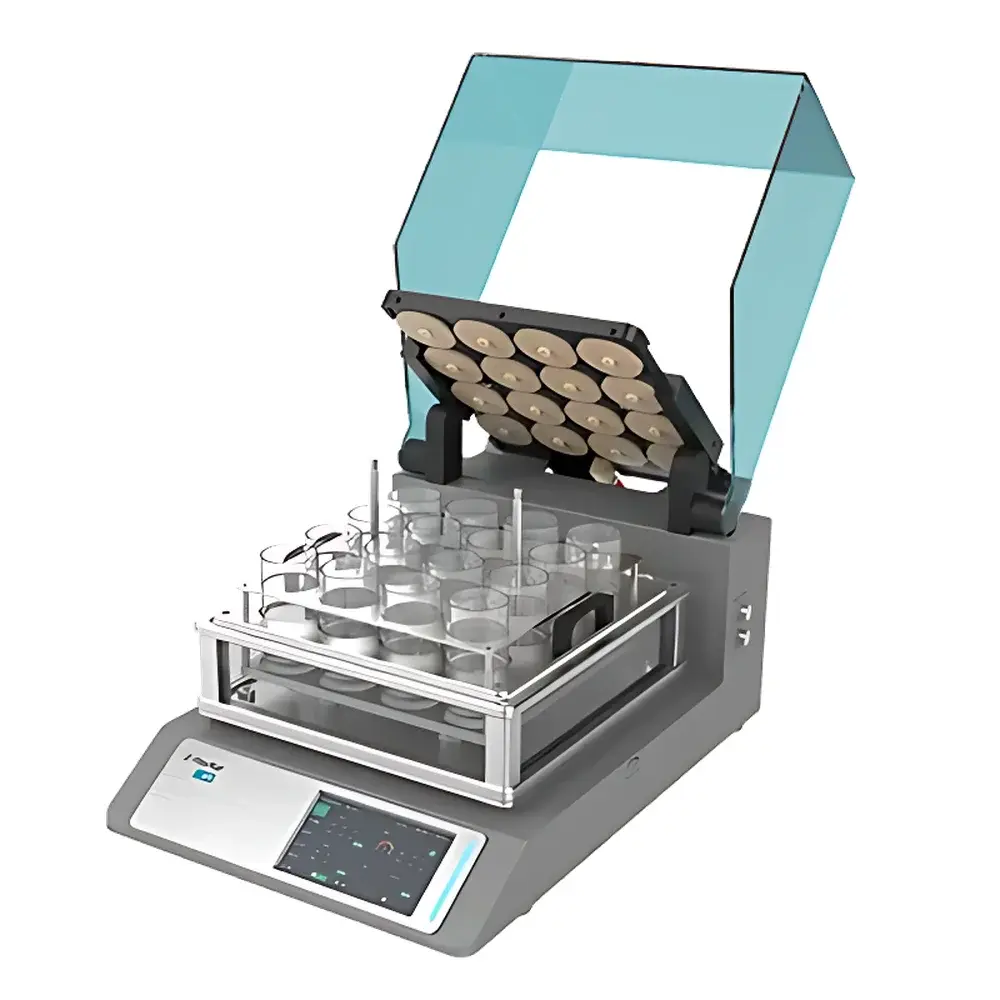
Raykol MPE High-Throughput Vacuum Parallel Concentrator
| Brand | Raykol |
|---|---|
| Origin | Fujian, China |
| Manufacturer Type | Direct Manufacturer |
| Regional Classification | Domestic (China) |
| Model | MPE |
| Instrument Type | Vacuum Centrifugal Concentrator |
| Temperature Range | Ambient to 80 °C |
| Temperature Control Accuracy | ±1 °C |
| Sample Volume Capacity | 1–200 mL |
Overview
The Raykol MPE High-Throughput Vacuum Parallel Concentrator is an engineered solution for quantitative, reproducible solvent removal in trace-level analytical workflows—particularly in environmental monitoring and food safety laboratories. It operates on the principle of vacuum-assisted evaporation under precisely controlled thermal and pressure conditions, integrating water-bath heating with digitally regulated vacuum control to maintain uniform evaporation kinetics across multiple samples simultaneously. Unlike conventional nitrogen blow-down systems or rotary evaporators, the MPE platform eliminates inter-sample variability by ensuring identical thermal exposure, vacuum setpoints, and mechanical agitation per position. Its design adheres to fundamental principles of mass transfer thermodynamics: reducing partial pressure of solvents via vacuum lowers boiling points while maintaining target analyte integrity through gentle, non-oxidative conditions. This makes it especially suitable for concentrating thermally labile, volatile, or semi-volatile compounds—such as PAHs, PCBs, nitrofuran metabolites, and multi-residue pesticide standards—prior to HPLC, GC-MS, or LC-MS/MS analysis.
Key Features
- Uniform temperature distribution across all 16 positions using high-heat-capacity water bath medium, achieving ±1 °C spatial consistency at setpoints from ambient to 80 °C.
- Digital vacuum regulation with ceramic pressure sensors enabling real-time feedback control; prevents co-boiling and analyte loss during low-pressure evaporation.
- Integrated cold-trap system with PTFE-lined serpentine condenser operating at ≤0 °C, delivering ≥99.2% acetonitrile recovery efficiency under standardized test conditions.
- Three-sided transparent water bath chamber for direct visual monitoring of sample volume reduction—critical for endpoint determination at 1 mL or near-dry states per regulatory methods (e.g., HJ 784-2016, GB 23200.8-2016).
- Modular sample rack accommodating vials from 1 mL to 200 mL; optional reflux module enables vapor-phase solvent condensation onto inner tube walls, enhancing recovery of highly volatile analytes.
- Quick-release heated lid assembly minimizes condensate formation on sealing surfaces and suppresses cross-contamination; optimized exhaust ducting ensures directional vapor evacuation without inter-position carryover.
- Gentle orbital shaking (non-centrifugal) promotes homogeneous heat transfer and prevents bumping or foaming—especially beneficial for viscous soil extracts or lipid-rich matrices.
Sample Compatibility & Compliance
The MPE supports a broad range of sample types including aqueous extracts, organic solvent eluates (e.g., dichloromethane, ethyl acetate, acetonitrile), and complex biological matrices such as soil leachates, sediment suspensions, meat homogenates, and fruit/vegetable tissue digests. Its PTFE-wetted components and corrosion-resistant construction comply with handling requirements for aggressive solvents under ISO 8573-1 (compressed air purity) and ASTM D1296 (solvent recovery testing). While not certified to GLP or GMP out-of-the-box, the instrument’s programmable method storage, endpoint auto-shutdown (pressure release + cooling), and digital audit trail capabilities support alignment with FDA 21 CFR Part 11 when deployed within validated laboratory information management systems (LIMS).
Software & Data Management
The MPE features an intuitive graphical user interface (GUI) with preloaded SOP templates aligned with Chinese national standards (e.g., HJ, GB series) and common international protocols. Users may store, recall, and modify concentration methods—including ramped temperature profiles, stepwise vacuum gradients, and timed agitation cycles. All operational parameters (vacuum level, bath temperature, runtime, endpoint status) are timestamped and exportable in CSV format for integration into electronic lab notebooks (ELN) or LIMS. Manual vacuum override mode allows fine-tuned experimental optimization where empirical adjustment is required—such as for novel extraction solvents or emerging contaminants lacking established evaporation protocols.
Applications
- Environmental analysis: PAH quantification in soils/sediments per HJ 784-2016 (HPLC); PCB determination per HJ 743-2015 (GC-MS/MS).
- Food safety testing: Nitrofuran metabolite residues in animal tissues per GB/T 20752-2006 (LC-MS/MS); multi-pesticide screening in produce per GB 23200.8-2016 (GC-MS) and GB 23200.9-2016 (GC-MS).
- Pharmaceutical residue analysis: Veterinary drug extraction from aquaculture products requiring high-volume (up to 200 mL), parallel processing with minimal analyte degradation.
- Forensic toxicology and clinical research: Concentration of urine or plasma extracts prior to targeted small-molecule profiling.
FAQ
What sample volumes can the MPE accommodate?
The system supports individual sample volumes ranging from 1 mL to 200 mL across its 16-position rack, with optimized performance for 100–200 mL soil or sediment extracts.
Is the instrument compatible with corrosive solvents like hydrochloric acid or trifluoroacetic acid?
PTFE-lined condensers and seals provide resistance to most organic solvents and mild acids; however, prolonged exposure to strong mineral acids or oxidizers is not recommended without custom wetted-part validation.
Does the MPE meet regulatory requirements for auditable data handling?
It records all critical process parameters with timestamps and supports CSV export; full 21 CFR Part 11 compliance requires integration with a qualified LIMS or ELN platform.
Can the MPE be used without the reflux module?
Yes—the reflux module is optional and removable; standard operation proceeds with primary condensation via the integrated cold trap.
How is temperature uniformity verified across positions?
Raykol performs factory calibration using NIST-traceable PT100 probes at each position; users may conduct periodic verification using calibrated immersion thermometers per ISO/IEC 17025 guidelines.



