
Raykol RKFI Intelligent Unmanned Water Quality Laboratory
| Brand | Raykol |
|---|---|
| Origin | Fujian, China |
| Manufacturer Type | Original Equipment Manufacturer (OEM/ODM) |
| Country of Origin | China |
| Model | RKFI Intelligent Unmanned Water Quality Laboratory |
| Price Range | USD 140,000 – 420,000 |
Overview
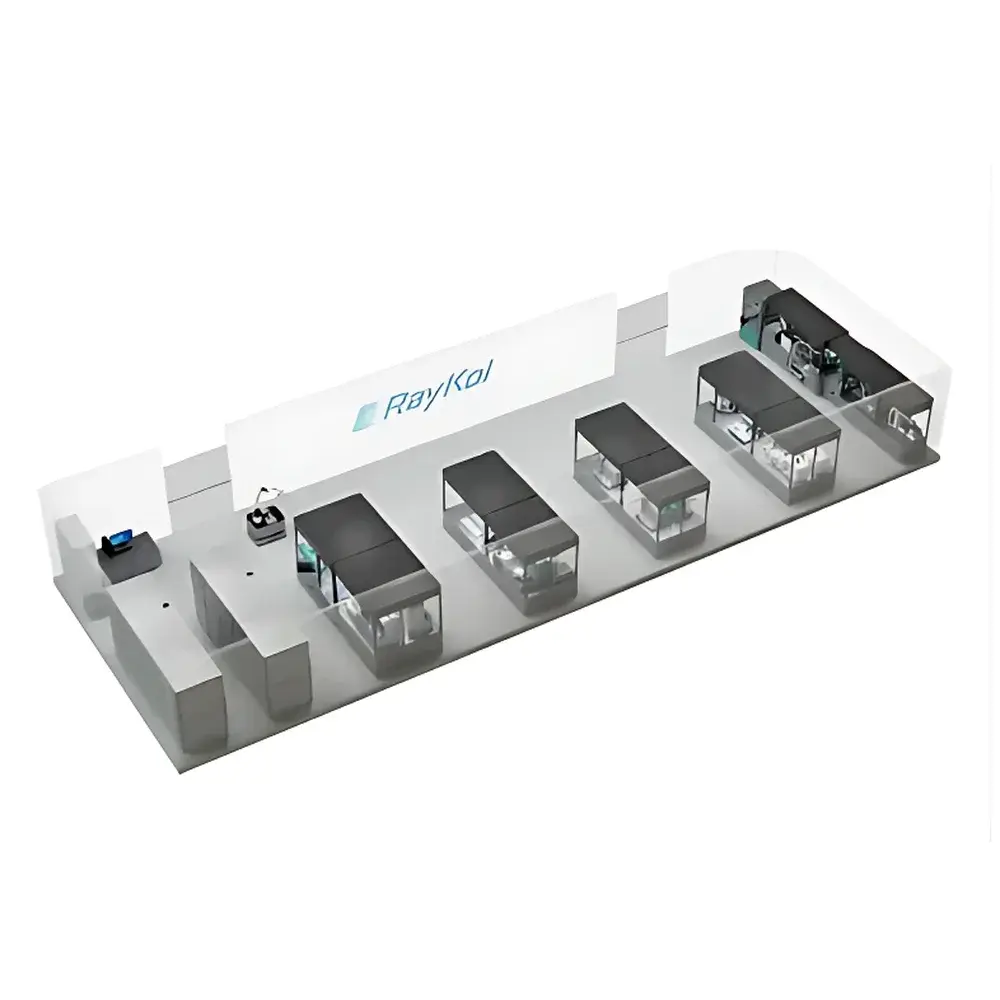
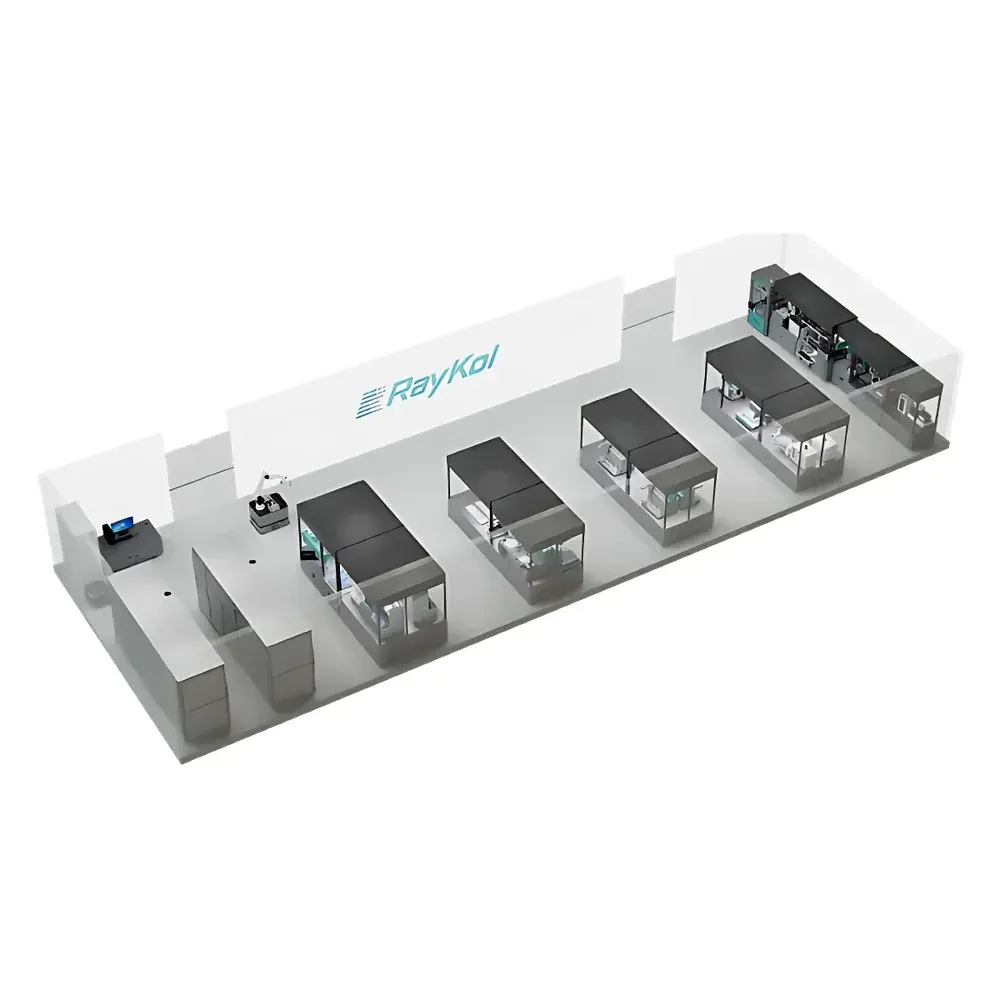
The Raykol RKFI Intelligent Unmanned Water Quality Laboratory is an integrated, modular automation platform engineered for end-to-end water quality analysis—from sample receipt and pH adjustment to digestion, separation, quantification, and data reporting. Built upon flow injection analysis (FIA), spectrophotometry (190–840 nm), high-precision liquid handling, and robotic material transport, the system implements a distributed functional island architecture. Each island operates as an autonomous unit—ammonia nitrogen, total phosphorus/total nitrogen, permanganate index, multi-parameter physicochemical analysis (pH, conductivity, turbidity, temperature), centrifugation, high-temperature/high-pressure digestion, microwave-assisted acid digestion, and UV-Vis spectrophotometric detection—interconnected via standardized sample carriers and synchronized by central orchestration software. Designed for compliance with ISO/IEC 17025:2017 and aligned with U.S. EPA Method 300.0, ASTM D1292, and HJ 636–2012, the laboratory enables unattended operation for up to 72 hours, supporting continuous monitoring at national surface water control sections (N = 3,600+), wastewater discharge points, and groundwater surveillance wells.
Key Features
- Modular Functional Islands: Eight configurable islands—including FIA-based ammonia nitrogen, total phosphorus/total nitrogen, sulfide, phenol, cyanide, anionic surfactants, and hexavalent chromium—each optimized for reagent economy, minimal carryover, and method-specific endpoint detection.
- Robotic Sample Transport System: Six-axis articulated robot with ±0.04 mm positional repeatability and 0.5 m/s linear speed; rail-guided AGV fleet enables cross-room, obstacle-free transfer of standard carrier racks without structural lab modification.
- High-Fidelity Liquid Handling: Dual-syringe precision pumps (CV < 0.5% RSD) with independent fluidic paths; ADP-controlled reagent addition eliminates cross-contamination in UV-Vis assays.
- Integrated Multi-Parameter Sensor Module: EXO-series multiparameter probes (YSI) for real-time, in-line measurement of pH, conductivity, turbidity, dissolved oxygen, and temperature—featuring automated cleaning, calibration verification, and self-diagnostic routines.
- Digestion & Pretreatment Flexibility: High-pressure autoclave module (up to 120 °C, 0.2 MPa) compliant with GB 11893 and HJ 636; microwave-assisted digestion island supports sequential acid addition, temperature ramping, and post-digestion cooling—all programmable per batch.
- Software-Controlled Spectral Acquisition: Full-spectrum photometer (190–840 nm) with interchangeable flow cells (optical path lengths: 10 mm, 20 mm, 50 mm); automatic wavelength selection and baseline correction per analytical method.
Sample Compatibility & Compliance
The RKFI platform processes raw water matrices including surface water (rivers, lakes, reservoirs), seawater, groundwater, municipal wastewater, and industrial effluents. All functional islands adhere to method validation requirements under GB/T 27025–2008 (equivalent to ISO/IEC 17025), HJ 91.2–2022, and HJ 91.1–2019. Ammonia nitrogen and total phosphorus modules are verified against GB 11893–1989 and HJ 636–2012 respectively. The system supports audit trails, electronic signatures, and data integrity features compliant with FDA 21 CFR Part 11 when deployed in GLP/GMP-regulated environments. Calibration standards, blanks, and QC samples are scheduled automatically, with traceability to NIST-traceable reference materials.
Software & Data Management
The RKFI Control Suite is a Windows-based, client-server application supporting role-based access control, method library management, and SOP-driven workflow execution. It logs all instrument events—including pipetting volumes, digestion parameters, spectral scans, and robotic motion sequences—with immutable timestamps. Raw spectral data (ASCII .csv or .jdx format), chromatographic integrations (where applicable), and QC reports export directly to LIMS via HL7 or ASTM E1384 interfaces. Audit trail records include user ID, action timestamp, parameter changes, and reason-for-change fields—fully compliant with ALCOA+ principles (Attributable, Legible, Contemporaneous, Original, Accurate, Complete, Consistent, Enduring, Available).
Applications
- National environmental monitoring networks requiring unattended, high-throughput analysis of >3,600 surface water control sections.
- Municipal wastewater treatment plants performing daily compliance testing for NH₃-N, TP, TN, CODMn, and physicochemical parameters.
- Third-party testing laboratories seeking ISO/IEC 17025 accreditation with reduced manual intervention and enhanced inter-laboratory reproducibility.
- Research institutions conducting method development for emerging contaminants (e.g., microplastics pre-concentration support via filtration islands, or trace metal speciation via hydride generation coupling).
- Industrial environmental departments managing effluent discharge reporting under GB 8978–1996 and GB 18918–2002, with full digital chain-of-custody documentation.
FAQ
Does the RKFI system require laboratory infrastructure modifications?
No. The AGV-based transport architecture eliminates the need for fixed conveyor belts or structural retrofitting. Standard floor-level navigation and rack-based sample logistics enable deployment in existing lab spaces.
Can new analytes be added post-installation?
Yes. New functional islands (e.g., for heavy metals or organic micropollutants) can be integrated via mechanical docking ports and software-defined method templates—no hardware rewiring required.
Is remote monitoring and troubleshooting supported?
Yes. The system provides secure HTTPS-based web dashboard access, real-time status visualization, predictive maintenance alerts (e.g., pump wear, lamp intensity decay), and remote firmware updates via encrypted TLS 1.2 channels.
What validation documentation is provided?
Each island ships with IQ/OQ documentation per ISO/IEC 17025 Annex A. Performance qualification (PQ) protocols—including spike recovery, LOD/LOQ determination, and inter-island correlation studies—are included for major parameters (NH₃-N, TP, TN, CODMn, pH, turbidity).
How is data integrity ensured during power interruption?
All critical operations use non-volatile memory buffers; robotic positions and assay states are checkpointed every 3 seconds. Upon power restoration, the system resumes from last validated step without data loss or sample misidentification.
Related Products







