
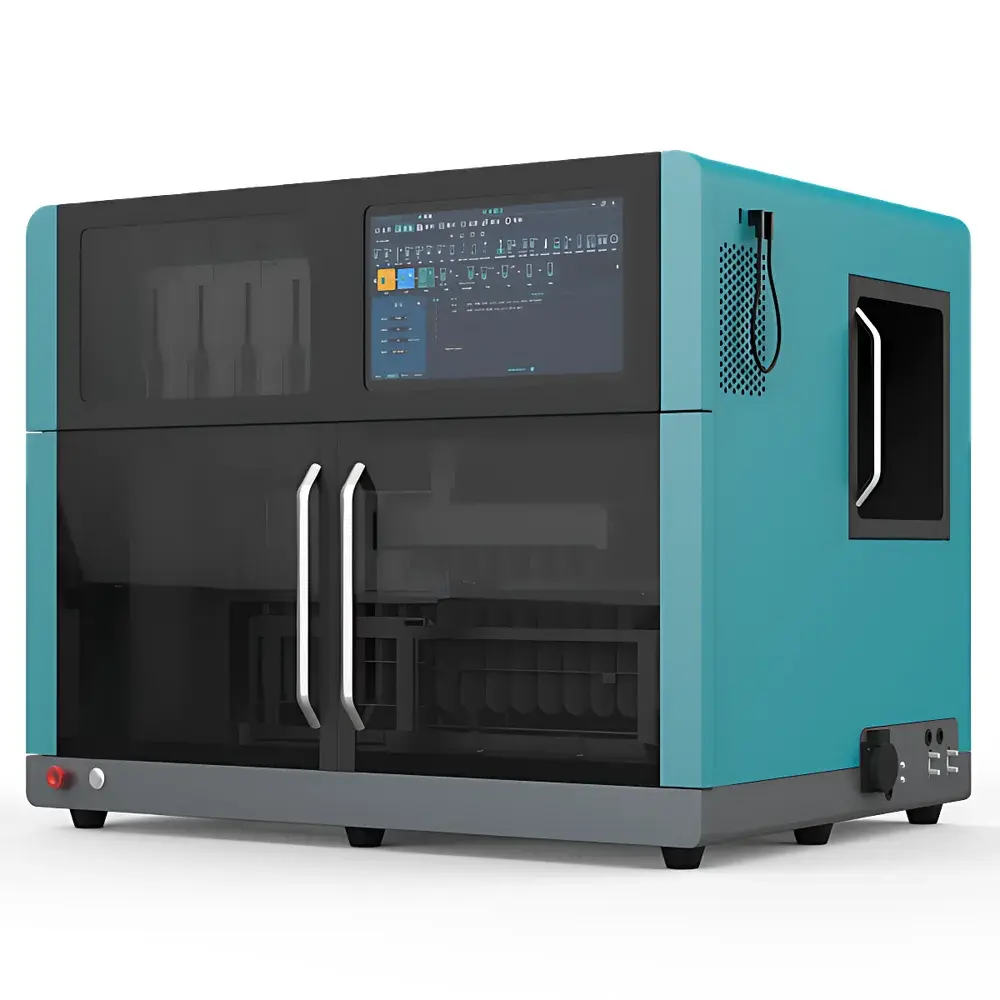
Raykol SPEVA Automated Solid Phase Extraction and Concentration System
| Brand | Raykol |
|---|---|
| Origin | Fujian, China |
| Manufacturer Type | Original Equipment Manufacturer (OEM) |
| Country of Origin | China |
| Model | SPEVA |
| Automation Level | Fully Automated |
| Number of Channels | 8 Parallel Channels |
| Extraction Format | Cartridge-Based SPE |
| Flow Rate Control | 0.1–100 mL/min |
| Solvent Selection | Up to 6 Independent Solvent Reservoirs |
| Sample Capacity | 80 Positions |
| Sample Loading Volume | 0.1 mL to Unlimited |
| Wetted Materials | PTFE, Polypropylene (PP), PEEK |
Overview
The Raykol SPEVA Automated Solid Phase Extraction and Concentration System is an integrated, fully automated platform engineered for high-throughput, reproducible sample preparation in analytical laboratories. It combines solid-phase extraction (SPE) and nitrogen-assisted concentration/transfer into a single, unattended workflow—eliminating manual intervention across all critical steps: cartridge conditioning, sample loading, washing, drying, elution, solvent evaporation, reconstitution, and optional secondary SPE pass-through. The system operates on the principle of pressure- and pump-driven liquid handling, utilizing precision syringe pumps and multi-position valves to deliver consistent flow rates independent of sample viscosity or matrix complexity. Designed for compliance-critical environments—including food safety testing, environmental monitoring, clinical toxicology, and pharmaceutical analysis—the SPEVA meets foundational requirements for method traceability, instrument qualification, and data integrity under GLP and GMP-aligned laboratory practices.
Key Features
- Integrated SPE + Concentration Workflow: Performs full SPE protocol (conditioning, loading, washing, drying, elution) followed by on-line nitrogen blow-down, solvent exchange, and optional re-injection—without manual transfer or tube handling.
- 8-Channel Parallel Processing: Simultaneously processes up to eight cartridges per cycle, supporting batch runs of up to 80 samples with programmable sequence logic and auto-loading capability.
- Precision Flow Control: High-accuracy syringe pump system coupled with column-insertion flow path design ensures direct contact between eluent and sorbent bed—minimizing dead volume and delivering true programmed flow rates (0.1–100 mL/min), unaffected by sample density or viscosity.
- Chemically Inert Fluid Path: All wetted components—including tubing, valves, needle guides, and collection vials—are constructed from PTFE, polypropylene (PP), and PEEK, eliminating analyte adsorption, leaching, or carryover.
- Patented Variable-Diameter Nitrogen Needle: Dual-layer stainless-steel needle maintains precise centering within conical vials; uniform inner diameter across all channels guarantees equal nitrogen distribution and reproducible evaporation kinetics.
- Intelligent Software Interface: Graphical touchscreen interface supports method editor, real-time status dashboard, dynamic sequence editing during run, and automatic log generation compliant with ALCOA+ principles (Attributable, Legible, Contemporaneous, Original, Accurate, Complete, Consistent, Enduring, Available).
Sample Compatibility & Compliance
The SPEVA accommodates diverse sample matrices without modification: aqueous environmental extracts (e.g., drinking water per GB 5749–2022, surface water per GB 3838–2002), biological fluids (plasma, urine, whole blood), viscous extracts (plant tissue homogenates, honey, serum), and complex food digests (meat, fish, fruits, vegetables). Its modular architecture supports standard 1 mL, 3 mL, and 6 mL SPE cartridges, as well as custom-packed columns. From a regulatory standpoint, the system supports audit-ready operation through timestamped event logs, user-access controls, electronic signatures (optional), and configurable audit trails—aligning with FDA 21 CFR Part 11 readiness when deployed with validated software configurations. It also facilitates adherence to ISO/IEC 17025 method validation requirements for sample preparation steps in accredited testing laboratories.
Software & Data Management
The embedded control software provides method-driven automation with drag-and-drop protocol builder, parameter locking for SOP enforcement, and multi-method queueing. Each run generates a structured .csv log file containing timestamps for every valve actuation, pump movement, pressure reading, solvent selection, and nitrogen activation event. Data export supports LIMS integration via standard OPC UA or CSV-based transfer protocols. Optional remote monitoring via secure HTTPS interface enables lab-wide oversight without local workstation dependency. All software updates are version-controlled and documented per ICH Q9 risk management guidelines.
Applications
- Multi-residue pesticide analysis in fruits and vegetables per GB 2763–2019
- Veterinary drug residue quantification in animal-derived foods per GB 31650–2019
- Organic pollutant enrichment (e.g., PAHs, PCBs, phthalates) from large-volume water samples (1–2 L) per GB/T 14848–2017
- Toxicological screening in clinical specimens including hemolyzed blood and turbid urine
- Active pharmaceutical ingredient (API) and metabolite isolation from herbal extracts and synthetic reaction mixtures
FAQ
Does the SPEVA support method validation according to ISO/IEC 17025?
Yes—its deterministic fluid handling, traceable event logging, and configurable access controls enable full documentation of sample preparation parameters required for method validation and uncertainty estimation.
Can the system handle viscous or particulate-laden samples?
Yes—integrated filter-compatible cartridge holders and adjustable aspiration parameters allow robust processing of plasma, milk, fermentation broths, and sediment extracts without clogging.
Is third-party software integration supported?
Yes—via open API endpoints and standardized data export formats (CSV, XML), the SPEVA integrates with major LIMS and ELN platforms including LabWare, Thermo Fisher SampleManager, and Benchling.
What maintenance is required for long-term reliability?
Routine maintenance includes quarterly calibration of syringe pump displacement accuracy, biannual inspection of PTFE seals and nitrogen needle alignment, and annual verification of solvent delivery line integrity using gravimetric flow checks.
How is solvent waste managed during operation?
The system features a dedicated solvent recovery port connected to external fume hood ducting or sealed waste collection—fully compatible with centralized lab solvent disposal infrastructure.
Related Products



