
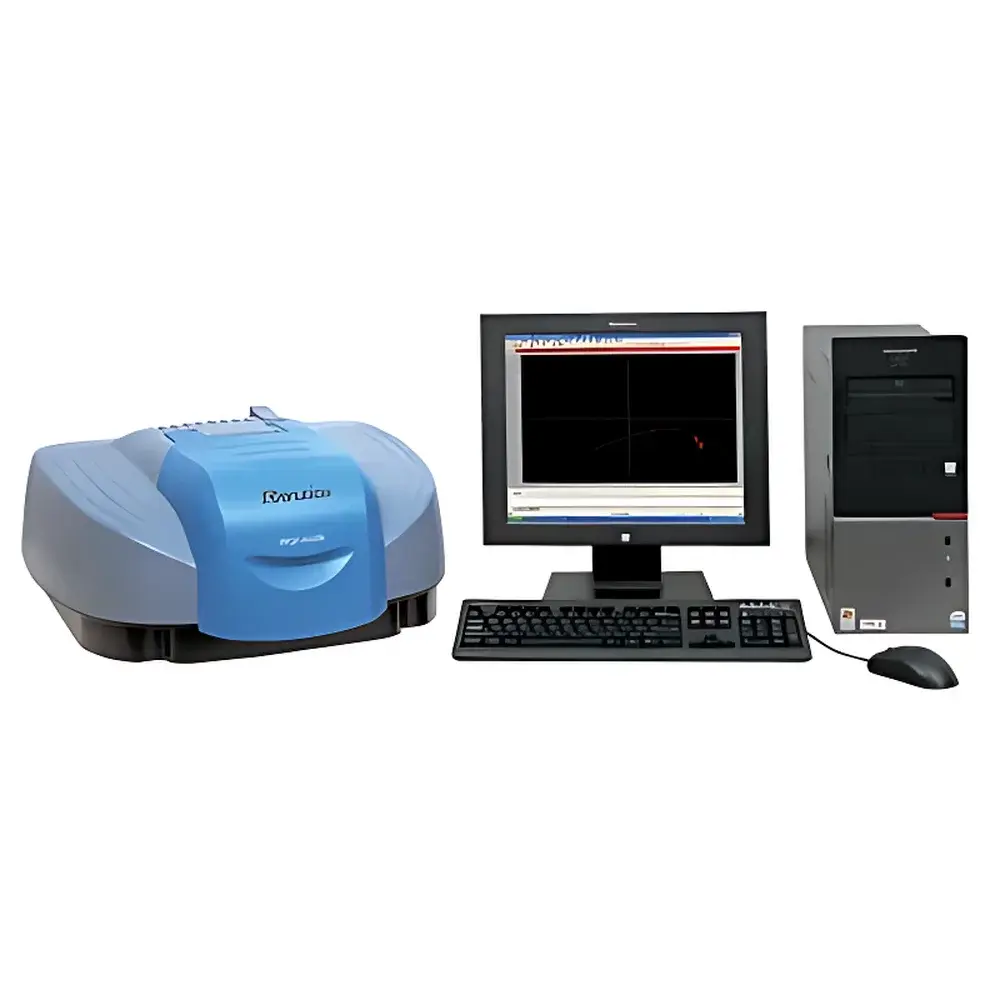
Rayleigh WQF-600N Fourier Transform Near-Infrared Spectrometer
| Brand | Rayleigh |
|---|---|
| Origin | Beijing, China |
| Model | WQF-600N |
| Instrument Principle | Fourier Transform (FT) |
| Wavenumber Range | 3300–10000 cm⁻¹ |
| Spectral Resolution | < 4 cm⁻¹ |
| Wavenumber Accuracy | Better than half the set resolution |
| Transmittance Repeatability | ±0.5% T |
| Signal-to-Noise Ratio (S/N) | >10,000:1 (RMS, 32 scans at 4300–4400 cm⁻¹) |
| Beam Splitter | CaF₂ |
| Detector Options | DTGS (PbS, InGaAs optional) |
| Light Source | Air-cooled tungsten-halogen lamp |
| Data System | PC-based with Windows OS |
| Software | Full-featured FT-NIR acquisition, preprocessing, chemometric modeling, and spectral analysis suite compliant with ASTM E1655 and ISO 12099 |
Overview
The Rayleigh WQF-600N Fourier Transform Near-Infrared (FT-NIR) Spectrometer is a high-performance analytical instrument engineered for precision molecular characterization in the 1000–3500 nm (3300–10000 cm⁻¹) spectral region. Based on Michelson interferometry, it acquires interferograms via a dynamically balanced oscillating mirror, which are then subjected to fast Fourier transformation to yield high-fidelity absorbance or transmittance spectra. Unlike dispersive NIR systems, the FT architecture delivers inherent wavelength accuracy, superior photometric linearity, and multiplex (Fellgett) and throughput (Jacquinot) advantages—enabling robust quantitative and qualitative analysis of organic functional groups, particularly C–H, O–H, and N–H overtones and combination bands. Designed for laboratory, pilot-scale, and near-line deployment, the WQF-600N meets the metrological demands of regulated environments where traceability, reproducibility, and long-term stability are critical.
Key Features
- Hermetically sealed, humidity-resistant pendulum-type interferometer with thermal isolation between IR source and optical path—minimizing drift and enhancing environmental resilience in ambient lab conditions.
- Optimized CaF₂ beam splitter delivering high transmission efficiency across the full NIR range, eliminating water vapor interference peaks common with KBr-based optics.
- High-speed, low-vibration oscillating mirror drive system enabling rapid spectral acquisition (≤1 s per scan), supporting real-time process monitoring and high-throughput screening.
- Dual-mode detector interface accommodating DTGS (deuterated triglycine sulfate) as standard, with field-upgradable options for PbS (extended range to 3500 nm) and InGaAs (enhanced sensitivity in 900–1700 nm).
- Air-cooled tungsten-halogen light source with integrated integrating sphere design—ensuring uniform illumination, stable radiant flux, and efficient thermal dissipation during extended operation.
- Fully modular electronics architecture featuring 24-bit ADC, real-time digital signal processing (DSP), and hardware-level phase correction—guaranteeing baseline stability and minimal instrumental artifact.
Sample Compatibility & Compliance
The WQF-600N supports diverse sampling modalities including diffuse reflectance (via integrated sphere or fiber-optic probes), transmission (liquid cells, cuvettes), and transflectance (coated tablets, films). It complies with key international standards governing spectroscopic instrumentation and data integrity: ASTM E1655 (standard practices for NIR quantitative analysis), ISO 12099 (animal feeding stuffs—guidelines for NIR calibration), and GLP-compliant operational workflows. While not pre-certified for FDA 21 CFR Part 11, its software architecture supports audit-trail logging, user access control, electronic signature integration, and raw-data immutability—facilitating validation under GMP, USP , and ICH Q2(R2) frameworks. All optical components are RoHS-compliant and manufactured to ISO 9001 quality management protocols.
Software & Data Management
The instrument is controlled by Rayleigh’s proprietary NIRSoft™ platform—a native 64-bit Windows application supporting spectral acquisition, baseline correction (asymmetric least squares, rubberband), scatter correction (SNV, MSC), derivative processing (1st/2nd order), and multivariate calibration (PLS, PCR, PCA). The software includes built-in chemometric model development tools with cross-validation, outlier detection, and residual analysis. Raw interferogram and spectrum files (.spc, .jdx) are stored in vendor-neutral formats; ASCII export enables seamless integration with third-party platforms such as MATLAB, Unscrambler®, and Python-based scikit-learn pipelines. Data security features include encrypted project archives, timestamped metadata embedding, and configurable backup to network drives or NAS devices.
Applications
- Petrochemical QA/QC: Real-time determination of hydrocarbon composition, distillation endpoints (T10/T50/T90), octane number, and sulfur content in gasoline, diesel, and jet fuel without sample preparation.
- Agricultural & Food Analysis: Rapid quantification of moisture, protein, oil, starch, and fiber in grains, flour, feed pellets, dairy powders, and meat products—validated against AOAC official methods.
- Pharmaceutical Manufacturing: Blend uniformity assessment, API identification, tablet hardness prediction, and moisture mapping in lyophilized products—supporting PAT (Process Analytical Technology) initiatives.
- Tobacco Quality Control: Simultaneous prediction of nicotine, reducing sugars, total nitrogen, chloride, and potassium in leaf lamina and cut filler using site-specific PLS models.
- Industrial Materials: Characterization of polymer crystallinity, cellulose degree of polymerization in pulp, and dye concentration in textile fibers.
FAQ
What is the typical measurement time per spectrum?
Standard single-spectrum acquisition requires 32 co-added scans (≈60 seconds) for S/N >10,000:1; however, 4–16 scans (15–60 s) are sufficient for routine QC applications.
Can the WQF-600N be used for in-line process monitoring?
Yes—when coupled with fiber-optic probes (e.g., 2-m quartz bundles) and external flow cells, it supports continuous monitoring in reactors, dryers, and conveyors with IP65-rated enclosures available upon request.
Is method transfer possible between different FT-NIR instruments?
Method portability is achievable through standardized spectral preprocessing, instrument standardization (using NIST-traceable polystyrene or polyethylene reference films), and model recalibration using transfer samples.
Does the system support automated calibration verification?
Yes—the software includes scheduled auto-check routines using internal reference channels and user-defined validation standards, generating compliance reports aligned with ISO/IEC 17025 requirements.
What maintenance is required for long-term reliability?
Annual interferometer alignment verification, desiccant replacement in the optical bench, and detector dark-current characterization are recommended; no consumables other than standard lamp replacements every 2,000–3,000 hours.
Related Products




