
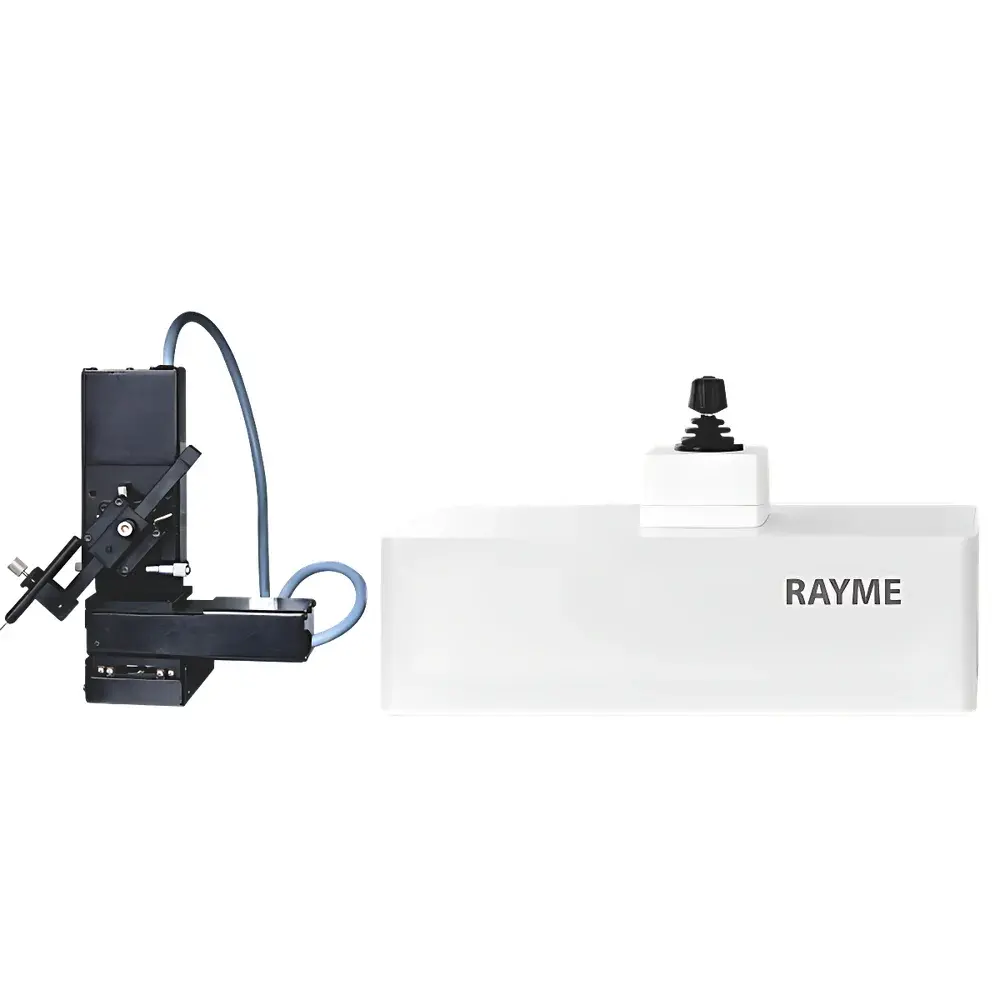
Raymetech MMS-200 Fully Automated Micromanipulator System
| Brand | Raymetech |
|---|---|
| Origin | Jiangsu, China |
| Model | MMS-200 |
| Type | Motorized, Closed-Loop Electrophysiology Micromanipulator |
| Drive Mechanism | Piezo-assisted Stepper Motor Actuation |
| Positioning Resolution | ≤50 nm (open-loop), ≤100 nm (closed-loop with integrated capacitive feedback) |
| Repeatability | ±0.1 µm |
| Maximum Load Capacity | 200 g per axis |
| Travel Range (X/Y/Z) | 25 mm × 25 mm × 20 mm |
| Control Interface | USB 2.0 + RS-422 |
| Compatibility | Standard Nikon, Olympus, Leica, and Zeiss inverted & upright microscope stages |
| Software Platform | RayControl v3.2 (Windows 10/11, 64-bit) with FDA 21 CFR Part 11–compliant audit trail module |
Overview
The Raymetech MMS-200 is a fully automated, closed-loop micromanipulator system engineered for high-precision mechanical positioning in live-cell electrophysiology, embryology, and single-cell functional assays. Built upon a hybrid actuation architecture combining high-torque stepper motors with piezoelectric fine-positioning stages, the MMS-200 delivers sub-micron reproducibility across X, Y, and Z axes under real-time optical feedback. Its modular kinematic design integrates seamlessly with inverted and upright microscopes from major OEMs—including Nikon Ti2, Olympus IX83, Leica DMi8, and Zeiss Axio Observer—enabling synchronized manipulation and imaging without mechanical interference. Unlike open-loop systems relying solely on step-counting, the MMS-200 incorporates capacitive position sensors at each axis to provide continuous, non-contact displacement verification, ensuring traceable positional fidelity required for GLP-compliant cell injection, patch-clamp electrode advancement, and embryo bisection protocols.
Key Features
- Three-axis motorized control (X/Y/Z) with independent programmable velocity profiles (0.1–50 µm/s) and acceleration ramping to minimize mechanical overshoot during rapid repositioning.
- Closed-loop capacitive position sensing with 100 nm resolution and <±0.1 µm repeatability over full travel range—validated per ISO 230-2 Annex B protocols.
- Modular toolholder interface compliant with standard 3.2 mm OD glass micropipette holders and 0.7 mm tungsten microelectrodes; supports simultaneous dual-probe mounting for paired-patch or injection+recording configurations.
- Rugged aluminum alloy frame with vibration-damped base plate, optimized for laminar flow hoods and seismic-isolated optical tables.
- Integrated emergency stop circuit and force-limiting firmware that halts motion upon unexpected resistance (>15 mN threshold), protecting both sample integrity and probe tip geometry.
Sample Compatibility & Compliance
The MMS-200 is validated for use with biological specimens ranging from isolated neurons and cardiomyocytes to zygotes, blastocysts, and organotypic brain slices (up to 500 µm thickness). Its low-noise motion profile ensures minimal mechanical perturbation during whole-cell patch clamp recordings (<1 pA baseline current drift over 10 min). The system conforms to IEC 61000-6-2 (immunity) and IEC 61000-6-4 (emission) standards for laboratory equipment. Firmware and RayControl software support 21 CFR Part 11-compliant user authentication, electronic signatures, and immutable audit trails—fully compatible with GMP/GLP documentation workflows in contract research organizations (CROs) and academic core facilities undergoing AAALAC or ISO/IEC 17025 accreditation.
Software & Data Management
RayControl v3.2 provides intuitive graphical trajectory programming, multi-step macro scripting, and time-synchronized logging of position coordinates, timestamped video frames (via HDMI/USB3.0 camera input), and external analog signals (e.g., amplifier output, temperature sensor voltage). All datasets are saved in HDF5 format with embedded metadata (user ID, protocol version, calibration timestamp, microscope objective used). Batch export to MATLAB, Python (via h5py), or Prism-compatible CSV is supported. Remote operation via secure RDP or VNC is enabled without compromising local audit trail integrity.
Applications
- Electrophysiology: Precise advancement of patch pipettes during blind patching or visualized patching; stable hold during long-duration recordings (>2 hr); coordinated movement with confocal line-scanning for Ca2+ transient mapping.
- Embryo Microsurgery: Blastomere biopsy for preimplantation genetic testing (PGT-A/PGT-M); pronuclear transfer in mitochondrial replacement therapy (MRT); cytoplasmic injection of CRISPR-Cas9 ribonucleoprotein complexes.
- Single-Cell Genomics: Targeted aspiration of nuclear material from fixed or live cells for downstream scRNA-seq library prep; spatially resolved subcellular organelle isolation under phase contrast guidance.
- Neuroscience: Dual-electrode stimulation/recording in acute brain slices; optogenetic fiber alignment with somatic targeting; microinjection of tracers into defined cortical layers.
FAQ
Does the MMS-200 support integration with third-party electrophysiology amplifiers (e.g., Axon Instruments, HEKA)?
Yes—via TTL trigger input/output ports and analog voltage control (±10 V, 16-bit DAC), enabling hardware synchronization with Clampex, PatchMaster, or custom acquisition software.
Is calibration required before each experiment?
No. Factory calibration is retained in non-volatile memory; users may perform optional daily verification using the included NIST-traceable stage calibration slide (5 µm pitch grating).
Can the system be operated inside a CO₂ incubator?
The main manipulator unit must remain outside the incubator; however, Raymetech offers an optional sterile, temperature-stable extension arm (MMS-200-INC) rated for 37°C/5% CO₂ environments with IP54-rated motor housings.
What maintenance is recommended for long-term positional stability?
Biannual inspection of lead screw lubrication and capacitive sensor alignment by Raymetech-certified field service engineers; no user-serviceable parts within the motion control module.




