
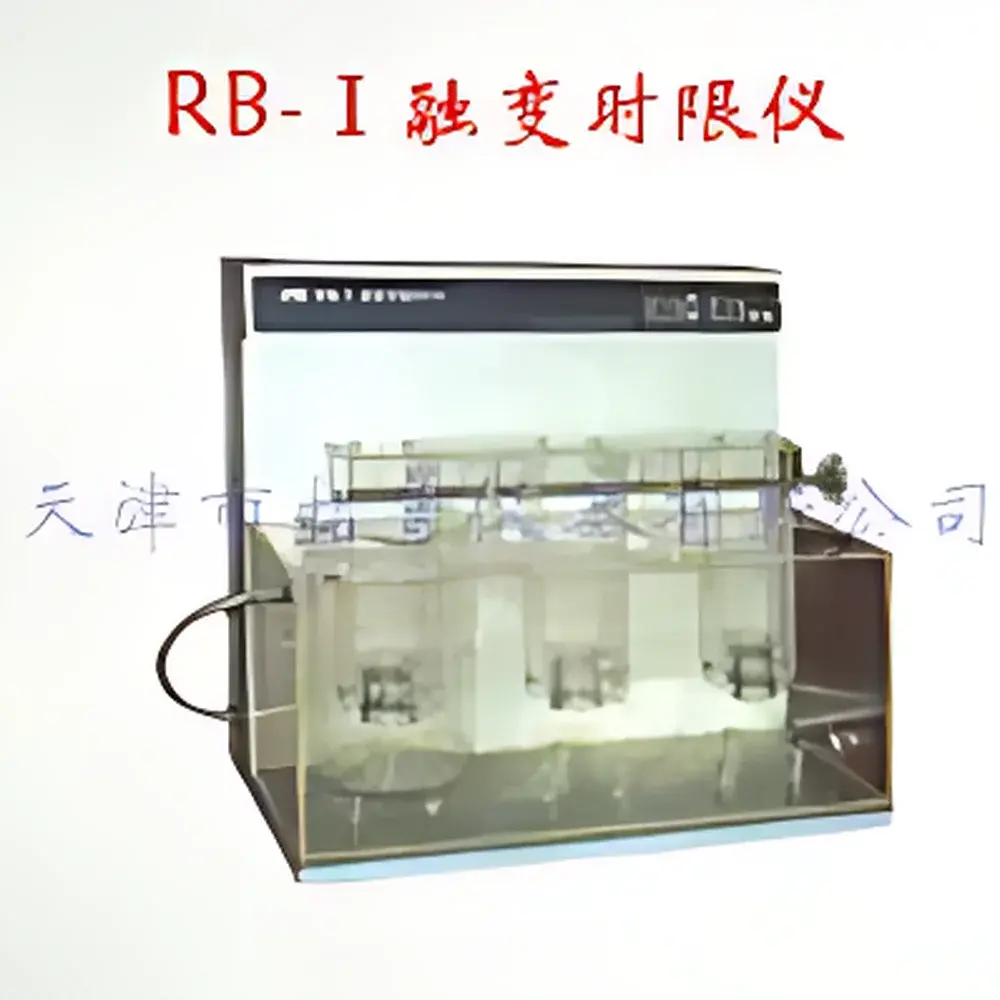
RB-I Drug Disintegration Tester
| Origin | Tianjin, China |
|---|---|
| Manufacturer Type | Authorized Distributor |
| Origin Category | Domestic (China) |
| Model | RB-I |
| Pricing | Available Upon Request |
| Tube Height | 60 mm |
| Tube Inner Diameter | 52 mm |
| Timer Range | 10–120 min |
| Temperature Control Accuracy | 37.0 ± 0.5 °C |
| Mesh Disk Dimensions | 50 mm diameter, 39 apertures of 4 mm each |
| Flip Frequency | 1 cycle per 10 min |
| Test Stations | 3 independent tube–mesh assemblies |
| Beaker Capacity | 4 L |
| Power Rating | 1000 W |
Overview
The RB-I Drug Disintegration Tester is a precision-engineered laboratory instrument designed in strict accordance with pharmacopoeial requirements—including the Chinese Pharmacopoeia (ChP), United States Pharmacopeia (USP <701>), and European Pharmacopoeia (Ph. Eur. 2.9.1)—for evaluating the disintegration behavior of solid dosage forms such as suppositories, vaginal tablets, and effervescent tablets. It operates on the principle of mechanical agitation combined with controlled thermal immersion: test units are suspended in a thermostatically regulated aqueous medium (typically purified water at 37.0 ± 0.5 °C), while a precisely timed vertical flip mechanism simulates physiological movement to assess structural integrity loss and matrix breakdown. The device employs a robust three-station configuration, enabling parallel testing of up to three samples under identical environmental conditions—ensuring inter-test comparability and statistical reliability required for QC release and stability studies.
Key Features
- Triple independent test stations with synchronized flip actuation—each comprising a transparent acrylic tube (60 mm height × 52 mm inner diameter) and a stainless-steel mesh disk (50 mm diameter, 39 × 4 mm apertures) for standardized sample retention and fluid interaction.
- Microprocessor-controlled temperature regulation with PID feedback loop, maintaining bath stability within ±0.5 °C at the nominal setpoint of 37.0 °C—critical for mimicking human physiological conditions during disintegration assessment.
- Precisely calibrated flip mechanism delivering one full 180° inversion every 10 minutes, replicating the mechanical stress profile specified in USP <701> and ChP General Chapter 0921.
- Integrated real-time timer with programmable range from 10 to 120 minutes, supporting both single-cycle and multi-interval protocols; automatic memory retention preserves last-used settings after power interruption.
- Self-diagnostic system with audible and visual fault alerts (e.g., temperature deviation >±1.0 °C, motor stall, sensor disconnect), ensuring operational integrity and minimizing unrecorded test failures.
- 4-liter borosilicate glass beaker with ergonomic handle and overflow drainage port, mounted on a thermally insulated base to minimize ambient heat loss and improve energy efficiency.
Sample Compatibility & Compliance
The RB-I accommodates standard suppository molds (e.g., cocoa butter, PEG-based, and glycerinated gelatin matrices), vaginal tablets (including film-coated and compressed variants), and rapidly disintegrating oral tablets where applicable. All wetted components—including mesh disks, tube sleeves, and bath fixtures—are constructed from medical-grade 316 stainless steel and non-reactive acrylic, compliant with ISO 10993-1 for biocompatibility and USP Class VI plastic certification. The instrument meets mechanical and procedural alignment with ICH Q5C (stability testing), FDA Guidance for Industry on Dissolution Testing of Immediate-Release Solid Oral Dosage Forms, and supports GLP-compliant documentation when paired with external audit-trail-capable data loggers.
Software & Data Management
While the RB-I operates via embedded hardware controls without proprietary software, its analog/digital hybrid interface enables seamless integration with third-party laboratory information management systems (LIMS) through RS-232 or optional USB-to-serial adapters. Time-stamped temperature logs and flip event markers can be exported for traceability. For regulated environments, users may deploy validated external data acquisition modules that satisfy 21 CFR Part 11 requirements—including electronic signatures, audit trails, and user access controls—ensuring full compliance during regulatory inspections or internal quality audits.
Applications
- QC release testing of batch-manufactured suppositories prior to distribution.
- Comparative disintegration profiling during formulation development (e.g., polymer selection, surfactant optimization).
- Stability-indicating studies under accelerated and long-term storage conditions (ICH Q1A–Q1E).
- Method validation per ICH Q2(R2) for disintegration time as a critical quality attribute (CQA).
- Educational use in pharmaceutical sciences curricula for hands-on demonstration of pharmacopoeial test principles.
FAQ
What pharmacopoeial standards does the RB-I comply with?
The RB-I conforms to USP <701>, Ph. Eur. 2.9.1, and ChP General Chapter 0921 for disintegration testing of solid dosage forms.
Is calibration verification supported out-of-the-box?
Yes—the unit includes NIST-traceable temperature probe calibration points and mechanical flip timing verification templates, aligned with ISO/IEC 17025-recommended practices.
Can the RB-I be used for enteric-coated tablets?
No—it is not configured for pH-selective media or dual-stage dissolution/disintegration protocols; it is intended exclusively for immediate-disintegration testing in neutral aqueous media at 37 °C.
What maintenance is required for long-term reliability?
Routine cleaning of mesh disks and tubes with deionized water post-use; annual verification of temperature sensor drift and flip actuator torque by authorized service personnel.
Does the RB-I support automated data export?
Not natively—but with optional serial interface hardware and compatible LIMS drivers, timestamped event logs and temperature history can be captured externally in CSV or XML format.






