
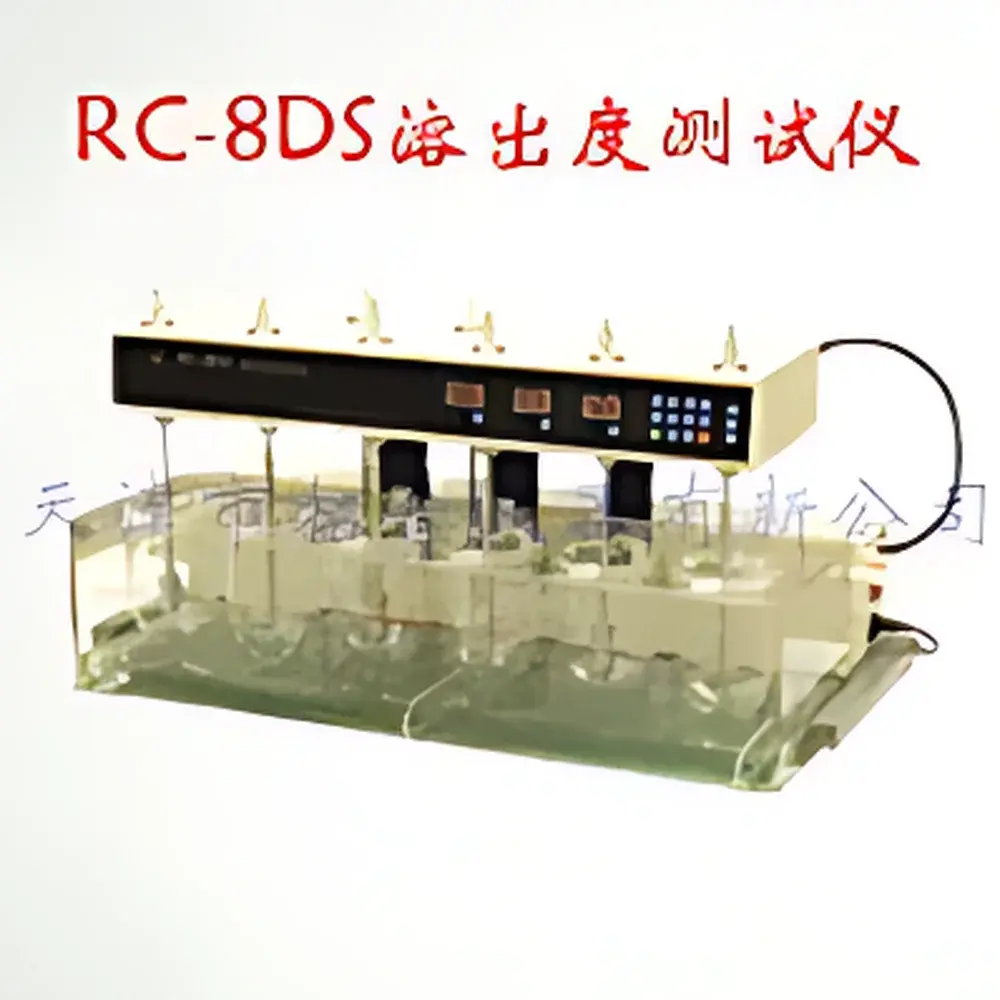
RC-8DS Dissolution Tester
| Origin | Tianjin, China |
|---|---|
| Manufacturer Type | Authorized Distributor |
| Origin Category | Domestic (China) |
| Model | RC-8DS |
| Pricing | Available Upon Request |
| Stirring Speed Range | 20–200 rpm |
| Speed Accuracy | ±2 rpm |
| Temperature Control Range | Ambient to 39.9 °C |
| Temperature Accuracy | ±0.3 °C |
| Timer Range | 0–999 min (6 programmable time points) |
| Basket Wobble Tolerance | ±1 mm |
| Paddle Wobble Tolerance | ±0.5 mm |
| Power Supply | 220 V / 50 Hz / 1000 W |
| Dimensions (W×D×H) | 680 × 540 × 480 mm |
| Construction Material | Imported SUS316L stainless steel for baskets, paddles, and shafts |
| Fluid Circulation System | Magnetic-drive water pump with uniform thermal distribution |
| Control Mode | Intelligent microprocessor-based PID control for temperature, rotation speed, and timing |
| Automation Features | Motorized head lift/lower mechanism, auto-diagnostic self-check, real-time parameter display (set vs. actual), programmable multi-point timed sampling alerts, USP-compliant dissolution method storage |
Overview
The RC-8DS Dissolution Tester is a fully automated, eight-station (plus one auxiliary fluid replenishment station) pharmaceutical dissolution testing system engineered for compliance with United States Pharmacopeia (USP) General Chapter <711>, European Pharmacopoeia (Ph. Eur.) 2.9.3, and Chinese Pharmacopoeia (ChP) Appendix XIX A. It employs the standard basket (USP Apparatus 1) and paddle (USP Apparatus 2) methods to quantitatively assess the rate and extent of active pharmaceutical ingredient (API) release from solid oral dosage forms—including tablets, capsules, and controlled-release formulations—under physiologically relevant hydrodynamic conditions. The system integrates precision mechanical design with closed-loop PID temperature regulation, high-reproducibility rotational actuation, and intelligent parameter management to support routine quality control (QC), formulation development, and stability-indicating dissolution profiling in GLP- and GMP-aligned laboratories.
Key Features
- Eight independent dissolution vessels with one dedicated auxiliary reservoir for automated medium replenishment—enabling uninterrupted long-duration tests and minimizing operator intervention.
- Motorized, programmable head-lift mechanism ensures smooth, repeatable vertical positioning of baskets or paddles during loading, sampling, and maintenance—reducing mechanical stress and improving alignment consistency.
- SUS316L stainless steel construction for all wetted components (baskets, paddles, shafts, vessel caps, and internal plumbing), ensuring corrosion resistance, non-reactivity with aggressive dissolution media (e.g., surfactant-containing buffers, organic-aqueous mixtures), and compliance with ISO 8573-1 purity class requirements for pharmaceutical-grade surfaces.
- Magnetic-coupled circulation pump eliminates seal wear and leakage risk while maintaining uniform water bath temperature distribution (±0.1 °C spatial gradient across all stations), critical for inter-vessel reproducibility.
- Microprocessor-based controller with dual-display interface: simultaneous readout of setpoints and real-time values for temperature, rotation speed, and elapsed time—supporting immediate deviation detection and audit-ready traceability.
- Onboard memory stores up to 100 preconfigured dissolution methods per user profile, including USP-specified parameters (e.g., 50 rpm/37 °C/900 mL HCl 0.1 N for immediate-release tablets), facilitating rapid method recall and reducing manual entry errors.
Sample Compatibility & Compliance
The RC-8DS accommodates standard USP-compliant 1000 mL cylindrical glass vessels and supports both Apparatus 1 (basket) and Apparatus 2 (paddle) configurations without hardware modification. Its mechanical tolerances—±1 mm basket radial runout and ±0.5 mm paddle wobble—meet or exceed USP <711> mechanical calibration specifications. The system is validated for use with common dissolution media, including phosphate buffers (pH 4.5–6.8), simulated gastric/intestinal fluids (SGF/SIF), and ethanol–water mixtures up to 20% v/v. All electronic controls conform to IEC 61000-6-3 (EMC emission standards) and IEC 61010-1 (safety requirements for laboratory equipment). Documentation packages include Factory Acceptance Test (FAT) reports, IQ/OQ templates aligned with ASTM E2500-13, and optional 21 CFR Part 11-compliant software add-ons for electronic signature and audit trail functionality.
Software & Data Management
While the RC-8DS operates as a standalone instrument with embedded firmware, it features RS-232 and optional USB-to-serial interfaces for integration with LIMS or third-party data acquisition platforms (e.g., LabWare, Empower). The controller logs timestamped operational data—including actual temperature, speed, and duration at each programmed time point—to internal non-volatile memory (retention ≥10 years). Exportable CSV files contain full session records suitable for statistical process control (SPC) analysis and regulatory submission (e.g., ANDA, MAA). Optional PC-based software provides graphical trend visualization, automated pass/fail evaluation against acceptance criteria (Q-value analysis per USP), and PDF report generation compliant with ALCOA+ principles.
Applications
- Routine QC release testing of commercial batches per pharmacopoeial monographs.
- Comparative dissolution studies for generic product development and bioequivalence assessment.
- Formulation optimization of modified-release dosage forms (e.g., matrix tablets, osmotic pumps).
- Stability-indicating method development under stressed conditions (e.g., elevated temperature, pH shift).
- Investigational support for IVIVC (in vitro–in vivo correlation) modeling and biopharmaceutics classification system (BCS) assessments.
FAQ
Does the RC-8DS comply with 21 CFR Part 11 requirements for electronic records?
The base instrument meets hardware-level security prerequisites (audit trail-capable logging, user access levels); full Part 11 compliance requires deployment of validated, vendor-supplied software with electronic signature, audit trail, and role-based permissions.
Can the system perform synchronized sampling across all eight vessels?
No—the RC-8DS does not include integrated autosamplers; it supports timed auditory/visual alerts at user-defined intervals to guide manual or external autosampler operation.
What validation documentation is provided with the instrument?
Standard delivery includes Installation Qualification (IQ) checklist, Operational Qualification (OQ) protocol with test scripts for speed, temperature, and timing accuracy, and calibration certificates for all critical sensors traceable to NIST or CNAS-accredited labs.
Is the water bath volume adjustable per vessel?
Vessel geometry is fixed per USP standards (1000 mL nominal capacity); medium volume must be manually adjusted prior to test initiation using calibrated volumetric cylinders.
How frequently should mechanical calibration be performed?
Per USP <711>, mechanical verification (centering, wobble, depth, vibration) is recommended before each study series and after any physical reconfiguration or maintenance event.





