
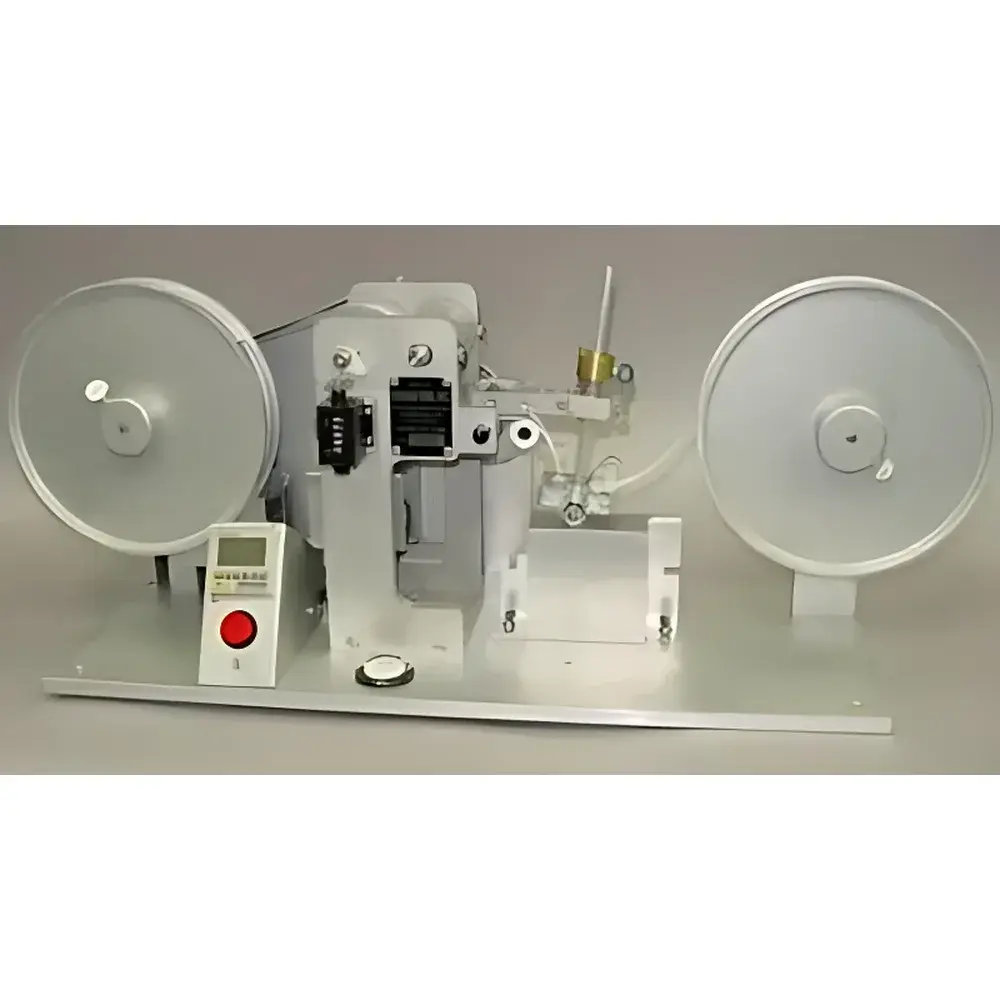
RCA Abrasion Tester Model 7-IBB by Norman
| Brand | Norman |
|---|---|
| Origin | USA |
| Model | 7-IBB |
| Compliance | ASTM F2357-04 |
| Abrasive Media | 11/16″ paper tape (1800 cycles/roll) or 1/4″ magnetic tape (3400 cycles/roll) |
| Load Options | 55 g, 175 g, 275 g |
| Cycle Counter Range | 0–9999 cycles |
| Import Status | Imported |
Overview
The Norman 7-IBB RCA Abrasion Tester is a precision-engineered tribological testing instrument designed for quantitative evaluation of surface wear resistance in consumer electronics components—particularly mobile device housings, coatings, and decorative finishes. It operates on the Rotational Crockmeter Abrasion (RCA) principle, wherein a standardized abrasive tape rotates under controlled normal load against a stationary test specimen. The resulting surface degradation—manifested as gloss loss, coating removal, substrate exposure, or visible scuffing—is assessed after a defined number of cycles. This method provides high repeatability and inter-laboratory correlation when conducted per ASTM F2357-04, the standard specification for evaluating the abrasion resistance of printed and coated surfaces using the RCA test method. The 7-IBB is not a general-purpose wear tester; its geometry, kinematics, and loading mechanism are optimized specifically for flat or gently curved planar samples typical of smartphone bezels, plastic casings, anodized aluminum panels, and PVD-coated substrates.
Key Features
- Compliance-certified design adhering strictly to ASTM F2357-04 mechanical and procedural requirements—including tape width tolerance, rotational speed stability, and load application accuracy.
- Dual-media capability: accommodates both 11/16″ (17.5 mm) paper tape for general surface durability assessment and 1/4″ (6.35 mm) magnetic tape for high-resolution evaluation of fine-printed graphics, logos, and ink layers.
- Precision-machined stainless steel test head with calibrated spring-loaded loading mechanism ensuring consistent normal force application at 55 g, 175 g, or 275 g—selected via mechanical toggle without recalibration.
- Electromechanical cycle counter with 4-digit LED display (0–9999), non-volatile memory retention, and manual reset function—enabling traceable test logging without external software dependency.
- Modular base plate with T-slot configuration for secure mounting of fixtures, jigs, or custom sample holders—supporting repeatable positioning of irregular or non-planar specimens within the test envelope.
- Robust cast-aluminum chassis and sealed bearing assembly ensure long-term operational stability and minimal maintenance under routine QC laboratory conditions.
Sample Compatibility & Compliance
The 7-IBB accepts flat or low-curvature specimens up to 100 mm × 100 mm × 25 mm (L×W×H), with clamping force adjustable via knurled thumbscrews. It supports rigid thermoplastics (e.g., PC, ABS, PC/ABS blends), anodized aluminum, glass, metallized films, and UV-cured acrylic coatings. While ASTM F2357-04 defines the test methodology, full compliance requires integration into a documented quality system aligned with ISO/IEC 17025 for testing laboratories. When deployed in regulated environments—such as supplier qualification for Tier-1 OEMs—the 7-IBB’s mechanical simplicity and deterministic operation facilitate audit readiness, particularly for GLP-aligned wear validation protocols. Note: The instrument itself carries no CE, UKCA, or FDA certification; however, its use in ASTM-conforming test procedures supports regulatory submissions where surface durability data is required (e.g., IEC 60529 IP rating auxiliary testing or UL 746C polymer evaluation).
Software & Data Management
The 7-IBB is a standalone electromechanical instrument with no embedded microprocessor or digital interface. All operational parameters are set manually, and results are recorded externally—ensuring immunity to firmware obsolescence, cybersecurity vulnerabilities, or software validation overhead. Users maintain traceability through hard-copy test logs or LIMS-integrated entry forms referencing batch ID, operator, ambient temperature/humidity (per ASTM D618 preconditioning guidance), tape lot number, and final visual/microscopic assessment per ISO 48-2 or ASTM D714. For laboratories requiring electronic records, optional third-party data acquisition modules (e.g., USB-connected optical encoders paired with LabVIEW or Python-based logging scripts) may be integrated—but such configurations fall outside Norman’s factory validation scope and require user-led IQ/OQ documentation.
Applications
- Smartphone and tablet housing abrasion screening during material selection and pre-production validation.
- Comparative ranking of anti-fingerprint coatings, oleophobic layers, and matte-textured lacquers under standardized mechanical stress.
- Quality control release testing for electroplated trim, laser-etched branding, and pad-printed icons on consumer electronics assemblies.
- Failure mode analysis of coating delamination or substrate scratching in root cause investigations following field return reports.
- Supporting technical documentation for IATF 16949 or ISO 9001 internal audits where surface durability is a critical-to-quality (CTQ) characteristic.
FAQ
Does the 7-IBB support automated pass/fail decision logic?
No. Pass/fail criteria are defined externally—typically by visual inspection under D65 illumination at 45°/0° geometry per ASTM D2244, or via ΔE*ab colorimetric thresholds measured with a spectrophotometer post-test.
Can the 7-IBB be used for textile or leather abrasion testing?
Not recommended. Its kinematic profile, tape path geometry, and load range are optimized for rigid, smooth-surface substrates—not flexible, fibrous, or highly compliant materials covered under ASTM D3884 or ISO 12947.
Is calibration service available from Norman or authorized partners?
Norman does not provide periodic calibration certificates; however, users may verify load accuracy using NIST-traceable gram weights and confirm cycle counter functionality via manual tally verification. Annual mechanical inspection is advised per ISO/IEC 17025 Clause 6.4.10.
What is the expected service life of the motor and drive train?
Under typical QC lab usage (≤10 tests/day), the brushless DC motor and gear-reduction assembly demonstrate >10,000 hours MTBF, supported by replaceable sintered bronze bushings and factory-lubricated timing belts.
Are replacement tapes supplied with lot-specific certification?
Yes—paper and magnetic tapes are provided with CoA indicating nominal abrasive particle size distribution, tensile strength, and dimensional conformity to ASTM F2357-04 Annex A1 requirements.



