
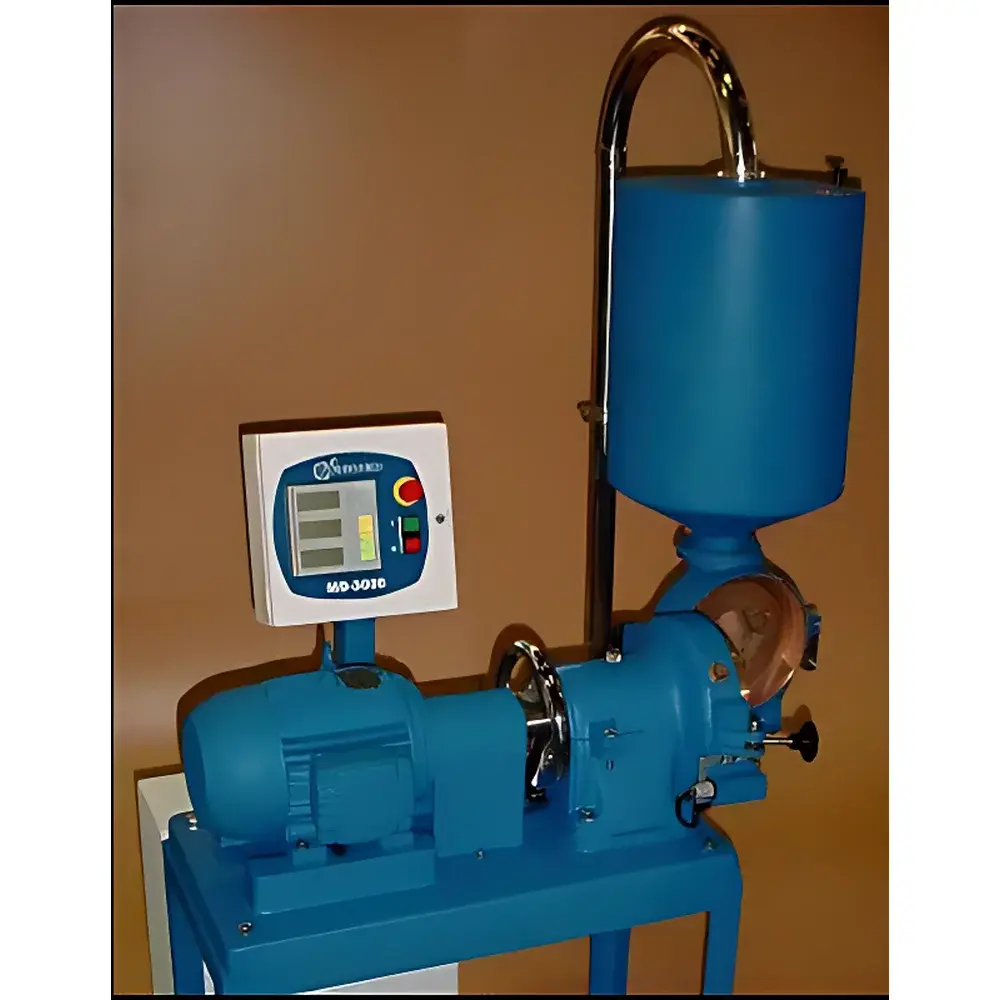
Regmed MD-3000 High-Consistency Laboratory Refiner
| Brand | Regmed |
|---|---|
| Origin | Brazil |
| Model | MD-3000 |
| Motor Power | 5.5 kW |
| Operating Speed | 1750 rpm |
| Consistency Range | 2–8% |
| Refining Chamber Volume | 50 L |
| Disc Gap Adjustment | 0–9 mm |
| Disc Diameter | 300 mm |
| Material of Wetted Parts | Bronze and Stainless Steel |
| Cooling Requirement | 3 bar, 0.5 m³/h clean water |
| Electrical Supply | 380 V, 60 Hz, 3-phase |
| Dimensions (W×D×H) | 850 × 750 × 1800 mm |
| Weight | 250 kg |
Overview
The Regmed MD-3000 High-Consistency Laboratory Refiner is a precision-engineered disc refiner designed for controlled fiber modification in pulp and paper R&D laboratories. It operates on the principle of mechanical refining—applying shear, compression, and fibrillation forces between rotating and stationary bronze discs to alter fiber morphology, swelling, and bonding potential. Unlike low-consistency refiners, the MD-3000 enables reproducible trials at 2–8% solids concentration, closely simulating industrial high-consistency refining conditions used in specialty paper, packaging board, and dissolving pulp production. Its robust architecture supports both process optimization—e.g., correlating refining energy (kWh/ton) with tensile strength or drainage rate—and fundamental research into fiber response under defined mechanical stress. The unit is not intended for continuous production but serves as a scalable, metrologically traceable bridge between lab-scale experimentation and full-scale mill trials.
Key Features
- Automated disc gap control (0–9 mm range) with digital readout for precise refinement intensity calibration.
- Three interchangeable 300 mm bronze refining discs: short-fiber optimized, long-fiber optimized, and universal design compatible with wood chips, hardwood, softwood, and non-wood pulps.
- Integrated refining chamber with 50 L capacity, engineered for uniform slurry distribution and minimal dead volume.
- Motor-driven automatic chamber opening/closing mechanism ensures operator safety and repeatable loading/unloading protocols.
- Digital control panel displaying real-time power consumption (kW), current draw (A), and operational status—enabling direct calculation of specific refining energy.
- Automatic feed shutoff during refining cycle to eliminate variability from inconsistent slurry inflow.
- High-torque startup sequence activated at full load, ensuring stable disc rotation without stalling or thermal shock.
- Continuous recirculating water cooling system (3 bar, 0.5 m³/h) maintains slurry temperature within ±2°C of ambient, preventing cellulose degradation or hemicellulose solubilization during extended runs.
- All wetted components—including discs, chamber liner, and feed housing—constructed from corrosion-resistant bronze and AISI 316 stainless steel for long-term dimensional stability and chemical inertness.
Sample Compatibility & Compliance
The MD-3000 accommodates a broad spectrum of fiber suspensions, including bleached/unbleached kraft, thermomechanical (TMP), chemithermomechanical (CTMP), recycled fiber, bamboo, bagasse, and microfibrillated cellulose (MFC) precursors. It complies with ISO 5267-1 (pulp—determination of drainability—Canadian standard freeness method) and ASTM D1995 (standard test method for freeness of pulp) sample preparation requirements when integrated into standardized refining workflows. While not certified to IEC 61000-6-2/6-4 for EMC or CE-marked for EU machinery directive, its electrical and mechanical design adheres to Brazilian ABNT NBR NM-IEC 60204-1 safety standards for industrial equipment. For GLP/GMP-aligned labs, the digital control system supports manual audit trails; optional RS-485 or Modbus RTU interface allows integration with LIMS for data logging and electronic record retention.
Software & Data Management
The MD-3000 operates via an embedded microcontroller-based interface with no proprietary software dependency. All operational parameters—including disc gap, runtime, average power, peak current, and cooling flow status—are displayed locally and can be manually logged. For automated data capture, the unit provides analog 4–20 mA outputs for power and current signals, compatible with third-party SCADA or LabVIEW acquisition systems. Optional firmware upgrade (v2.1+) adds timestamped CSV export via USB port, enabling correlation of refining metrics with downstream tests (e.g., handsheet formation, tensile testing, fiber length analysis per ISO 5269-2). No cloud connectivity or remote access is implemented—consistent with secure lab infrastructure policies requiring air-gapped instrumentation.
Applications
- Optimizing refining energy profiles for tissue, filter paper, and electrical insulation papers where fiber flexibility and conformability are critical.
- Evaluating fiber source suitability—e.g., comparing eucalyptus vs. pine kraft pulp response to identical gap and energy inputs.
- Developing low-energy refining strategies compliant with ISO 14040 life cycle assessment frameworks.
- Studying hornification effects in recycled fiber by quantifying freeness loss versus refining energy across multiple cycles.
- Preparing standardized refined samples for ISO 5263-1 (pulp—laboratory sheet-forming—conventional sheet former) handsheet production.
- Supporting FDA-regulated applications (e.g., pharmaceutical filter media) by generating documented, consistent fiber morphology for extractables/leachables studies.
FAQ
What is the maximum allowable fiber length for safe operation?
The MD-3000 accepts fibers up to 8 mm in length; longer fibers or unrefined chips require pre-cutting to avoid disc jamming or uneven load distribution.
Can the unit be operated at 50 Hz power supply?
No—the motor and drive electronics are calibrated for 60 Hz input only; voltage conversion alone does not compensate for frequency-dependent torque characteristics.
Is validation documentation available for IQ/OQ protocols?
Regmed provides a Factory Acceptance Test (FAT) report with mechanical and electrical verification data; site-specific OQ must be performed using user-defined reference pulps and calibrated torque meters.
How often must the bronze discs be resurfaced?
Under typical R&D usage (≤4 hrs/day), disc resurfacing is recommended every 6–12 months or after 500 refining cycles—verified by profilometry measuring groove depth deviation >0.15 mm.





