
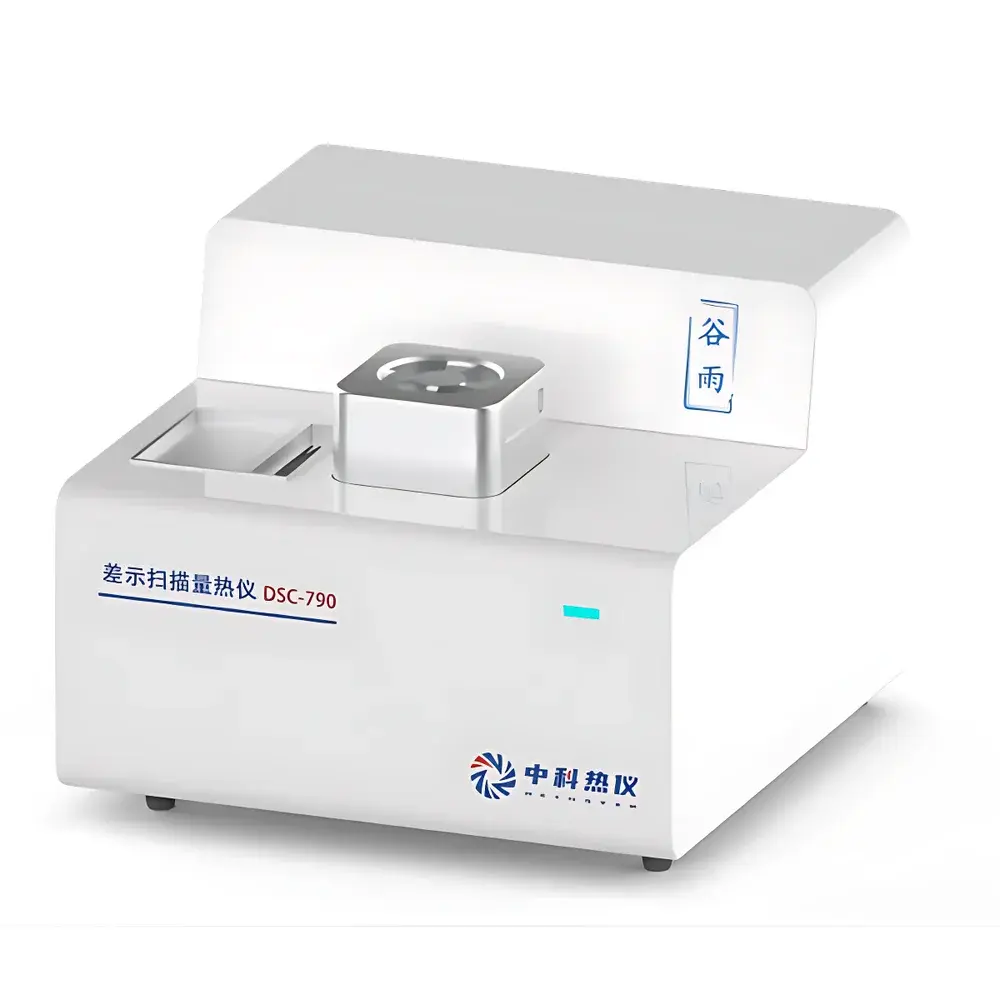
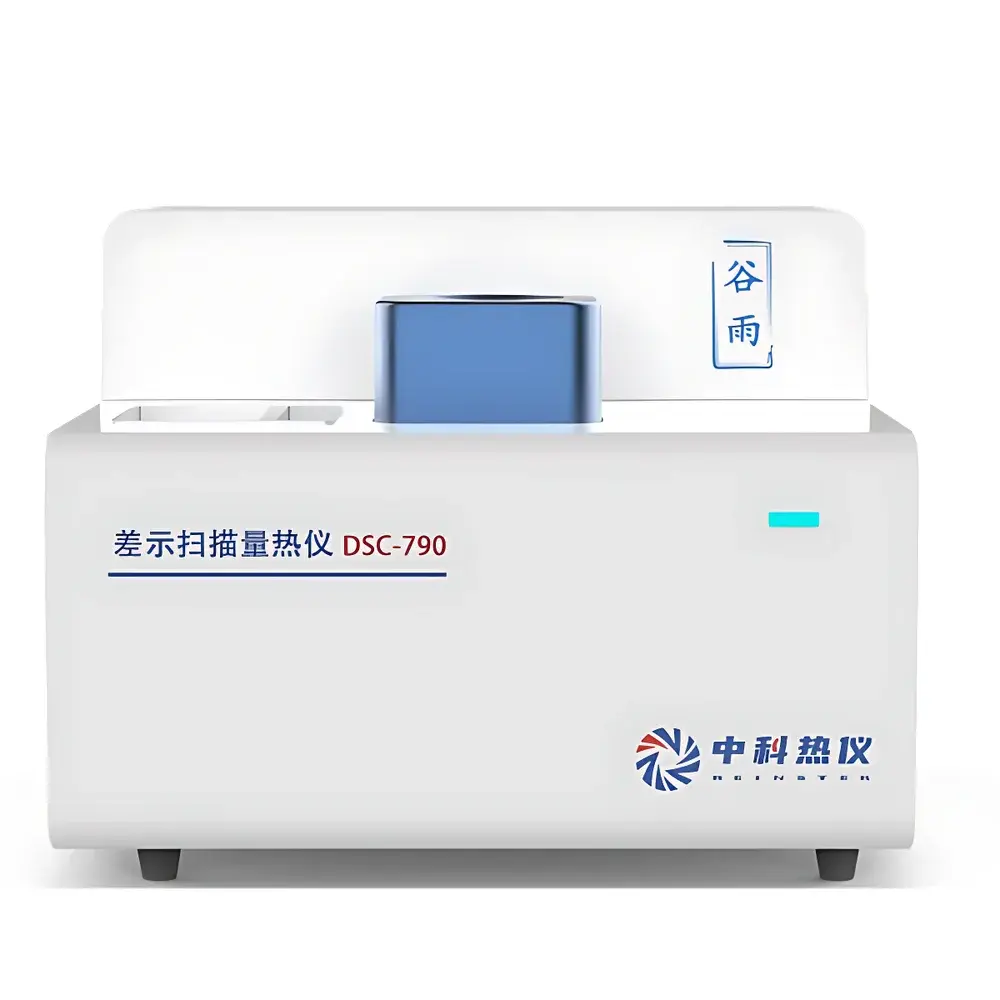
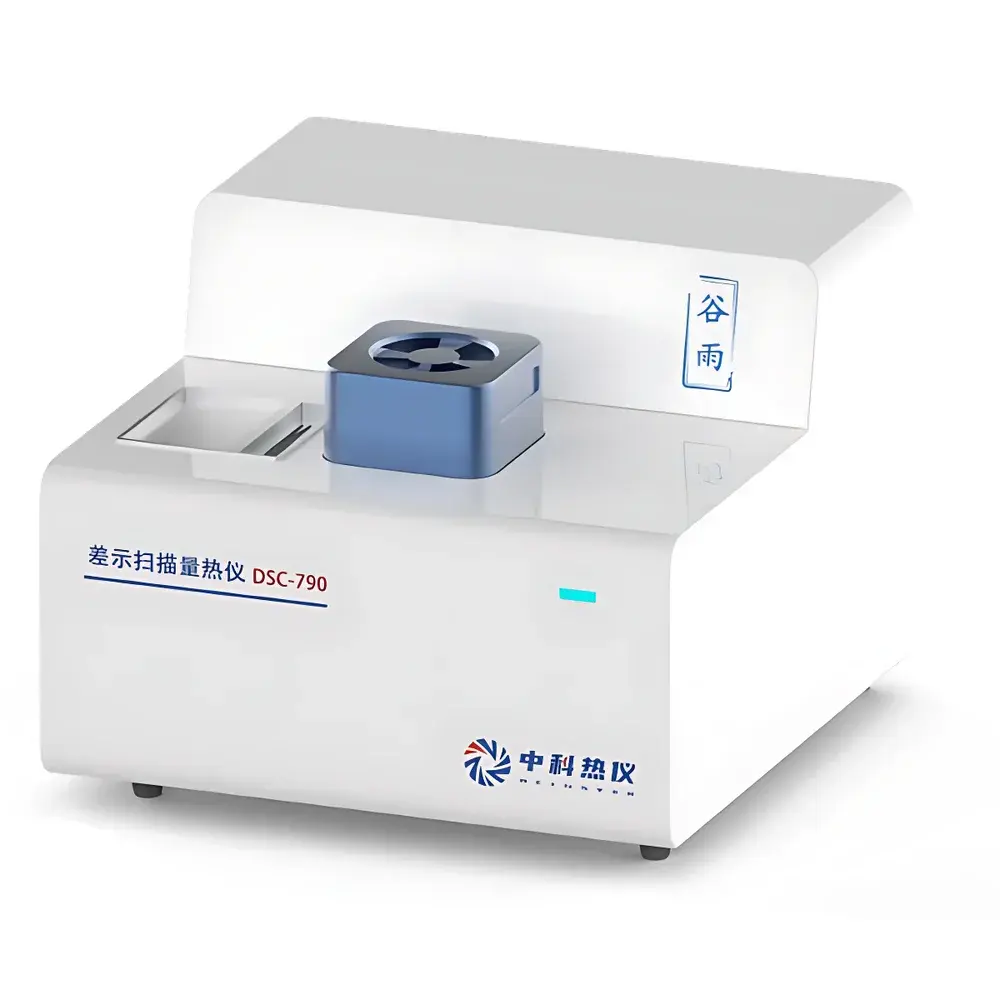
Reinstek DSC-790 Thermal Analysis System – Heat-Flow Differential Scanning Calorimeter
| Brand | Reinstek |
|---|---|
| Origin | Anhui, China |
| Manufacturer Type | Direct Manufacturer |
| Model | DSC-790 |
| Sample Capacity | Single |
| Instrument Type | Heat-Flow DSC |
| Temperature Range | −150 °C to 700 °C |
| Temperature Accuracy | ±0.1 °C |
| Temperature Precision | ±0.1 °C |
| DSC Heat Flow Range | ±6000 mW |
| Cooling Options | Liquid Nitrogen, Mechanical, or Ambient Air |
| Heating Rate | 0.01–100 °C/min |
| Heat Flow Resolution | 0.1 µW |
| Calorimetric Accuracy | ±0.1% |
| Calorimetric Precision | ±0.1% |
| Atmosphere Control | Dual-gas inlet with software-driven automatic switching |
| Dimensions (W×D×H) | 950 mm × 555 mm × 360 mm |
| Weight | 30 kg |
| Power Supply | 220–240 VAC, 50/60 Hz |
Overview
The Reinstek DSC-790 is a high-performance heat-flow differential scanning calorimeter engineered for precision thermal analysis across research, quality control, and industrial development laboratories. It operates on the fundamental principle of heat-flow DSC, where the differential heat flow between a sample and an inert reference is measured as both are subjected to identical, precisely controlled temperature programs. This architecture enables quantitative determination of enthalpic transitions—including glass transitions (Tg), melting (Tm), crystallization (Tc), solid-solid transitions, oxidative induction time (OIT), and cure kinetics—under reproducible, instrumentally stable conditions. The system features a high-thermal-conductivity silver furnace core paired with E-type thermocouples and a proprietary planar heat-flow sensor, delivering exceptional thermal homogeneity and signal fidelity over its full operating range of −150 °C to 700 °C. Its modular cooling architecture supports liquid nitrogen, mechanical refrigeration, or ambient air cooling—allowing users to select the optimal configuration for required low-temperature performance and cooling rates without hardware retrofitting.
Key Features
- Heat-flow DSC platform with dual-sensor architecture and silver-furnace thermal core for superior baseline stability and signal-to-noise ratio
- Temperature accuracy and precision both rated at ±0.1 °C across the entire range, validated per ASTM E794 and ISO 11357 standards
- Calorimetric resolution of 0.1 µW and full-scale heat flow range of ±6000 mW, enabling detection of subtle thermal events in low-mass or highly stabilized samples
- Modular cooling system: interchangeable liquid nitrogen, mechanical, or forced-air units—each integrated with real-time thermal feedback and programmable ramp/soak profiles
- Replaceable planar heat-flow sensor assembly—designed for field-level maintenance without recalibration, minimizing downtime and lifecycle cost
- Dual-gas atmosphere control with automated, software-triggered switching between inert (N2, Ar) and reactive (O2, air) environments, compliant with ASTM D3895 (OIT) and ISO 11357-6
- Robust mechanical design: rigid aluminum frame, vibration-damped optical-grade baseplate, and electromagnetic shielding for operation in shared lab environments
Sample Compatibility & Compliance
The DSC-790 accommodates standard crucible formats—including 40 µL and 100 µL aluminum pans, alumina crucibles (up to 700 °C), and high-pressure stainless-steel vessels (rated to 10 MPa)—ensuring compatibility with volatile, reactive, or pressurized samples. It supports compliance-critical workflows through built-in audit trail functionality, user-access controls, and electronic signature support aligned with FDA 21 CFR Part 11 requirements. All thermal calibration procedures follow traceable NIST-certified reference materials (e.g., indium, zinc, tin, sapphire), and data output conforms to ASTM E1953 metadata standards. The system is routinely deployed in GLP-compliant polymer characterization labs, pharmaceutical thermal stability studies (ICH Q1A–Q1E), and cement hydration calorimetry per ASTM C1679.
Software & Data Management
Control and analysis are performed via Reinstek’s ThermAnalyst™ v4.x software—a Windows-based platform supporting method creation, real-time visualization, multi-step isothermal/linear/ramp protocols, and post-run deconvolution. Raw data are stored in vendor-neutral .tdms format (NI Technical Data Management Streaming), ensuring long-term accessibility and third-party interoperability. The software includes automated peak identification, baseline correction algorithms (tangent, sigmoidal, polynomial), kinetic modeling modules (Ozawa-Flynn-Wall, Kissinger), and customizable reporting templates exportable to PDF, Excel, or CSV. All user actions—including method edits, calibration events, and data exports—are logged with timestamp, operator ID, and IP address for full traceability in regulated environments.
Applications
- Polymers & Composites: Quantification of Tg, Tm, Tc, cold crystallization, enthalpy of fusion, degree of cure (via residual exotherm integration), and OIT under ASTM D3895
- Pharmaceuticals: Polymorph screening, amorphous content assessment, excipient compatibility, and thermal degradation kinetics per ICH guidelines
- Energy Materials: Phase change material (PCM) enthalpy and cycling stability, battery electrode decomposition onset, and thermal runaway profiling
- Inorganics & Ceramics: Sintering behavior, polymorphic transitions in oxides, and glass transition of specialty glasses
- Construction Materials: Cement hydration calorimetry (ASTM C1679), supplementary cementitious material reactivity, and alkali-silica reaction potential
- Food Science: Fat crystallization/melting profiles, starch gelatinization, and protein denaturation thermodynamics
FAQ
What calibration standards are recommended for routine verification?
Indium (Tm = 156.6 °C, ΔHfus = 28.45 J/g), zinc (Tm = 419.5 °C), and sapphire (for heat capacity calibration) are traceable NIST SRMs used for temperature, enthalpy, and Cp validation.
Can the DSC-790 perform modulated DSC (MDSC®)?
No—the DSC-790 is a conventional heat-flow DSC platform; it does not implement temperature modulation. For MDSC capabilities, consult Reinstek’s DSC-890 series.
Is remote monitoring supported?
Yes—ThermAnalyst™ supports secure LAN/WAN access via TLS-encrypted VNC tunneling, enabling real-time instrument status viewing and method queuing from authorized workstations.
What safety certifications does the instrument carry?
CE marked per EN 61010-1:2019 (Safety Requirements for Electrical Equipment), RoHS 2011/65/EU compliant, and tested to IEC 61326-1 for EMC immunity in laboratory environments.
How is data integrity ensured during long-duration experiments (e.g., 72-hr isotherms)?
The firmware implements cyclic redundancy checksums (CRC-32) on all acquired data packets, automatic disk-write buffering with journaling, and optional RAID-1 mirrored storage configuration for continuous acquisition resilience.



