
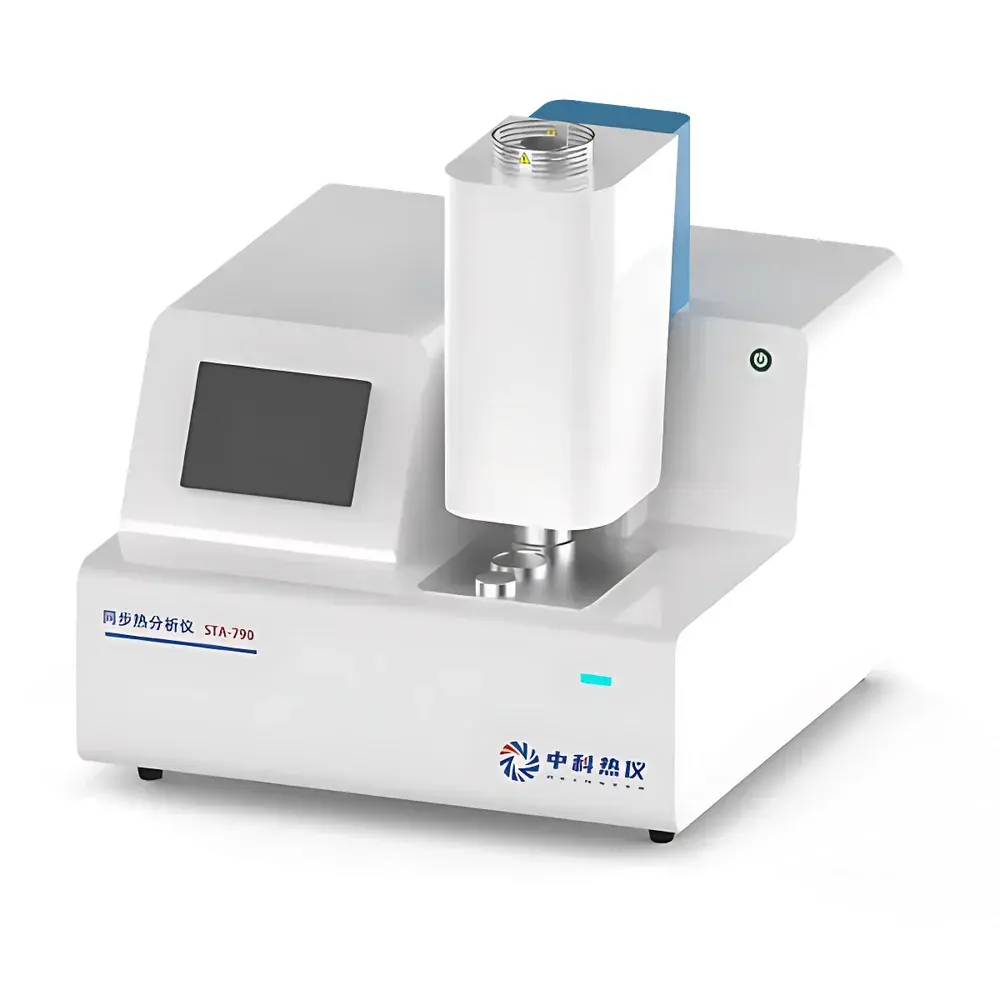
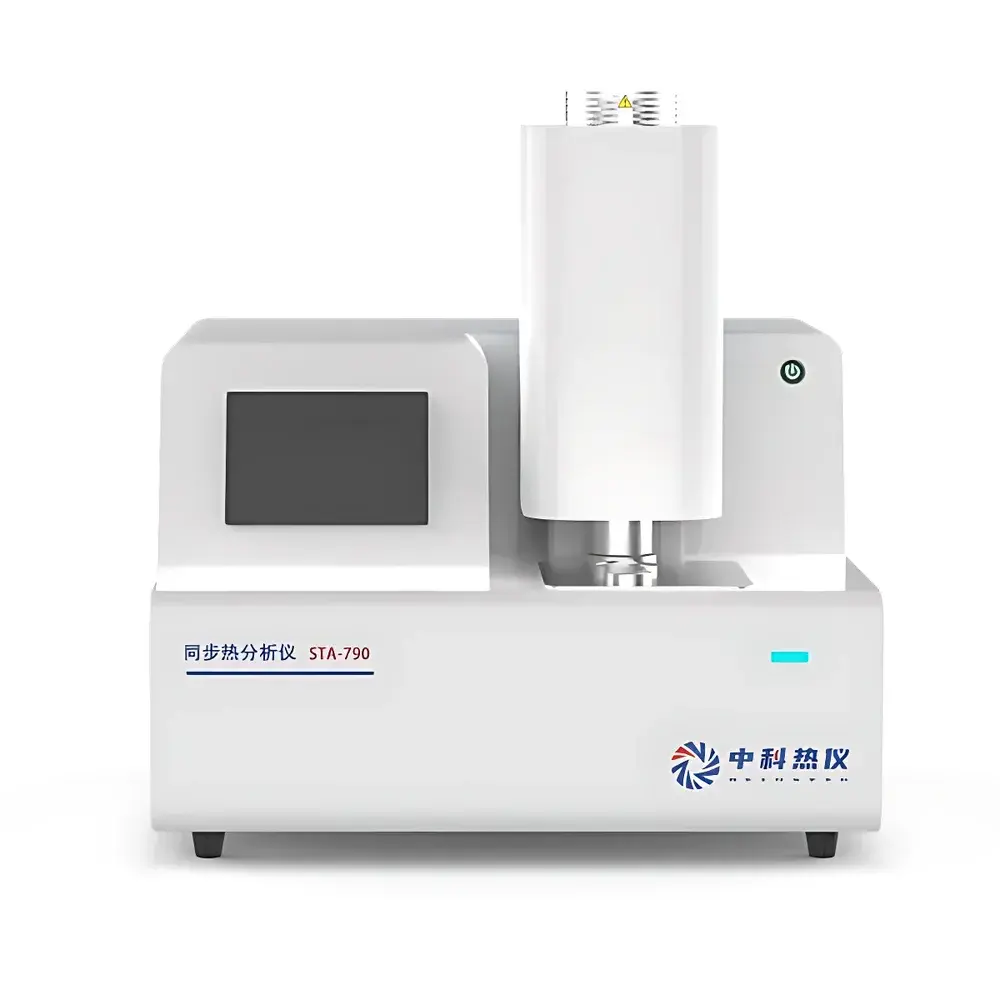
Reinstek STA-790 Simultaneous Thermal Analyzer
| Brand | Reinstek |
|---|---|
| Origin | Anhui, China |
| Manufacturer Type | Manufacturer |
| Model | STA-790 |
| Temperature Range | Ambient to 1300 °C / 1600 °C |
| Heating Rate | 0.01–50 °C/min |
| Thermogravimetric (TGA) Range | ±200 mg / ±1000 mg |
| TGA Resolution | 0.02 µg |
| DSC Resolution | 1 µW |
| Atmosphere Control | Dual independent mass-flow-controlled gas lines with software-programmable switching |
| Crucible Options | Al₂O₃, quartz, BN (optional) |
| Furnace Cooling | Integrated water-cooled furnace housing |
| Power Supply | 220 V, 50/60 Hz |
Overview
The Reinstek STA-790 Simultaneous Thermal Analyzer is a high-performance instrument engineered for precision-coupled thermogravimetric analysis (TGA) and differential scanning calorimetry (DSC) measurements under controlled atmospheric conditions. Based on the top-loading architecture—featuring a furnace mounted above a bottom-positioned, fully symmetric dual-arm microbalance—the STA-790 delivers exceptional thermal stability, low drift, and high mass resolution across its extended operating range. Its measurement principle relies on concurrent detection of mass change (via electromagnetic force compensation balance) and heat flow (via planar noble-metal heat-flux sensor), enabling direct correlation between weight loss/gain events and endothermic/exothermic transitions. This dual-signal acquisition supports rigorous kinetic modeling, phase transition quantification, specific heat capacity (Cp) determination, and decomposition pathway analysis—critical for R&D and QA/QC workflows in advanced materials science, pharmaceutical development, energy storage, nuclear fuel characterization, and process safety assessment.
Key Features
- Top-loading design with bottom-mounted high-stability microbalance ensures mechanical isolation from furnace thermal expansion, minimizing baseline drift and enhancing long-term reproducibility.
- Interchangeable, plug-and-play sensor modules—including standard heat-flux DSC and optional high-sensitivity Cp-optimized configurations—enable rapid method adaptation without hardware recalibration.
- Water-cooled furnace assembly maintains thermal homogeneity and linearity over the full temperature range (ambient to 1300 °C standard; 1600 °C optional), supporting accurate high-temperature kinetics and refractory material characterization.
- Dual independent mass-flow controllers provide precise, software-synchronized gas switching between inert (N2, Ar), oxidative (air, O2), or reactive atmospheres—essential for oxidation stability testing and reaction mechanism studies.
- Comprehensive safety architecture includes overtemperature cutoff, pressure-relief venting, active furnace shielding, and real-time thermal runaway monitoring compliant with IEC 61010-1 requirements.
Sample Compatibility & Compliance
The STA-790 accommodates standard crucibles in alumina, fused quartz, and optional boron nitride—selected based on sample reactivity, temperature ceiling, and signal-to-noise requirements. It supports routine compliance with ASTM E1131 (standard test method for compositional analysis by TGA), ASTM E1269 (determination of heat capacity by DSC), ISO 11357 series (plastics—DSC), and USP <1231> (thermal analysis in pharmaceutical development). Data acquisition and reporting meet GLP/GMP traceability requirements, with optional audit trail logging aligned with FDA 21 CFR Part 11 for regulated environments.
Software & Data Management
Control and analysis are executed via Reinstek’s proprietary STA-Suite software, a Windows-based platform supporting multi-step temperature programming (ramp, hold, step, modulated), real-time signal overlay, automatic peak identification, and kinetic model fitting (e.g., Kissinger, Ozawa-Flynn-Wall, Friedman). Raw data export adheres to ASCII and universal .tdms formats for third-party integration with MATLAB®, OriginLab®, or Thermo-Calc®. All method files, calibration records, and raw datasets are timestamped, user-annotated, and stored with version control—ensuring full experimental traceability and regulatory readiness.
Applications
- Mineralogical decomposition pathways: Discrimination of polymorphic transitions, dehydration sequences, and redox-dependent decomposition mechanisms—e.g., distinguishing CaC2O4·H2O decomposition profiles in N2 vs. air.
- Polymer composition and thermal stability: Quantitative identification of filler content, plasticizer volatility, and degradation onset temperatures across thermoplastics, elastomers, and biopolymers.
- Phase-change material (PCM) characterization: Latent heat quantification, cycling stability assessment, and supercooling behavior evaluation under programmable thermal profiles.
- Cement hydration thermodynamics: Early-age exothermic reaction mapping, cumulative heat evolution modeling, and supplementary cementitious material reactivity ranking.
- Energetic materials safety screening: Decomposition onset temperature (Tonset), adiabatic time-to-explosion (TMR), and pressure-rise kinetics under confined heating conditions.
FAQ
What is the maximum recommended operating temperature for routine use?
The standard configuration is rated for continuous operation up to 1300 °C; the 1600 °C variant requires optional furnace upgrade and specialized crucibles.
Can the STA-790 perform specific heat capacity (Cp) measurements?
Yes—using the optional Cp calibration kit and reference materials (sapphire, synthetic sapphire), the system complies with ASTM E1269 and ISO 11357-4 protocols.
Is remote operation supported?
The STA-Suite software supports secure LAN/WAN access via VNC or RDP; however, real-time control requires local administrator privileges and network-configured firewall exceptions.
How is atmosphere purity maintained during switching?
Dual mass-flow controllers feature integrated zero-dead-volume manifolds and purge synchronization logic to minimize cross-contamination during gas transitions.
Does the system support automated calibration verification?
Yes—built-in auto-calibration routines verify balance linearity, temperature sensor accuracy (via In, Sn, Zn, Ag, Au reference points), and heat-flux baseline stability before each scheduled run.



